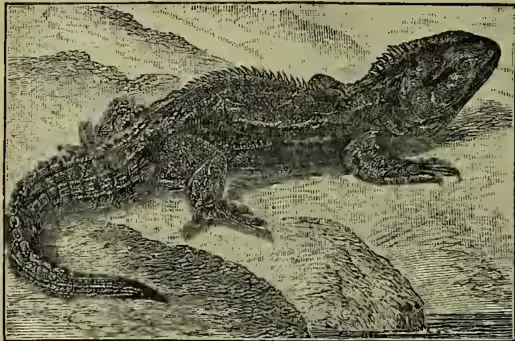
Sphenodon, or HATTERIA, the representative of a distinct reptilian order—Rhynchocephalia—which in Permian and Triassic times included several genera. Now there is only one species—Sphenodon, or perhaps better Hatteria punctata—the Tuatara of the Maoris. It was formerly abundant along the coasts of New Zealand, but is now restricted to a few small islands in the Bay of Plenty, both the Maoris and the hogs being blamed for its rapidly increasing rarity. In all likelihood it will soon be exterminated, and one of the most interesting of 'living fossils' will be lost.
In appearance the Hatteria is like an Iguana; on the upper surface the general colour is 'dull olive-green spotted with yellow,' on the under surface whitish; the tail is compressed from side to side and dorsally crested, brittle and replaceable as in many of the genuine lizards. The maximum length of the animal seems to be about two feet, but smaller forms are commoner. Nocturnal in its habits, the Hatteria lives in holes among the rocks or in small burrows, and feeds on small animals.
But the chief peculiarities of this old-fashioned reptile are internal, and cannot be stated except in technical language. The vertebrae are bi-concave like those of most fishes, as is also the case in geckos among lizards and in many extinct reptiles. Some of the ribs bear uncinate processes as in birds and crocodiles. As in crocodiles there are 'abdominal ribs,' or ossifications in the fibrous tissue beneath the skin of the abdomen. The skull, unlike that of any lizard, has an ossified quadrato-jugal, and therefore a complete infra-temporal arcade; the quadrate is immovably united to pterygoid, squamosal, and quadrato-jugal; the pterygoids meet the vomer and separate the palatines. There are teeth on the palatine in a single longitudinal row, parallel with those on maxilla and mandible, and the three sets seem to wear one another away; there is also a single tooth on each side of a sort of beak formed from the premaxilla.
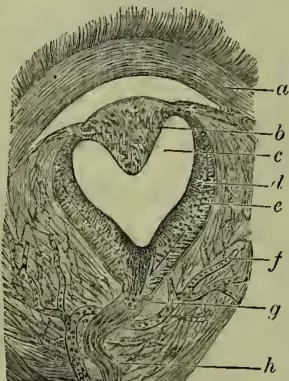
It was in Hatteria first that Baldwin Spencer discovered what seems to be the secret of the pineal body. This structure occurs in all Vertebrates, except the very lowest, at the end of an upgrowth from the 'tween brain or optic thalami. Its import remained for long an enigma. But in Hatteria the pineal body reaches the skin on the top of the head, and retains distinct traces of an eye-like structure—for instance a complex retina. As the same vestigial hint of eye-structure has since been seen in several lizards, many naturalists are confident that the pineal body should be called a pineal or parietal eye, and regarded as a persistent vestige of a median, unpaired, upward-looking sense-organ. See PINEAL GLAND.
Near the living Hatteria the Permian Palæohatteria, the Triassic Hyperodapeton, and some other important extinct types must be ranked. Nearly allied too is the remarkable Proterosaurus from the Permian. There is no doubt that the order Rhynchocephalia once included several generalised types, of which Hatteria now alone remains. It is much to be desired that the development of this animal be studied before it also disappears.