Sphinx, a Greek word signifying the 'strangler,' applied to certain symbolical forms of Egyptian origin, having the body of a lion, a human or an animal head, and two wings. Various other combinations of animal forms have been called by this name, although they are rather griffins or chimæras. Human-headed sphinxes have been called andro-sphinxes; that with the head of a ram, a criosphinx; and that with a hawk's head, a hieraesphinx. The form when complete had the wings added at the sides; but these are of a later period, and seem to have originated with the Babylonians or Assyrians. In the Egyptian hieroglyphics the wingless Sphinx bears the name of Neb, or Lord, and Akar, or Intelligence, corresponding to the account of Clement that this emblematic figure depicted intellect and force. Others see in it the idea of resurrection, symbolised by the triumph of the dawn over the darkness of night. The idea that it allegorised the overflow of the Nile when the sun was in the constellations Leo and Virgo appears to be unfounded. In Egypt the Sphinx also occurs as the symbolical form of the monarch considered as a conqueror, the head of the reigning king being placed upon a lion's body, the face bearded, and the usual head-dress. Thus used, the Sphinx was generally male; but in the case of female rulers the figure has a female head and the body of a lioness.
The most remarkable Sphinx is the Great Sphinx at Gizeh (Giza), a colossal form hewn out of the natural rock, and lying about a quarter of a mile south-east of the Great Pyramid. It is sculptured out of a spur of the rock itself, to which masonry has been added in certain places to complete the shape, and it measures 172 feet 6 inches long by 56 feet high (Vyse, Pyramids, iii. 107). Immediately in front of the breast Caviglia found in 1816 a small naos or chapel, formed of three hieroglyphic tablets, dedicated by Thothmes III. and Rameses
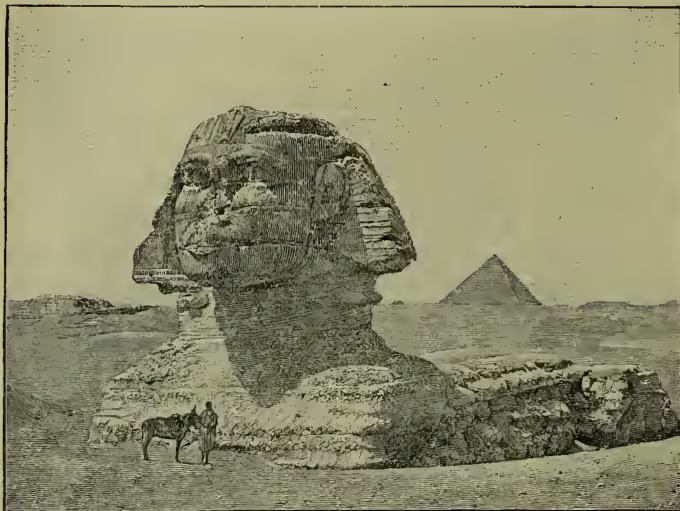
II. to the Sphinx, whom they adore under the name of Haremkhu, or Harmachis, as the Greek inscriptions found at the same place call it—i.e. the Sun on the Horizon. These tablets formed three walls of the chapel; the fourth, in front, had a door in the centre and two couchant lions over it. A small lion was found on the pavement, and an altar between its fore-paws, apparently for sacrifices offered to it in the time of the Romans. Before the altar was a paved causeway or dromos, leading to a walled staircase of thirty steps, repaired in the reign of M. Aurelius and L. Verus on the 10th May 166 A.D. In the reigns of Severus and his sons, 199-200 A.D., another dromos, in the same line as the first, and a diverging staircase were constructed, while some additions had been made to the parts between the two staircases in the reign of Nero. Votive inscriptions of the Roman period, some as late as the 3d century, were discovered in the walls and constructions; and on the second digit of the left claw of the Sphinx an inscription in pentameter Greek verses, by one Arrian, probably of the time of Severus, was discovered. In addition to these walls of unburnt brick, galleries and shafts were found in the rear of the Sphinx extending northwards. The excavations of M. Mariette in 1852 threw further light on the Sphinx, discovering that it was surrounded by a peribolos or outer wall; and showing that the head only was sculptured; that the sand which had accumulated round it was brought by the hands of man and was not an encroachment of the desert; and that the masonry of the belly was supported by a kind of abutment. To the south of the Sphinx Mariette found a dromos which led to a temple of the time of the fourth dynasty, built of huge blocks of alabaster and red granite. In the midst of the great chamber of this temple were found seven diorite statues, five mutilated and two entire, of the monarch Chafra or Chephren, which are fine examples of the oldest Egyptian sculpture. While the dignity and grandeur of the Great Sphinx have often attracted the admiration of travellers (see SCULPTURE, p. 264), its age has always remained a subject of doubt; but these later discoveries prove it to have been a monument of at least the age of the 4th dynasty, or contemporary with the pyramids, and Maspero regards it as anterior even to Menes.
Besides the Great Sphinx, avenues of Sphinxes have been discovered at Sakkara, forming an ap- proach to the Serapeum of Memphis and elsewhere. Sphinxes of the time of the Shepherd dynasty have been found at Tanis, and another of the same age is in the Louvre; while a granite Sphinx, found behind the 'vocal Memnon,' and inscribed with the name of Amenophis III., is at St Petersburg. An avenue of criosphinxes, each about 17 feet long, is still seen at Karnak, and belongs to the time of Horus, one of the last monarchs of the 18th dynasty. Various small Sphinxes are in the different collections of Europe, but seldom are of any very great antiquity.
The Theban Sphinx of Greek legend, whose myth first appears in Hesiod (Theog. 326), is described as having a lion's body, female head, bird's wings, and serpent's tail, ideas probably derived from Phoenician sources. She was said to be the issue of Orthros, the two-headed dog of Geryon, by Chimæra, or of Typhon and Echidna, and was sent from Ethiopia to Thebes by Hera to punish the transgression of Laius, or, according to other accounts, by Dionysus or Ares (see EDIPUS). The Sphinx was a favourite subject of ancient art, and appears in reliefs, on coins of Chios and other towns, and often as a decoration of arms and furniture.
In Assyria and Babylonia representations of Sphinxes have been found, and the same are not uncommon on Phoenician works of art.