Spiders (Araneidæ) form an order within the heterogeneous class Arachnida. The name, which seems to be a corruption of spinther, refers to the well-known spinning powers which these animals so cleverly exercise. They are found almost everywhere upon the earth, especially in warm countries, and are of much importance in checking the multiplication of insects. A few tropical forms, notably the bird-catching spiders, exceed two inches in length of body, but the majority measure only some fraction of an inch.
Structure and Functions.—The body is divided into two distinct parts—an unsegmented cephalothorax, bearing six pairs of appendages, and a soft unsegmented abdomen, at the end of which are the spinnerets. On the skin there are hairs of various kinds, some being specialised as sensitive structures. The colours, which are often very brilliant, are due in part to pigments occurring in the tissues, or diffused on the skin, or concentrated in special chromatophores, in part also to the way in which the light is reflected from the hairs and skin. They vary with age and sex, with food and environment, and, as we shall see, are often of importance in courtship and in protective adaptations. Soon after the young spider is hatched it casts its cuticle, and this moulting is repeated at intervals until the full size is reached. It is probable that the Attidæ moult from seven to eleven times before reaching maturity. As this moulting proceeds, the colour, which in young spiders is generally bright yellow or green, whitish or livid, gradually becomes in tints and markings that which is characteristic of the species.
There are six pairs of appendages: (1) the clawed chelicerae or falces, of which the last joint works against the second last and contains a poison-gland; (2) the leg-like pedipalps, the terminal joint of which is modified in the male for copulatory purposes; (3-6) four pairs of walking-legs, of which the foremost pair are much used as feelers. The embryo has four pairs of abdominal legs which abort. Near the anus are situated two, three, or four pairs of closely approximated spinnerets, and on each of these there are numerous 'spinning-spoils,' out of which oozes the viscid fluid which hardens into the silken thread. A figure is given of the foot of the hindmost leg in the Garden Spider, showing the claws and spines, which are of use in drawing out the silken secretion. Among other external characters are the simple eyes, of which a variable number, most frequently eight, occur on the head; the openings or stigmata of the respiratory sacs or tubes; the opening of the reproductive ducts between the anterior stigmata; and (in the female) the adjacent but separate aperture or apertures of the receptacula seminis.
The nervous system conforms to the usual Arthropod type, consisting of a dorsal brain, a ring round the gullet, and a ventral nerve-cord; but the ventral ganglia are concentrated in a single ganglionic mass in the thorax, giving off nerves to the limbs and other parts.
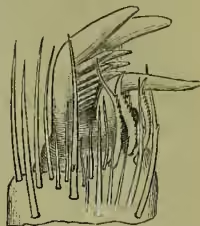
As regards the senses of spiders, it seems that few have much power of precise vision. Some discern rapid movements of objects, but seem unable to see their cocoon though it be but a few inches off. The hunting Saltigrades, however, have been observed to stalk prey from a distance of 10 inches, but that this is regarded as exceptional shows how limited the ordinary power of vision is believed to be. In many cases it has been experimentally proved that spiders exhibit an apparent preference (perhaps dependent on sexual associations) for certain colours, and it is certain that the males of some kinds (e.g. Attidæ) display their bright colours before their desired mates. The limited nature of visual power is in great part compensated for by the exquisite delicacy of the sense of touch, for the lurking spinner feels rather than sees the insect tangled in its snare or web. Vibrations such as those caused by the whizzing of insects' wings or by a tuning-fork are propagated along the taut lines of the web and interpreted by the spider. According to some observers, the courtship is sometimes conducted in this telephonic fashion. This tactile sensitiveness seems to be in great part diffused over the body, but the hairs towards the ends of the legs are specially sensitive. We know little with regard to the sense of hearing in spiders. That some males, e.g. of Theridium and Mygale, are able to produce a stridulating noise, suggests that their mates can hear, but the evidence is not conclusive. Nor are the numerous accounts of spiders which descend chandeliers and the like to listen to music, for spiders often do this when there is no music, and are especially likely to do this of an evening, and it is difficult to abstract the influence of vibrations other than those of sound-waves. Many, however, believe that spiders really hear, and it may be that careful experiments will prove that what are described as 'auditory hairs' on the palps and legs are really such. The sense of smell seems to be slight, though marked for certain strongly-scented substances, and there is a sensory structure, perhaps olfactory or gustatory, on the basal joint of the pedipalps.
All spiders are predaceous and feed on insects, which they entangle in their snares and webs, or stalk, or catch after patient lurking. In most cases they kill their prey with their poisonous falcis. The mouth is small, and behind the gullet there is a powerful suctorial region which acts as a suction-pump. From the mid-gut five paired outgrowths extend into the bases of the pedipalps and legs. There are also large tubular digestive outgrowths, and two excretory Malpighian tubes grow out from the hind-gut. The heart lies dorsally in the abdomen, and has three chambers with three pairs of valved openings. In one set (Tetrapneumones, e.g. the bird-catching Mygale; see BIRD-CATCHING SPIDER) there are four pulmonary sacs like those of the scorpion; in the great majority (Dipneumones) there are two pulmonary sacs and two main tracheal tubes.
The sexes are separate except in a few casual hermaphrodites, and the males are often fewer in number, always smaller in size, and usually more brightly coloured than the females. In most cases, as we shall afterwards see, the courtship is elaborate, and is often attended with considerable danger to the males. The fertilised egg segments peripherally, like that of insects, around a central core of yolk. A cocoon is usually formed around the eggs, and this is hidden or carried about by the female, who exhibits much maternal solicitude.
The fertility of spiders varies in different species within wide limits. Thus, as Mrs Peckham notes, one species may lay 800 or 1000 eggs, while another, equally common, lays only fifty. In the family Epeiridæ Argiope cophinaria lays 500 to 2200 eggs, while Tetragnatha laboriosa lays only 34; in the family Attidæ Phidippus morsitans lays about 180 eggs, while Synageles pecuta lays only three. While the rate of multiplication is immediately dependent on the constitution of the different species, it also bears some relation to the rate of mortality, or, what comes almost to the same thing, to the efficiency of the protective adaptations by which spiders are saved from their enemies. Those with a low birth-rate are usually protected very efficiently, and have consequently a low rate of mortality.
In many cases female spiders are savage and quarrelsome, fighting with one another, and frequently destroying the smaller males when these offer them amatory attentions. 'Ridiculously small and weak in build, the males of many species can only conduct the rites of marriage with their enormous and voracious brides by a process of active manoeuvring, which, if unsuccessful, is certain to cost them their lives.' In a great number of cases, e.g. in at least two-fifths of all the species of Attidæ, the males are more brilliantly coloured than the females, and that this is in part related to sexual selection is rendered almost certain by the observations of Professor and Mrs Peckham, who often worked four or five hours a day for a week in getting a fair idea of the habits of a single species. They describe among many species of Attidæ the manner of the wooing, the cautious circling dances of the ardent males, the strange attitudes by which they display their charms of colour, the occasional wooing by vibrations of the web-lines, the capacious irritability of the females, who often bring the courtship to a tragic end, the quarrelsome nature of rival males in presence of the females. 'The males vie with each other in making an elaborate display, not only of their grace and agility but also of their beauty, before the females, who, after attentively watching the dances and tournaments which have been executed for their gratification, select for their mates the males which they find most pleasing' (see SEXUAL SELECTION).
Spinning-work.—On each of the spinnerets—of which in the majority there are six—there are numerous, usually sixty to seventy, 'spinning-spoils,' out of which there flows a viscid secretion formed in the numerous internal glands. The resultant thread into which the secretion hardens, though of a delicacy hardly rivalled except by quartz fibres, is from the nature of its origin a complex structure. Its texture is not always the same; it may be covered with minute adhesive beads, or be stronger and unbeaded, or very light and filmy as in gossamer. In some spiders there is a special chitinous plate—called the cribellum—lying in front of the spinnerets and perforated by the ducts of numerous glands. 'Its presence is correlated with that of the calamistrum, a single or double row of long wavy hairs on the dorsal aspect of the second last tarsal joint of the fourth pair of walking-legs. One of the calamistra is rapidly vibrated over the cribellum, and draws out the secretion from the glands in the form of threads, used to strengthen the web, to assist in forming the cocoon for the eggs, and sometimes perhaps in making a domicile.'
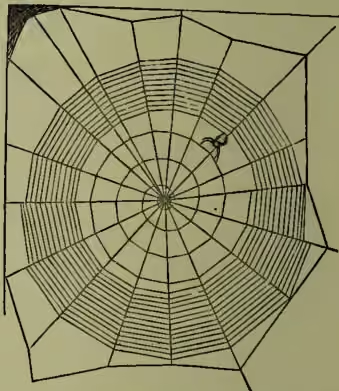
The webs of spiders vary as much as do the nests of birds, but as a single example of their making we may take that of the Common Garden
Orb-weaver (Epeira diademata).
The spinner first lays down a number of firm foundation-lines, which may be disposed 'by hand' if the situation admits of this, but are more frequently blown fortuitously by air-currents. Having secured a number of these foundation-lines enclosing the area for the web, the spider forms the radii which intersect in the centre. This done, she begins from the centre and stepping outwards in a wide spiral lays down the spiral scaffolding. Finally, beginning at the circumference and working inwards, the spider lays down the delicate viscid spirals on which the efficiency of the web depends. The primary spirals simply form a scaffolding, and are undone, in fact eaten up, as they are replaced. But the web of the garden spider is a comparatively simple case; we have to distinguish 'orb-webs,' 'ribboned orbs,' 'composite snares and sectional orbs,' 'horizontal snares and doined orbs,' 'unbeaded orbs and spring snares,' and so on, as Dr McCook, in his incomparable work on American spiders, has pointed out.
No structures made by animals—not even the nests of birds, the homes of bees, the hills of the Termites—are more marvellous than the webs and snares of spiders. The framework is so delicate yet so effectively firm, so clever in its construction, so sensitive, we may almost say, in its mechanism, that we must rank it highest among works of instinctive art. Instinctive, for each species of weaver has its characteristic web, and there is no reason to suppose that the art of making this is the result of education. Yet the mode of construction is not rigidly fixed, but varies a little according to the site, according to the wind, and even, it is said, in relation to the abundance of insects in the neighbourhood. We see the strength of the web when it remains unbroken in the wind, and when it is laden with drops of dew, but sometimes it is much stronger than such sights suggest. Mosely tells how Willemoes Suhm on the Challenger expedition found a Glossy Starling (Calornis metalllica) hopelessly entangled in a spider's web, and other naturalists relate the same of humming-birds and other small creatures. Thus a snake, nine inches long, has been found hanging in a web; and Dr McCook, whose carefulness as an observer is worthy of all praise, relates how a young living mouse was in some manner securely entangled in the snare of a spider, how the spinner, by means of silken threads two or three feet long, hoisted the mouse up four inches, and how the mouse after living for ten hours at length succumbed. A spider three-quarters of an inch in length has been seen to land a fish about three inches in length, but perhaps the raising of a mouse in a web is more wonderful. Mr Wallace and other exploring naturalists also tell of spider-webs strong enough to be a serious obstacle to travellers in the woods, and in other reports fancy has magnified this strength tenfold. As to the intelligence involved in modifying the web in various conditions it is not easy to form an accurate estimate. On a long hedge we may see scores of webs disposed so as best to stand the stress of the prevailing wind, but we must remember that the foundation-lines of the web are in most cases wind-blown. Often in the geometric webs there are interesting irregularities which show that equal precision is not always attained. On the other hand fractured snares are sometimes mended by skilfully disposed trusses. Many observers have described cases where small stones were found hung from the web, as if to weight them against the force of the wind. But McCook maintains, and we would agree with him, that it is most likely that these stones have been raised from off the ground by the shrinkage of the web, and that the alleged advantage—which, if foreseen, involves a complex inference—is simply accidental.
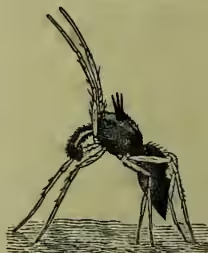
The threads which the spiders spin are used not only in fashioning webs and snares, but in many different ways. Behind them, as they move where a footing is insecure, there trails a drag-line, perhaps the rudiment of all their weaving, and this is of special use when they drop from a height. Jonathan Edwards long ago (1716) observed that spiders in order to cross an unbridged gap will form a sort of swinging basket, and he also noticed their exceedingly strange habit of ballooning. Raising themselves on tiptoe and with upturned abdomen on some point of vantage, they allow long threads of gossamer to float out in the air until these acquire sufficient momentum to carry the spider aloft. In this way they have been known to cross considerable sheets of water. 'To this mode of diversion young spiders of several families are very much addicted, especially in the fine days of autumn. Sometimes the flying threads are excessively numerous, and on their descent cover every- thing; they are particularly striking on hedges, and constitute, at all events, one of the causes of the phenomenon well known in the country as gossamer.' And again, the threads may help to form the cocoon for the eggs, or may be used to bind leaf to leaf and form a well-hidden nest.
Enemies and Protective Adaptations.—While spiders are the fatal enemies of many insects, they are in turn frequent victims. 'To feed the hungry maw of a stronger, more skilful, or more fortunate fellow Araneid; to be paralysed and entombed within a clay sarcophagus by a mother wasp, and serve as food for a growing wasp-worm (see SPHEX); to be snapped up as a delicate titbit by birds, toads, and other creatures—these are some of the ways in which the spider meets its doom.' Among birds the chief enemies of spiders are the humming-birds, among insects the wasps. The ichneumon flies often lay their eggs—with destructive results—in the cocoons of spiders. Small monkeys prey upon spiders a good deal, and so do some insectivorous mammals. Between different kinds of hunting and running spiders there is much keen warfare.
Many spiders hide in crevices or in bivouacs of leaves which they roll up or bind together. McCook describes the nest of the Purse-web Spider (Atypus abbotii), a purse-shaped tube attached to the bark of trees, with the outer surface dark and covered with sand. The nests of the trap-door spiders have lids which fit accurately, and are covered with moss, earth, and lichen; in fact the nests of a great number of species believed to be trap-door spiders have never been found. In many cases the vibratory sensitiveness of the web is such that an approaching enemy finds the spider forewarned. When Argiope cophinaria has not time to drop from her web to the ground, 'she makes use of another power—she will render herself invisible. The web begins to sway backward and forward; the rapidity of the motion increases; the outlines become indistinct, and within a few seconds of the first movement spider, web, and all have vanished from sight! Others, such as Pholcus atlanticus, hang by the legs, and whirl the body rapidly with the same bewildering result.' Mr Herbert Smith suggests that the sideways movement of the Laterigrade has a protective value, since the enemies are likely to allow for a forward movement of their prey. Many Epeiridae and other spiders drop to the ground when danger threatens, and remain motionless on a surface which they often resemble in colour. McCook seems inclined to regard this death-feint as a trick, not as fear paralysis or catalepsy. The cocoons are hidden in crevices, or covered with web and debris, or carried about by the mother—sometimes attached to the abdomen, sometimes in the jaws. For further examples of the thousands of protective habits, see the works of the Peckhams and Dr McCook.
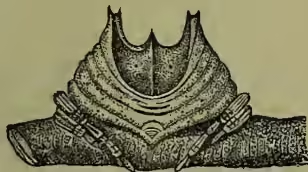
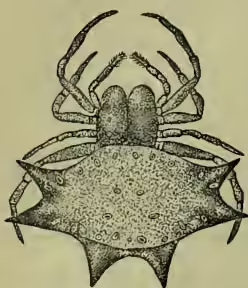
Gasteracantha rufospinosa,
female, mag. 2½ diameters.
(After E. G. Peckham.)
Often the forms and colours of spiders have a protective resemblance to pieces of plants or to dead things. The species of Uloborus are like small pieces of bark; Hyptioides cavatus resembles a bit of dirt or the ends of the dead pine branches among which it lives; Cyrtophora conica is hardly distinguishable from the pieces of light rubbish which it accumulates in its web; Cerostris mitralis resembles a woody knot on the branch on which it rests; Thomisus foku, a species much dreaded in Madagascar, has a very strange, crab-like form, and resembles in colour and general appearance the fruit of Hymenæa verrucosa, a tree common in the forests where this spider is found; Drapetisca socialis is very like the bark of birches and other trees on which it lives; among the bird-excrement, so that the discoverer actually plucked the leaf on which the spider was resting, and looked at it for some moments before he discerned his captive. In short, what Mr Wallace said about the leaf-like butterfly is often true of spiders: 'Size, colour, form, markings, and habits all combine to produce a disguise which may be said to be absolutely perfect.'
Again, there are spiders which are rendered inedible by an armature of spines and plates, and many of these (e.g. some Gasteracanthidæ) are very brilliantly coloured. It is possible that their conspicuousness impresses their enemies with the fact that they are better left alone.
Lastly, there are spiders which exhibit a protective mimicry of animal forms. 'Spiders most commonly mimic ants,' Mrs Peckham says; 'but we hear also of their imitating beetles, snail-shells, ichneumon and horse flies. There is also a curious Madagascarian species which looks exactly like a little scorpion, the resemblance being heightened by the habit of curving its flexible tail up over its back when irritated.' Nearly all the species of Coccherestes and Homalattus resemble beetles; Cytarachne is like a snail-shell; Synagelcs picata and Synemosyna formica are good examples of those which have a mimetic likeness to ants.
Classification.—Spiders of the Bird-catcher (Mygale) type differ from all the others in having four pulmonary sacs (Tetrapneumones). The Dipneumones, which form the vast majority, including several thousand species, are conveniently classified according to their habits whether sedentary or wanderers, and according to their spinning-work, this physiological classification being also justified anatomically. Another fact of some importance is the presence or absence of a cribellum. Thus we distinguish
| Sub-order—TETRAPNEUMONES. | ||
| Tribe | I.—Territelariæ: Tunnel-weavers. | |
| 'Sedentary' | Sub-order—DIPNEUMONES. | |
| Tribe | II.—Tubitelariæ: Tube-weavers, including Ecribellatæ and Cribellatæ. | |
| Tribe | III.—Retitelariæ: Line-weavers. | |
| Tribe | IV.—Orbitellariæ: Orb-weavers, including Ecribellatæ and Cribellatæ. | |
| 'Wanderers' | Tribe | V.—Laterigradæ. |
| Tribe | VI.—Citigradæ. | |
| Tribe | VII.—Saltigradæ. |
Numerous extinct species of spiders have been obtained from Tertiary deposits, especially from amber. The oldest known form (Protolycosa) occurs in Carboniferous strata.
British Species.—Among the British species the following may be noted: The Common Garden
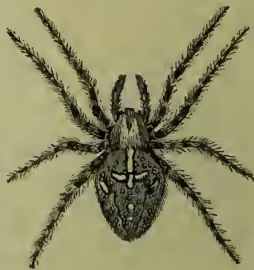
Spider (Epeira diadema), and other species of this genus; the House-spiders (Tegenaria domestica and T. civilis); Agelena labyrinthica, which makes large cobwebs, very abundant on heaths; the Water Spider (Argyroneta aquatica), which inflates its sub-aquatic dome-shaped web with air brought from the surface entangled among the hairs of the spider's body; the Green Crab-spider (Sparassus smaragdulus), whose young are fond of ballooning in autumn evenings; a few Wolf-spiders, such as Lycosa piratica and Dolomedes fimbriatus; Salticus scenicus, exceedingly common on walls and fences, and Atypus sulzcri, the only British representative of the Trap-door Spiders (see Systematic List: P. Cambridge, Proc. Linn. Soc., xxx. 1875).
Relations to Man.—The wide-spread prejudice against spiders is not scientifically justifiable. We must admire their dexterity, their instinctive aptitudes, their intelligence, the beauty of their architecture, the elaborateness of their courtship (tragic as it sometimes is for the suitor), and their maternal care. Although there are countless tales of 'black spiders,' rarely preserved for identification, which are alleged to have given dangerously poisonous bites, this is not true except in regard to the famous Tarantula (Lycosa tarantula), and even the effects of its bite have been grossly exaggerated both by evil intention and credulous superstition. Of a not uncommon line-weaver (Lathroductus oculatus), which has a very bad reputation as a venomous biter, one of the authorities on spiders says that he repeatedly allowed himself to be bitten and suffered no inconvenience. In fact, if we except the Tarantula, there are few spiders more dreadful than fleas. In old medical practice a spider was sometimes applied to the wrist in cases of fever, and another custom of applying the web to staunch bleeding is still practised by schoolboys, who are happily ignorant of antiseptic precautions. The great value of spiders is the obvious one that they destroy so many insects; thus, McCook counted thirty-six mosquitoes on a single web.
See especially H. C. McCook, American Spiders and their Spinning-work (3 vols. Phila. 1890-94); also Bertkau, numerous papers trans. in Annals and Magazine of Natural History; Blackwall, British Spiders (Lond. 1861-64); E. Blanchard, Arachnides (Paris, 1853-64); P. Cambridge, article 'Arachnida,' Encyclo. Brit.; J. H. Emerton, The Structure and Habits of Spiders (Salem, 1878); Hahn and Koch, Die Arachniden (Nuremb. 1831-49); Hentz, Spiders of the United States; O. Hermann, Ungarns Spinnen-Fauna (Budapest, 1879); E. Keyserling, Die Spinnen Amerikas (Nuremb. 1880-86); Koch and Keyserling, Die Arachniden Australiens (Nuremb. 1872-88); Latreille, Dugès, and Milne Edwards, Arachnida of Cuvier's Régne Animal; H. Lebert, Bau und Leben der Spinnen (Berlin, 1878); Mogridge, Trap-door Spiders (Lond. 1872); Menge, Preussische Spinnen; G. W. and E. G. Peckham, Observation on Sexual Selection in Spiders of the family Attidæ (Milwaukee, 1889); E. G. Peckham, Protective Resemblance in Spiders (Milwaukee, 1889); E. Simon, Les Arachnides de France (Paris, 1874-84); Thorell, European Spiders (Upsala, 1870); and Walckenaar and Gervais, Histoire Naturelle des Insectes Aptères (1837-47); W. Wagner, L'Industrie des Araneina (1894).