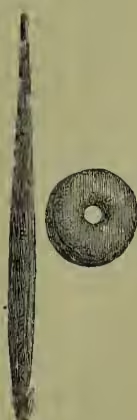
Spinning is the art of twisting fibrous substances into rounded strands of yarn fitted for weaving, or for thread or rope making. To form such strands two operations are essential—(1) the drawing out of uniform quantities of fibre in a continuous manner, and (2) twisting the material so drawn out to give it coherency and strain-resisting power. The earliest and for ages the only spinning apparatus was the spindle with the distaff. The latter was a stick or staff upon which a bundle of the fibre to be spun was loosely bound, and it was either held in the left hand or stuck in the belt. The spindle (fig. 1) was a smaller tapering rod, the rotation of which gave the twist, and around which the thread was wound as it was twisted. The twist was given by causing the spindle to rotate against the person, and allowing it to fall towards the ground whilst spinning around. To give the spindle increased momentum it was weighted with a whorl (fig. 1) of stone or metal, but as the weight of the yarn on it increased this make-weight was removed. A graphic description of this method of spinning is given by a Scotch rhymester of the 18th century.
To save their plaiding coats some had
Upo' the haunch a bonnet braid
Or an auld wecht or kairding skin
To run and gar the spindle rin
Down to the ground wi' twirling speed
An' twine upo' the floor the thread.
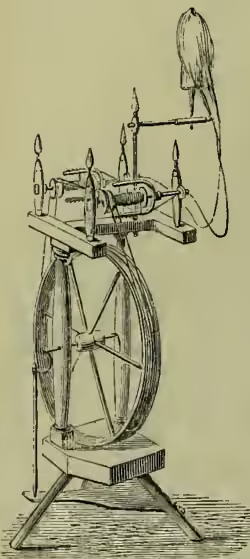
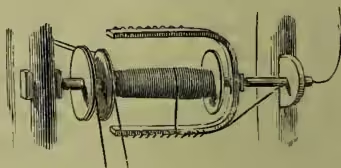
Simple as it is, the spindle has continued in use from prehistoric times to the present day. In some outlying regions of the Scottish Highlands and Islands, according to Sir Arthur Mitchell (The Past in the Present, Rhind Lectures, Edin. 1880), yarn is still made with it, and in the East Indies the exceedingly delicate yarn for Dacca (q.v.) muslins is made on the spindle. The first improvement on this simple apparatus consisted in fixing the spindle in bearings and causing it to rotate by a belt passed over a wheel. Next came the fitting on the spindle of a separate bobbin to receive the spun yarn, and this in effect constitutes the charka or spinning-wheel of the East, which has been used from time immemorial, and also the 'muckle wheel,' the use of which continued in Scotland till recent times. This simple wheel was known in Europe as early as the 14th century, but the greatly improved small or Saxon wheel (fig. 2), with a treadle motion giving continuous rotation to the spindle and allowing the spinner to sit with both hands free, was not known till much later times. In the spinning-wheel in its improved form a bobbin or pirl with a separate motion was placed on the spindle (fig. 3), which had two bent arms, the flyer or flight, for winding the yarn on the bobbin. The bobbin and flyer revolved at different rates—the revolutions of the spindle giving the twists and the difference of rotation causing the winding on. In such wheels it was possible to have two spindles and pirls a little apart (the two-handed wheel, fig. 2), with distaff or rock between them, and on these the spinner produced thread with each hand. The introduction of mechanical spinning towards the end of the 18th century gave a death-blow to this great domestic industry, but in the Northern and Western Highlands of Scotland a good deal of worsted yarn still continues to be made for local manufactures on spinning-wheels.
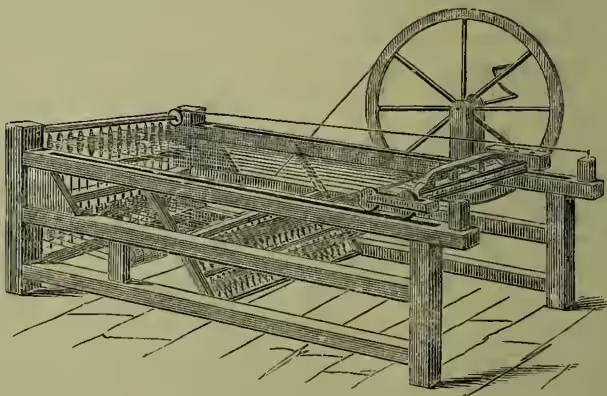
The series of inventions which overthrew hand-spinning may be said to have been begun by Lewis Paul in 1738, when he patented the important principle of drawing out and attenuating a sliver or loose coil of fibre by passing it between successive pairs of rollers revolving at increasing rates of velocity. This principle of drawing out fibres by accelerated motion was developed in the spinning-frame or throstle invented by Arkwright in 1767, and it forms a fundamental feature of all modern spinning machinery. About 1764 James Hargreaves at Standhill, near Blackburn, invented his spinning-jenny (fig. 4), an apparatus by which eight threads could be spun at once, and this was soon improved upon until eighty could be produced as easily. In this apparatus a number of large reels filled with thickish coils of fibre called rovings were set on upright fixed spindles, and the end of these rovings was passed between two small movable bars of wood placed horizontally and under the control of the spinner, who could thus make them press more or less on the roving, and consequently increase or decrease the draw upon it from the spinning-spindles, which were set in a row at the other end of the frame. These spinning-spindles gave the twist to the rovings when they were fully drawn out, and thereafter wound on themselves the twisted yarn by being moved in the frame towards the bobbins of roving whilst they continued to rotate. The principle of the jenny was important and, developed in the spinning-mule of Crompton in 1779, it is the basis of the second of the two great methods of machine-spinning now in use.
While the operation of spinning is one of the simplest of all arts, requiring as we have seen only the aid of two short pieces of stick, its modern developments have produced more delicate and varied mechanical devices, and have called forth more inventive ingenuity, than any other industrial operation. To convey an adequate idea of the variety of machines used in any single branch of the spinning trade, and of their highly complicated structure, would require much more space than can be here afforded. Different kinds of fibre require different treatment and special machines; and, moreover, yarns of the same fibrous material may be prepared and spun in several different ways according to the uses for which they are intended and other circumstances. Spinning thus becomes a complicated and delicate art, varying widely according to the material treated and the purpose to which the yarn is to be devoted. Dealing with wool, for example, the treatment of that fibre for the production of worsted and of woollen yarns is diametrically opposite. For worsted yarns long staple wools are employed. These are combed so as to separate the short fibres—the 'noils'—from the long or 'top' fibres. The 'top' afterwards passes through a long series of operations, the principal object of which is to lay every single fibre as nearly as possible parallel and level with its neighbour. For woollen yarn, on the other hand, short staple and wavy wools are used. These are carded together so that the fibres may as far as possible cross each other and interlace before being spun, and these peculiarities form the essential distinction between woollens and worsteds. Apart from worsteds, however, there is a general sequence in the treatment of all fibres which may be here briefly outlined.
The object of all operations preliminary to the actual spinning is (1) to free the fibres from all extraneous matter; (2) to lay them side by side in level parallel order; (3) to pull them out in a continuous strand or sliver of uniform thickness; and (4) to attenuate this sliver till the quantity required to form the yarn is reached. The operations necessary for these purposes, combined with a properly regulated amount of twist, constitute the conditions necessary to produce sound, level, and uniform yarn.
Taking the case of cotton, the opening and partial cleaning of the matted fibres are secured by passing the material through two machines called respectively the opener and the scutcher. In these machines are cylinders revolving at a high rate of speed, with their surfaces studded with stout teeth which seize separate flocks of the fibre and carrying it round form a broad uniform teased mass which is called a lap. In the first of these machines it is tube it is compressed into a soft rounded coil or sliver. This sliver is taken to the drawing-frame, which consists of say four successive pairs of rollers, each pair in succession going at a greatly accelerated rate, so that the last pair may be going six times quicker than the front pair. In this way a sliver is drawn out six times its original length, and six slivers fed in come out the thickness of one. This drawing out ultimately brings the slivers to a very uniform thickness, and places the fibres in a parallel order. It may be repeated many times, and thereby the fibres which lay together in the original strand may be drawn out to a great length. Thus, passing a sliver of one yard three times through the drawing-frame elongates it yd., or four times passed through it is stretched out to 1296 yd. For fine yarns this drawing out frequently repeated may represent an elongation many thousandfold. In the slubbing-frame comes the beginning of the spinning process; the sliver being here further drawn out and twisted sufficiently to enable it to be wound on a bobbin. The intermediate frame draws out two slubbings to the thickness of one, again slightly twists it, and winds it on a bobbin. In the roving-frame the slubbing is drawn out further, slightly twisted, and wound on a bobbin. The rovings or bobbins of rove are then ready for the spinning-frame, which in the case of heavy stout yarns is invariably the throstle, but when fine counts are spun the spinning is done on the mule. In throstle-spinning the roving is attenuated by passing between rollers increasing in speed till the desired tenuity is attained, at which point the final twist is given, and the yarn is wound on the bobbin or pirn ready to receive it.
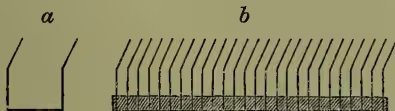
a, card wire; b, card setting.
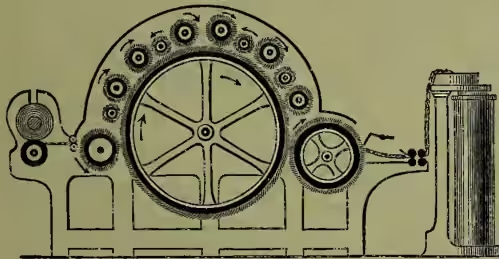
There are three methods of twisting practised in throstle-spinning. The first and oldest is with spindle, bobbin, and flyer, in principle precisely the same as the arrangement in the spinning-wheel. The second method is cop-spinning, in which the spindle is stationary, but the bobbin which revolves around it is caused at once to give the twist and wind the yarn on its own surface. This is effected by fitting over the bobbin a steel cop or cover of sufficient dimensions to cover a filled bobbin. The cop has a smooth steel edge which keeps the yarn free from the bobbin while the twist is being put on, and which by its motion up and down regulates the winding of the finished yarn on the bobbin. The third and most recent development of throstle-spinning is the ring and traveller frame. In this both spindle and bobbin revolve together and give the twist; but the yarn passes to the bobbin through a traveller or eye of steel set on a flanged steel ring which encompasses the spindle and bobbin. The traveller keeps the yarn free from the bobbin while the twist is being put in, and being carried round by the bobbin it winds the yarn on the bobbin, the filling of which is regulated by an up-and-down motion communicated to the rail on which ring and traveller are fastened. In mule-spinning the bobbins of rove are mounted on a fixed frame, and corresponding yarn bobbins or paper cops are attached to the spindles, which are mounted on a carriage made to travel back and forward over a space of two yards or thereby. The spinning in this apparatus is intermittent. The drawing rollers at the fixed frame give out a certain length of roving; and simultaneously the carriage begins to move away, and the spindles rotating rapidly put twist on the rove. At a certain point the rollers cease to give off roving, but, the carriage still travelling backward and the spindles rotating, the yarn is further drawn out and correspondingly more twist is imparted. The twist becomes hardest at the points where the yarn is weakest, the also submitted to a strong current of air which blows dust and dirt out of the cotton. From the scutcher a well opened and spread lap of the fibre is delivered to the carding-engine (fig. 5), in which a series of cylinders of various sizes, and rotating at different velocities, further open and tease the fibre. The cylinders are covered with teeth of fine wire (fig. 6) bent at about half their length, of which there may be from six to seven millions in a single machine. According to the direction in which the cylinders rotate, and the rate of their revolution, the wire points may meet each other, or the points and flat sides of the wires may meet and pass; and in this way certain cylinders lift the fibres from their neighbours and pass it on to others, so that the fibre is gradually teased, brushed, and spread out in a uniform manner. From the carding-engine the fibre is delivered in a broad lap; but by passing it through a ring or drawing power of the carriage is exercised most on the thickest portions of the yarn, and thus twisting and drawing so compensate each other that yarn of great regularity is produced. When the carriage reaches its full stretch the yarn is completely spun, and in returning towards the frame the separate strands are lowered so that they are wound around the cops by their rotation. Then the operations are repeated, and go on doing to perhaps 200 strands of yarn by mechanical agency precisely the series of operations which for ages mankind with a single spindle did for a single strand of yarn—viz. drawing out, twisting, and ultimately winding up the finished yarn. Previous to the invention of the mule few spinners could make yarn of 200 hanks to the pound (the hank being always 840 yards). At the same time the natives of India were weaving yarn of numbers ranging between 300 and 400 (i.e. 400 hanks to the pound). Now, however, our manufacturers have reached such extraordinary perfection that Manchester spinners have made No. 700, which was woven by a French firm. No. 10,000, a pound of which would reach 4770 miles, has been made to test machinery.