Sponges (Porifera), a class of animals whose type of structure is simpler than that of all the other multicellular forms or Metazoa. For the body of a sponge is not differentiated into organs, and tissues are only, as it were, in the making. Almost all are marine, occurring from the shore to the great depths. Except as embryos, they are always fixed to rocks, or in the mud, or upon seaweeds, or on other animals. Their sedentary life, the usual absence of any marked contractility, their frequently herb-like growth, and other characters, led early naturalists to regard sponges as plants; but their animal nature is at once evident when we examine into their internal structure and activities, or when we trace their development. Yet they remained puzzles for centuries. Peysonnel regarded them as worm-nests, for were not worms found inside of them? Lamarck thought they were colonies of polypes, but the polypes were not to be seen. In popular classification they were ranked with seaweeds. A great step was made when, about 1820-25, Robert Grant observed the water-currents which pass in by minute pores all over the surface and pass out by the larger apertures. Since then our knowledge of sponges has been rapidly progressive.
If we examine a very simple sponge, such as Ascetta, we see a small vase-shaped body, fixed at its base, open at the apex.
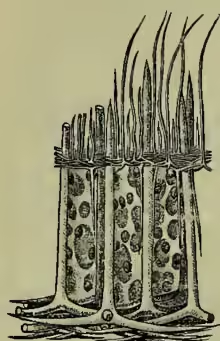
Through the walls run numerous fine canals, and if we observe a larger sponge living in water with which a little powdered carmine has been mixed we can verify Grant's observation that water passes in by minute pores all over the surface and passes out by the larger apical apertures. On these currents of water, which continually feed and refresh the body, the life of the sponge depends. Every Metazoon organism is 'a city of cells'—a sponge is peculiarly Venice-like. The currents also relatively complex. Yet with the simple primitive cups, the most complex forms are connected by a gradual series of steps, and simple cups they all are when very young. Let us consider briefly how the complication of structure is brought about.
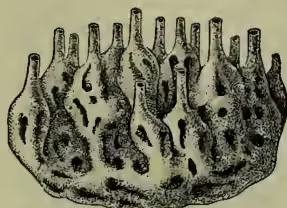
(1) The vegetative character of sponges is shown by the prolific way in which buds grow out from the parent body. These buds may produce other buds, and the walls of neighbour-buds may fuse; in this way there arise from an original sac-like form complex structures puzzling to those who seek logical clearness as to the nature of animal individuality (see fig. 3).
(2) In the simple Ascon type the internal cavity is lined by the characteristic Monad-like, 'collared,' ciliated cells. If this layer grow more rapidly than the outer strata it will naturally become folded into a number of side-aisles, and this is seen in the Sycon type of calcareous sponges, in which the characteristic collared and ciliated cells are restricted to a series of radial chambers around the central cavity. If a similar process of folding occur in the radial chambers the characteristic collared and ciliated cells become restricted to little ciliated ampullæ or chambers, which afferent canals from the surface enter, and from which efferent canals lead to the central cavity and thence outwards. This is the state of affairs in the Lencon type of calcareous sponges, and, with further complications, in the great majority of forms.
(3) Another seat of complication is the middle stratum. This is called the mesogloea in order to emphasise the fact that in sponges, as also in Cœlenterates, it has not the same definiteness as the middle layer or mesoderm which occurs in the Cœlomata, that is, in all animals higher than Cœlenterata. In the simple sponges the middle stratum is very simple, and always it seems to owe its units to contributions from the inner layer or endoderm. In more complex forms, however, the mesogloea contains a great variety of cells: some skeleton-making, others contractile, others like simple connective tissue, others full of pigment, others forming reproductive elements, and so on. In sponges the outer layer or ectoderm is always unimportant, though it may line the outer portions of the inhalent canals; the mesoderm forms the skeleton and contains the reproductive elements; the inner layer or endoderm is very important, including, as it does, the collared ciliated cells which cause the water-currents and absorb the food, as well as other flattened and often ciliated cells which line the efferent channels.
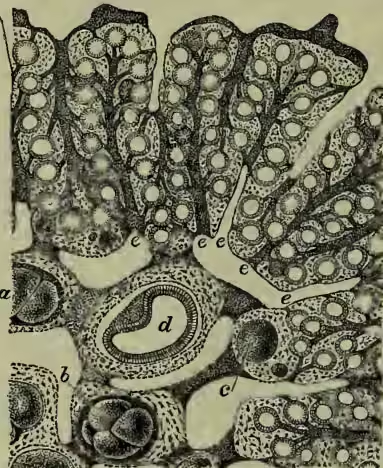
Life of Sponges.—Although sponges do not move, there is great motor activity in the ciliated cells of the endoderm. Like many other passive organisms sponges are profoundly influenced by their surroundings, for their shapes vary according to the nature of their anchorage and the currents which play around them. Sensitiveness to stimulus is shown by the closure of the little superficial pores and sometimes even of the larger exhalant aperture or apertures. This closure is due to special contractile-cells in the mesogloea, and in some cases it seems that these are connected with sensitive and nervous cells on the surface. The food of sponges consists of microscopic organisms and particles of organic debris, which are borne by the water-currents, and caught by the ciliated cells which, like so many Monads, swallow first and digest intracellularly afterwards. From the cells which feed surplus nutritive material oozes to adjacent cells, or is passed to mobile amoeboid cells in the mesogloea. Useless debris is also got rid of by the collared cells. Respiration is of course effected by the currents of water which wash the cells, and some of the bright pigments, such as floridine, characteristic of many sponges, readily absorb are sustained by the activity of the internal ciliated cells, which by their ceaseless lashing draw the water inwards and drive it also outwards, and at the same time absorb food-particles which drift along in the current.
But few sponges are so simple as the vase-like Ascetta; we are familiar, for instance, with the complex 'horny' skeleton of the bath-sponge (Euspongia), or with the beautiful flinty framework of the Venus' Flower-basket (Euplectella); and an examination of the fresh-water sponge (Spongilla) of the lake or canal, or of the Mermaids' Gloves (Chalina) so often cast up half alive on the beach, convinces us that the structure of the soft parts is oxygen. The green pigment of Spongilla is at least closely analogous to chlorophyll.
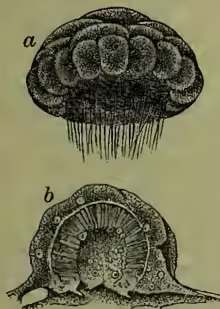
Reproduction.—Sponges multiply, like many plants, by overgrowth and budding, but the buds remain continuous with the parent mass, though sometimes it happens that small portions are set adrift from a moribund body. As a sponge is but slightly differentiated, as a fragment is a fair sample of the whole body, we can understand the success with which the sponge-farmers bed out portions of sponge in suitable places, leaving them to grow to a size fit for use. But sexual reproduction also occurs in all sponges. The ova and spermatozoa are included in the mesogloea, originating from apparently similar cells. Both unisexual and bisexual forms occur, in rare cases within one species. The ova are fertilised by spermatozoa drawn in by the water-currents, and development proceeds through several stages before the embryo leaves the parent (see fig. 2).
The life-history of the fresh-water sponge, Spongilla, as told by Marshall, is one of interesting vicissitudes. In autumn the sponge begins to suffer from the cold and the scarcity of food, and dies away. But throughout the moribund parent clumps of cells combine into 'gemmules,' which are furnished with capstan-like spicules, and are able to survive the winter. In April or May they float away from the parental corpse, and form new sponges. Some of these are short-lived males, others are more stable females. The ova produced by the latter, and fertilised by the cells of the former, develop into another generation of sponges, which in turn die away in autumn, and give rise to gemmules. The life-history thus illustrates Alternation of Generations (q.v.).
Development.—The development of sponges varies considerably in the different types, but we may sketch that of a calcareous sponge. The fertilised ovum divides completely, and forms a hollow sphere of in part ciliated cells, which escapes from the parent into the water. In the course of a short free-swimming life the ball of cells becomes invaginated, and forms a two-layered gastrula. This fixes itself, mouth downwards. But pores soon appear through the walls; the internal cells which had meanwhile lost their cilia regain them; an exhalant orifice is formed by rupture at the apex; a middle stratum is derived from the inner layer and begins to form spicules: the young sponge is made.
Classification.—One of the oldest and most convenient classifications of sponges is that which distinguishes three main sets according to the nature of the skeleton:
- (1) CALCISPONGE: with spicules of carbonate of lime, including Ascon, Sycon, and Leucon types. The purse-like Sycandra (or Grantia) compressa is common on British shores.
- (2) SILICISPONGE: with spicules and threads of silica—e.g. the Venus' Flower-basket (Euplectella); the likewise deep-sea Glass-robe Sponge (Hyalonema); Mermaids' Gloves (Chalina oculata), with a fibrous as well as a flinty skeleton; the common Crumb-of-bread Sponge (Halichondria panicea); Clione, which bores in oyster shells; Suberites domuncula, which grows round a whelk shell inhabited by a hermit-crab; and the fresh-water Spongilla.
- (3) CERATOSPONGE: with a framework of spongin or sponge-stuff and no proper spicules—e.g. the Bath-sponge (Euspongia), which thrives on some of the Mediterranean coasts.
To these may be added a few, probably degenerate, forms which have no skeleton at all (Myxospongiae)—e.g. Oscarella (or Halisarca) lobularis.
History.—Sponges, as we should expect, occur in very ancient strata; remains of a flinty form (Protospongia) have been found in Cambrian strata. In succeeding ages they are almost always represented. Remains of calcareous forms are almost confined to one peculiar set of large forms (Pharetrones) in Devonian and several succeeding epochs. Professor Franz Eilhard Schulze—the greatest authority on sponges—divides the sponge branch of the genealogical tree into three: the calcareous forms to one side, the siliceous Hexactinellida with triaxial spicules to the other, and between these the other flinty sponges whose spicules have four axes (Tetraxonia) or only one (Monaxonia), and the horny sponges without any spicules. It is generally allowed that the sponges are quite distinct from the Cœlenterates, and that they are somewhat degenerate and divergent descendants of the primitive Metazoa.
Relation to other Organisms.—'Sponges are living thickets in which many small animals play hide-and-seek.' Polypes, worms, and some other animals are often found associated with sponges, using them partly for shelter, partly as browsing-grounds. From the appetite of larger animals sponges are doubtless in great part saved by their spicules, and their frequently offensive taste and odour. Some sponges are borers, and others smother forms of life as passive as themselves. Several crabs are masked by growths of sponge, and within several sponges minute Algae live in constant partnership.
Several species of Euspongia are in use for economic purposes. Two species are brought from the Levant, and one (not much inferior) from the West Indies and coast of Florida. The trade in sponge is very considerable; it is carried on chiefly by Greeks, Sicilians, and Tunisians, and by the inhabitants of the Bahama Islands. The number of men employed in the Levantine sponge-fishery is between 4000 and 5000, forming the crews of about 600 boats. These boats find their chief employment on the coasts of Candia, Barbary, and Syria. The sponge is obtained by diving, the diver taking down with him a flat piece of stone of a triangular shape, with a hole drilled through one of its corners; to this a cord from the boat is attached, and the diver makes it serve to guide him to particular spots. When he reaches the growing sponges he tears them off the rocks, and places them under his arms; he then pulls at the rope, which gives the signal to his companions in the boat to haul him up. The value of sponges collected in Greece and Turkey is from £90,000 to £100,000 annually. The diving-bell and diving-dress are sometimes made use of. The Greeks of the Morea, instead of diving, obtain sponges by a pronged instrument; but the sponges thus collected are torn, and sell at a low price. The best sponges are obtained on detached heads of rock in eight or ten fathoms water.
The sponges of the Bahamas and other West Indian islands are of a larger size and coarser quality; the sponge-trade there employs 500 small vessels and 5000 to 6000 people; in 1890 the crop exceeded 900,000 lb., worth £61,400; and about 215,000 lb., worth £17,000, are sent annually to Great Britain. The sponges are torn from the rocks by a fork at the end of a long pole. To get rid of the animal matter they are buried for some days in the sand, and then soaked and washed.
The domestic uses of sponge are familiar to every one. It is also of great value to the surgeon, not only for removing blood in operations, but for checking hæmorrhage. Burnt sponge was once a valued remedy for scrofulous diseases and goitre; but iodine and bromine, from which it derives all its value, are now administered in other forms.
See popular account of sponges by Sollas in Cassell's Natural History; E. Haeckel, Die Kalkschwämme (1872); Challenger Reports on Sponges, by Haeckel, Poléjaeff, Schulze, Sollas; Vosmaer, 'Die Poriferen,' in Bronn's Thierreich; Von Lendenfeld, 'A Monograph of Australian Sponges,' Proc. Linn. Soc. N.S. Wales (vol. ix. 1884).