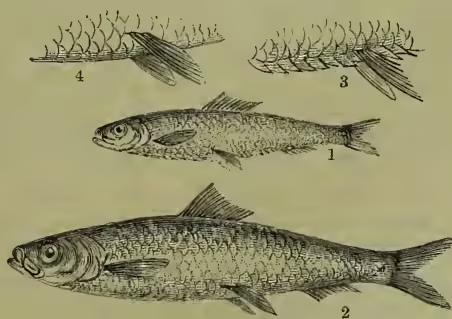
Sprat (Clupea sprattus), a fish of the family Clupeidæ, very abundant on many parts of the British coast, and elsewhere in the northern parts of the Atlantic. It is smaller than the herring, being only about five inches in length when full grown, but much resembles it. It is, however, easily distinguished by the serrated belly, and by the position of the fins, the ventral fins beginning immediately beneath the first ray of the dorsal fin, and not beneath the middle of it, as in the herring 1, sprat; 2, herring; 3, belly of sprat; 4, belly of herring. and pilchard. Another easily observed distinction is the want of axillary scales to the ventral fins, which both the herring and pilchard have. The dentition is also different, and on this account Valenciennes constituted for the sprat and a number of other species the new genus Harengula, characterised by having teeth on the jaws, tongue, palatines, and pterygoids, but no teeth on the vomer. The herring has teeth on the vomer. The sprat has only forty-seven to forty-nine vertebrae, whilst the herring has fifty-six to fifty-eight. The mode of reproduction of the sprat has only recently been discovered. It was for a long time unknown, because the adult sprats taken in estuaries are scarcely ever in breeding condition. But it has now been proved by Victor Hensen of the German Fishery Commission, and by J. T. Cunningham of the Marine Biological Association, that the eggs of the sprat are pelagic, like those of the pilchard—i.e. that they float in the sea and are hatched in that condition. The eggs have been taken both in Germany and at Plymouth in England from the ripe female sprat, and proved to be identical in all respects with floating eggs previously obtained from the surface-waters of the sea. Perfectly ripe sprats are only found in the sea, to which they repair for the purpose of spawning, not, however, wandering very far from land. On the south coast of England at Plymouth the sprat spawns from December to May, but in the Firth of Forth and east coast of Scotland in May or June. The young sprats are found, together with young herrings, in estuaries, such as the Thames, Forth, Exe, Tamar, &c., and are taken in large numbers to be consumed as whitebait. Sprats abound especially on the coasts of Norfolk, Suffolk, Essex, and Kent in November and several following months. Drift-nets are used for the capture of sprats off the coast of Kent, but the usual instrument for the purpose is the stow-net worked from a moored boat in estuaries and tide-ways. The stow-net is a large bag-net suspended between two horizontal beams beneath the boat, and about a fathom from the bottom of the water; ropes from the ends of the upper beam enabling the fisherman in the boat to keep the mouth of the bag always open and against the tide. Vast quantities of sprats are taken in this way, so that they are used as manure by farmers, although London is also very largely supplied with them, and being sold at a very cheap rate they are a favourite article of food of the poorer classes. The Firth of Forth also produces sprats—in Scotland called garvies—so abundantly that they are sold both in Edinburgh and Glasgow by measure, and cheaper than any other kind of fish. But there are many parts of the British coast where the sprat is rare, some of these being parts where the herring is plentiful. Notwithstanding its cheapness the sprat is a very fine fish, of flavour quite equal to the herring, although decidedly different. Dried sprats are a very common article of provision, and sprats are also sometimes salted. The kilkies brought from Riga and other ports on the Baltic are sprats cured with spices, as also are the 'Norwegian Anchovies' sent in small wooden barrels from Norway to England. The value of the sprat does not seem to be as yet fully appreciated in Britain. Very closely allied to the sprat is another fish (Clupea latula), the Blanquette of the French, which is caught in great abundance on some parts of the west coast of France. Other allied species are found in other seas. One of them (C. humeralis), which abounds in the West Indies, and southwards as far as Rio Janeiro, is much esteemed, but becomes poisonous at certain seasons, from some unknown cause. The prepared Sardine (q.v.) is frequently a sprat.