Spring, a stream of water issuing from the earth. The source of springs is the rain and snow that falls from the clouds. Very little of the water precipitated in any district finds its way immediately by rivers to the sea; the great proportion either sinks into the earth or is evaporated from the surface of the earth, and, reabsorbed by the atmosphere, is employed by plants and animals. All loose soils and gravels greedily absorb water, which descends until it meets with a stratum through which it cannot penetrate. A pit dug into the water-charged soil would speedily fill itself by draining the water from the soil. All rocks contain water; some retain it by capillary attraction, like a sponge, others hold it merely mechanically, and easily part with it. Chalk will absorb and retain one-third of its bulk of water; and sand, on the other hand, while it will absorb as much, will part with nearly the whole amount to a well dug in it. Argillaceous deposits and compact rocks are barriers to the passage of water, and cause the superincumbent pervious strata to become water-logged when there is no outlet. Sometimes the edges of the strata are exposed on the sides of a valley, and permit the free escape of the contained water, which pours from them over the neighbouring land. But rents and fissures, as well as inequalities on the surface of the impervious beds, give the water a circumscribed course, and cause it to issue in springs.
The water, as it percolates through the earth, always becomes more or less charged with foreign matter, owing to its solvent property. Carbonate, sulphate, and muriate of lime, muriate of soda, and iron are the most common impurities in spring-waters; magnesia and silica also frequently occur. These substances, from the evaporation of part of the water, or the escape of the carbonic acid gas, by which so large a quantity is often held in solution, are frequently deposited on the margins of the springs, or in the courses of the streams flowing from them. Such deposits are found in all so-called petrifying springs; and the hot wells of Iceland, the Yellowstone Park, and the Azores are surrounded with basins formed of siliceous sinter which has been derived from the water. When the foreign ingredients have medicinal qualities the springs are known as Mineral Waters (q.v.).
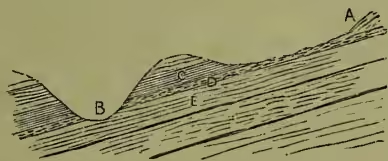
Springs are either associated with the superficial strata or rise from a considerable depth. Surface-springs occur where the absorbent surface-deposits rest on an impervious bed, which prevents the further downward progress of the water, or where the beds through which the water flows are near the surface, as shown in fig. 1, where C and E are impervious clay-beds, and D is a bed of sand or gravel, which in the upper portion is exposed on the surface, or is only overlaid by loose soil, and after being covered for some distance by the clay-bed, C, makes its appearance again at B, where the valley cuts it through: here the water collected over the area, A, is discharged. Surface-springs, depending as they do so directly on the rain for supplies, are very variable in the amount of water they deliver. They frequently fail entirely in the summer, and always after great droughts. Their temperature varies with that of the district where they exist, being warm in summer and cold in winter, as they do not penetrate below that plane in the earth's crust which is affected by the seasonal changes in temperature.
When the bed which forms the reservoir for the spring is at such a distance from the surface as to be beyond the zone of season changes, and yet within that which is influenced by the climate, the water has a temperature equal to the mean temperature of the locality where it springs. Such springs have generally a large area for the collection of the superficial water, and are consequently regular in the quantity of water they give out. They are brought to the surface by means of master-joints and dislocations. The celebrated Well of St Winifred at Holywell, in Flintshire, rises through a fault in the coal-measures. It formerly discharged about 4400 gallons per minute, and the water, in its short course of little more than a mile to the sea, was used to propel eleven mills; but the discharge has been much diminished by drainage works.
Most deep wells have a lower origin than the zone of climate temperature, which in Britain is between 200 and 300 feet. It is well known that a regular increase in the temperature is observed after this zone is passed, equal to 1° of F. for every 54 feet. As wells have a temperature corresponding to that of the strata from which they spring, it follows that the deeper the spring the higher will be its temperature. Local conditions may affect the thermal state of springs, as in the case of the geysers in the active volcanic district in Iceland, and the warm springs near Naples; but where no such local influences exist the depth of the bed from which the water comes may be to some extent estimated by its temperature. Thermal springs occur in Britain at Matlock (66° F.) and Buxton (82°) in Derbyshire, at Bath (117°) in Somerset, and at Clifton (76°) in Gloucestershire. Artificial communications have been opened with deep-lying strata, by which the water they contain has been brought to the surface, and in these the temperature is found to increase in proportion to the depth of the bore (see ARTESIAN WELLS). The most remarkable thermal springs are the geysers of Iceland and the Yellowstone Park (see GEYSER, YELLOWSTONE PARK).
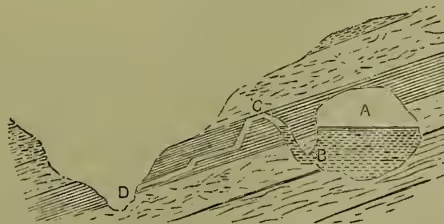
Intermittent springs are sometimes produced by the ebb and flow of the tide, as at Richmond, where the rise at high-water is seen in the wells which flow from the arenaceous strata on the banks of the Thames; and sometimes they depend on the supply of rain-water. But there is a kind of spring the intermittences of which are believed to be owing to the structure of the internal cavities from which the supply is obtained. This will be more easily understood by a reference to the accompanying diagram (fig. 2). The large reservoir, A, is fed by the rain percolating through the rock. It communicates with the surface by a siphon-shaped tube, BCD. As long as the water in the reservoir is at a lower level than the arch of the siphon at C no water can escape; but as soon as it reaches its level the whole of the water in the cavity will be drawn off, the spring will then cease, and will only make its appearance when sufficient water has accumulated to permit the siphon again to act.