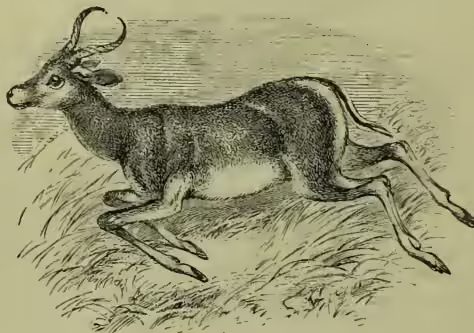
Springbok (Gazella cuchoire), an autelope, which like many others is getting scarcer; it is still, however, abundant a little south of the Zambezi. It is an extremely beautiful creature, of graceful form, and fine colons. It is larger than the roebuck, and its neck and limbs much longer and more delicate. The general colour is fulvous brown on the upper parts, pure white beneath, the colours separated on the flanks by a broad band of deep vinous red. The whole head is white, except a broad brown band on each side from the eye to the mouth, and a brown spot in the centre of the face. Two curious folds of skin ascend from the root of the tail, and terminate near the middle of the back; they are usually closed, but open out when the animal is bounding, and disclose a large triangular white space which is otherwise concealed. The springbok derives its name from the prodigious leaps which it takes either when alarmed or in play, often to the height of 7 feet, and sometimes of 12 or 13 feet. Its ordinary residence is in the karroos or arid sandy plains; but when all pasture there is burned up immense herds congregate together, and migrate to more fertile regions, often devastating the fields of the colonist. Pringle speaks (1834) of seeing the country near the Little Fish River specked with them as far as the eye could reach, and estimates the number in sight at once as not less than 25,000 or 30,000. Cumming describes (1850) a still more extraordinary scene, a vast herd pouring through an opening among hills, in one living mass, half a mile in breadth, and so continuing for hours together. The strongest animals are generally foremost, but when satiated with food they fall behind, and others, hungry and active, take their place. When taken young the springbok is easily tamed, and becomes very familiar, troublesome, and tricky.