Squill (Scilla), a genus of bulbous-rooted plants of the natural order Liliaceæ, with radical leaves, and flowers in terminal racemes or loose corymbs. The species, which are numerous, are natives chiefly of the Mediterranean and Caucasian regions. Three are natives of Britain, S. verna, which is abundant on the east coast of Ireland, the west and north coasts of Scotland, more sparingly on the east coast of Scotland, and very locally in north-eastern England; S. autumnalis, which is confined to some of the southern counties of England; and S. nutans, the wood-hyacinth or blue-bell of England, which is very abundant in most parts of Great Britain and Ireland. These and many exotic species are frequently cultivated for the sake of their beauty in British gardens.
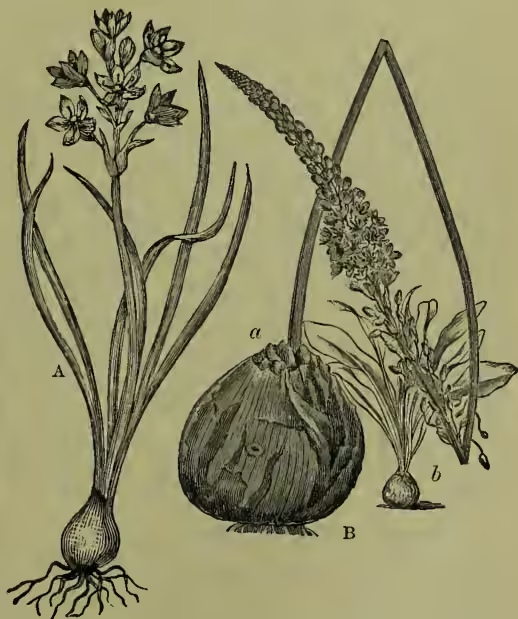
Very different in habit from these, and now separated from the genus, is the Official Squill (Urginea Scilla, or maritima; formerly called Scilla maritima), a native of the sandy shores of the Mediterranean, which has a scape from two to four feet high, with a raceme of many whitish flowers and large leaves. The bulb is of the size of a man's fist, or sometimes as large as a child's head, and contains a viscid juice so acrid as to blister the fingers if much handled, whilst the vapour arising from it irritates the nose and eyes.
Squill was used in medicine by the ancients, and is still largely employed. The bulb is dug up in autumn, divided into four parts, the centre being cut out as being inert, and the remainder being cut into thin slices, which are quickly dried by a gentle heat. The dried slices are white or yellowish white, slightly translucent, odourless, disagreeably bitter, brittle, and easily pulverisable if very dry. The bulb contains a number of active principles, the chief of which is a glucoside, scillain, having much the same action as digitalis; other active ingredients have been described under the names scillitoxin, scillin, and scillipicrin. This medicine is prescribed as a diuretic and expectorant, and occasionally as an emetic; but it must be recollected that in moderately large doses it acts as a narcotico-irritant poison, twenty-four grains having proved fatal. When given as a diuretic it is usually prescribed in combination with digitalis and calomel, when it seldom fails to produce an increased secretion of urine, and thus promotes the absorption of the dropsical effusion which is generally present when diuretics are ordered. Its dose as a diuretic is from one to three grains of the powdered bulb, or about twenty minims of the tincture. As an expectorant it is much employed in the subacute stages and chronic forms of pulmonary affections, and is very serviceable in bronchitis and pneumonia of children. From its property of promoting the secretion of mucus, it gives relief by facilitating the expectoration in cases of asthma, &c., in which the sputa are viscid. In those cases it is usually prescribed with some of the more stimulating expectorants, as carbonate of ammonium. As an expectorant the dose of the powdered squill should not exceed one grain, repeated several times daily. For children the syrup, in doses of from ten to thirty minims, may be given. As its action as an emetic is uncertain and dangerous, it should not be prescribed with the view of inducing vomiting.