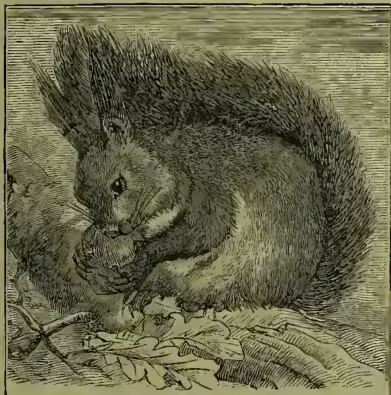
Squirrel, the vernacular name of the Sciurus vulgaris, and in a wider sense of all members of the sub-family Sciurinae. These are characterised by their slender body, cylindrical hairy tail, and large prominent eyes; the ears are of variable size—often tufted; anterior limbs shorter than posterior, the former have four fingers and a rudimentary thumb, the latter five complete toes. Their habits are for the most part arboreal; some few excavate subterranean retreats. Their distribution is cosmopolitan, excluding the Australian region. There are seven recent genera and several fossil ones. (1) Sciurus, in addition to the characters of the family above mentioned, has the tail long and bushy, ears pointed—often tufted, the digits with long, curved, sharp claws, skull delicate, with long post-orbital processes, penultimate upper premolar, when present, minute. S. vulgaris, the common squirrel, measures 18 inches long (including the tail, which is 8 inches), and weighs about half a pound; its colour in summer is brownish red above, mixed with gray on the side of the head, white below from the chin; in winter the brownish red above becomes mixed with grayish hairs, whilst in Siberia and northern Europe generally the whole animal becomes whitish gray without a trace of red; black varieties occasionally appear. It occurs at the present day all over the palæarctic region, from Ireland to Japan and from North Italy to Lapland, whilst its remains occur as far back in the geological history as the 'Cromer Forest Bed.' In Scotland it bade fair to become extinct, but with the planting of new woods in the later half of the 18th century it has again spread rapidly, so much so as in places to become a great nuisance. Its favourite dwellings are dry and shady woods, especially of beech and oak, whose nuts furnish it with a winter food-supply. It is always in motion, and in fine weather may be seen skipping from tree to tree as if in pure enjoyment; on the ground its pace is so rapid that a dog can scarcely catch it, but it is still more at home among the branches, where its sharp claws enable it to cling safely to the smoothest bark. When undisturbed it seems to be constantly on the look-out for food, which, if abundant, is stored up for future use; and, according to Radde, it is so altruistic as to impale fungi on the tips of branches so that any passing squirrel in need may share them. It eats berries, nuts, buds, occasionally a beetle or two, and is a greedy and successful plunderer of birds' nests; it does great mischief in the spring by nibbling the fir-buds and gnawing the bark, the rising sap being apparently specially palatable to it. Soft fruit does not seem to be much appreciated, the flesh of apples and pears being discarded in favour of the pips. The squirrel will use a bird's nest for a temporary lodging, but the home is always constructed afresh, though the materials collected by others may be utilised. The nest is usually situated in the fork of a branch near the stem, and has a roof to keep out rain, a main entrance opening downwards, and a smaller accessory opening near the stem. The squirrel lies curled up when asleep, is very sensitive to the weather, and even seems to be prescient of storms. It swims freely on occasion. Pairing takes place in March, when there are often savage fights between the males; four weeks later from three to seven young are born, which remain blind for about nine days; for five days or so after the young leave the nest the whole family sports together among the trees, and then breaks up; in June there is a second brood, which may occasionally be seen in company with the former one. In winter the squirrel hibernates, awaking from time to time to feed on its stores. Its chief enemy is the marten, which is much stronger and climbs equally well, though it cannot take such leaps from tree to tree. The fur of the squirrel has a commercial value. On the Lena trapping it furnishes occupation for many hands, some hunters having as many as 1000 snares; Russia and Siberia yield six or seven million skins per annum, valued at £150,000, but the best Siberian skins fetch as much as 1s. 6d. The genus includes between seventy and eighty other species, some of those from the Oriental region being very highly coloured; in one of them (S. caniceps) the back becomes of a bright orange colour during the breeding season, a rare phenomenon among mammals. (2) Pteromys includes the Taguan or Flying Squirrel (P. petairista), the largest of the sub-family, being nearly as large as a cat; see FLYING ANIMALS. (3) Rhithrosinurus is a large squirrel from Borneo, with black and white striped sides and grooved incisor teeth. (4) Tamias is an American genus, though one species extends into Asia and even to eastern Europe. All the four species have cheek-pouches, and the back is ornamented with darker and lighter stripes; see CHIPMUNK. (5) Xerus includes the so-called 'Spiny Squirrels,' of which there are four species, all African; the fur is coarse, the claws straight, and the external ear small or absent. They inhabit the dry steppes, and dig holes in the roots of trees or among rocks. The Prairie Dog (q.v.) was sometimes called the 'Barking Squirrel.' See J. A. Harvie-Brown's History of the Squirrel in Great Britain (Edin. 1881).