St Bernard, a breed of dogs which derives its name from the hospice of St Bernard, where it was first introduced for the purpose of finding the pass across the mountain in snow. Every morning during the winter two dogs, one old and one young, accompanied by one or more of the monks or attendants, started from the monastery for the shelter at the foot of the mountain on the Italian side; a similar party of men and dogs also descended to the shelter at the Swiss end of the pass. If any travellers were found there they were helped on their way to the hospice, the dogs going on before to show the road. Possibly, on rare occasions, the dogs were allowed to go down to the valley by themselves, but as a rule they only acted as guides to the monks. Pictures and stories of the dogs laden with food and clothes, and sometimes actually carrying a benumbed traveller, are plainly due to the exaggeration of their admirers.
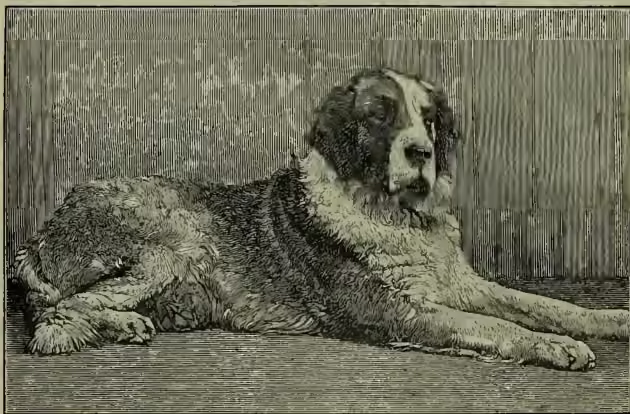
The St Bernard, according to the traditions of the monastery, is the result of a cross between a Danish bull-bitch and a mastiff, a native hill dog, though at what time effected it is impossible to say. After the breed was once established it was kept pure until 1812, when owing to the severity of the winter the monks were obliged, contrary to their usual custom, to send out the brood bitches as well as the dogs, with the result that all the females succumbed to the cold, and the monks found themselves without the means of continuing the true breed. In this extremity a cross with the Newfoundland was tried, but at first failed, owing to the excessive coat of the Newfoundland, which hampered the dogs in snow; however, by breeding back to their own short-coated dogs, the monks obtained the desired shortness of coat, though occasional specimens were born with the rough coats. These rough-coated specimens were sold or given away to the inhabitants of the surrounding valleys, who continued to breed them, so that St Bernard dogs soon became general in Switzerland. About 1860 these dogs first attracted the attention of English travellers, who imported them to Britain, where they were exhibited and at once excited much notice on account of their size and beauty. Others were introduced, and the St Bernard was soon established as the most popular big dog, a popularity which has gone on increasing. The St Bernard, as bred to modern English ideas, is an immense red or orange coloured dog, marked with white on muzzle, neck, chest, feet, and tip of tail. The head should be massive and imposing, with a strong square muzzle, a point of great importance. Legs should be straight, with large feet, and double or, at least, single dew claws.
Hind-feet should turn out, though not sufficiently to hinder the dog's movements. The coat of the rough variety is of medium length; it should not be too curly. In the smooth variety the coat should be short and wiry. Many of the finest St Bernards measure over 30 inches high at the shoulder, and weigh over 150 lb. On account of his great size and weight the St Bernard often moves in an awkward manner, a defect which should be avoided. St Bernards, though occupying a great deal of space, are so handsome that they are kept as companions in great numbers; as a rule they are good tempered, though many are not to be trusted.
See Hugh Dalziel's The St Bernard (1888), and his St Bernard Stud-book (1891).