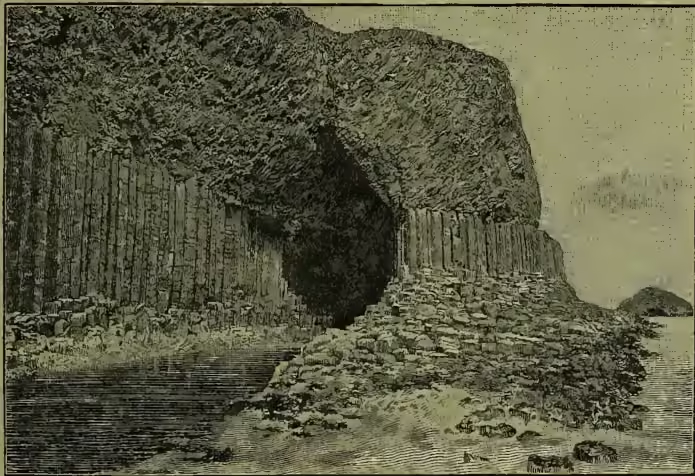
Staffordshire, a west midland county of England, bounded by Cheshire, Derbyshire, Leicestershire, Warwickshire, Worcestershire, and Salop. Measuring 54 by 35 miles, it has an area of 1169 sq. m. or 748,433 acres. The only hilly district is in the north, where the wild 'Moorlands,' the southern extremity of the Pennine range, extend from north- west to south-east in long ridges, separated by deeply-cut valleys, and subside as they near the valley of the Trent. Several points exceed 1500 feet above sea-level, but Axe Edge Hill (1756) falls just within Derbyshire. The rest of the county is gently undulating, with the low upland of Cannock Chase in the centre. The Trent, flowing first south-eastward through the interior, and then north-eastward along the Derbyshire border, is the chief river, and receives the Sow, Tame, Blythe, and Dove. New Red Sandstone occupies nearly three-fourths of the total area; and in the north and south are the Pottery and Dudley coalfields, which, besides containing cliffs from 84 to 112 feet high. Regarded in section, the rocks show themselves to be of three kinds—conglomerated tufa, forming the basement; columnar basalt, arranged in colonnades, which form the façades and the walls of the chief caves; and amorphous basalt, overlying the columnar basalt, but pierced here and there by the ends of columns and by angular blocks. The most remarkable feature of the island is Fingal's or the Great Cave, the entrance to which is formed by columnar ranges on each side, supporting a lofty arch. The entrance is 42 feet wide, and 66 feet high, and the length of the cave is 227 feet. The floor of this marvellous chamber is the sea, which throws up nearly 600 collieries, yield also (especially the northern one) vast quantities of ironstone (see IRON, Vol. VI. p. 216). The climate is cold and humid, with a rainfall of 36 inches; and, though more than four-fifths of the area is arable, much of the soil is cold and clayey, and agriculture is in rather a backward condition. In the 'Potteries' of North Staffordshire, embracing Stoke-upon-Trent, Etruria, Hanley, Burslem, &c., most extensive manufactures of china and earthenware are carried on (see Vol. VIII. p. 367); and in the 'Black Country' in the south, with Wolverhampton and Walsall, iron is very largely manufactured in all its branches. The Burton breweries are world-famous. There is a perfect network of railways and canals. Staffordshire, which is mainly in the diocese of Lichfield, contains five hundreds and 247 parishes. There are 100 county councillors, and for parliamentary purposes the county has been divided since 1885 into seven divisions, each returning one member—Leek, Burton, West, North-west, Lichfield, Kingswinford, and Handsworth. The thirteen municipal boroughs, with their population in 1891, are Burslem, 30,862; Burton-on-Trent, 46,047; Hanley, 54,846; Lichfield, 7864; Longton, 34,327; Newcastle-under-Lyme, 18,452; Stafford, 20,270; Stoke-upon-Trent, 24,027; Tamworth, 6614; Walsall, 71,791; Wednesbury, 25,342; West Bromwich, 59,489; and Wolverhampton, 82,620. Pop. of entire county (1801) 242,693; (1841) 509,472; (1881) 981,009; (1891) 1,083,408. Staffordshire has no great wealth of antiquities, and has been the scene of no battles more important than Blore Heath (1459) and Hopton Heath (1643). Among its natives have been Lord Anson, Ashmole, Dr Johnson, Thomas Newton, Cardinal Pole, Earl St Vincent, Izaak Walton, and Josiah Wedgwood.
See county histories by R. Plot (1686), S. Erdeswick (1717; 4th ed. 1844), S. Shaw (1798-1801), and R. Garner (1844-60); the Proceedings of the William Salt Archaeological Society (1880 et seq.); Collections for a History of Staffordshire (vol. xiii. 1893); and works cited in Simms's Bibliotheca Staffordiensis (Lichfield, 1894).