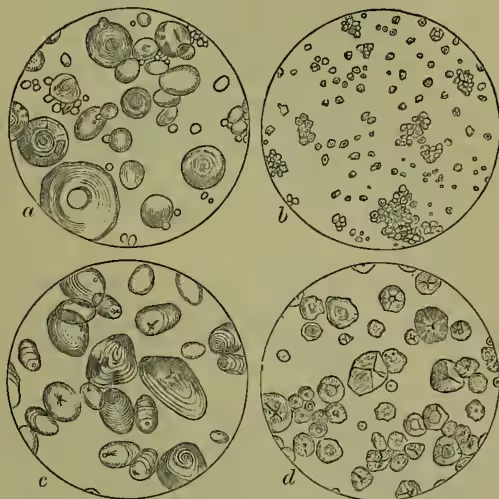
Starch, . It is one of the essential functions of the leaves of plants to decompose carbonic acid, by the help of sunlight which shines through the chlorophyll, with evolution of oxygen and the formation of starch. The starch becomes converted by a diastatic ferment into sugar, which passes from the leaves to various parts of the plants, and being reconverted into starch, is stored. See CHLOROPHYLL, LEAF, and SEED. It is in this way that fruits and seeds, stems—e.g. that of the sago palm—tubers like the potato, tap-roots, bulbs, &c. become stored with starch. The granules of starch are usually of a rounded form, consisting of a nucleus surrounded by a number of envelopes or layers. Each species of plant has its own peculiar shape of granule which can be recognised under the microscope, but in the same plant these granules differ in size. The smallest size of a granule of oat-starch is .0001, while the largest sized granule of Tous-les-mois starch is about .0015 of an inch. In a small book on the Chemistry of Foods, by Dr Bell of the Somerset House Laboratory, the reader will find a considerable number of illustrations of starches as seen under the microscope.
Starch has the same elementary composition as sugar, gum, and woody fibre (cellulose). These all belong to a class of substances called carbohydrates, because they could be represented as compounds of carbon and water, as shown by the formula given above, which corresponds to six atoms of carbon and five molecules of water, . Starch contains no nitrogen, and is thus distinguished from characteristic animal compounds. The peculiar structure of starch granules and the way in which they occur in the vegetable cell permit of their being readily separated from other matters occurring along with them in plants. As usually prepared, starch is either a white glistening powder or it is obtained in irregular prisms which arise from the cracking up of a cake of the dried material. When pressed between the fingers a slight but peculiar sound is produced. Its specific gravity varies from 1.55 to 1.60. Starch is soluble only to a very slight extent in cold water, but when heated in water to above 150° F. the granules burst, and a clear ropy solution is formed which, on cooling, becomes a translucent jelly called starch-paste. This paste gives a deep blue colour with iodine and an orange yellow with bromine, the former being a highly characteristic and delicate test for starch. If a salt of iodine, such as iodide of potassium, is used, the iodine must be liberated either by a drop of strong nitric acid or preferably by a little chlorine water. By the gentle action of nitric acid on starch an explosive compound called xyloidine is obtained. At a temperature of about 320° F. (160° C.) starch is converted into dextrine or British gum, and the same change is produced on starch by the action of dilute mineral acids. Dextrine is usually made on an industrial scale from potato-starch. It is this Dextrine (q.v.) which is the adhesive matter on postage-stamps, but it is otherwise largely used in the arts. By the further action of acids on starch dextrose or grape-sugar, and also the crystallisable sugar, maltose, are obtained. Maltose sugar is likewise produced during the operation of malting by the action of diastase on the starch of grain.
Starch is heard of in England as early as 1511, but was not much used till 1564, when, according to Planché, 'Mistress Bingham Vandh Plasse, a Fleming, came to London, and publicly taught the art of starching. . . . Stubbes falls foul of this "liquid matter which they call starch, wherein the devil hath learned them to wash and dive their ruffs, which being dry will then stand stiff and inflexible about their necks."'
Manufacture.—Starch is manufactured on a large scale in Europe from maize, wheat, rice, potatoes, and from sago-flour. Maize-starch is most largely made. The grain contains 65 per cent. of starch and about 14 of gluten and other nitrogenous matters. The Indian corn is first steeped for forty-eight hours in water at a temperature not exceeding 120° F. It is then ground with water by millstones into a milky state, after which it is sieved to keep back the husks. From the sieve the starchy liquid passes into 'runs' or channels made of wood, from 2½ to 4 feet broad and 9 inches deep, in which the starch deposits. It is then removed from the runs and put along with water into vats or tuns (10 feet in diameter and 4 feet 6 inches deep) provided with stirrers, some very weak soda-lye being added. After it is sufficiently stirred the liquid is allowed to settle, when the starch falls to the bottom. At this stage the vats contain a layer of starch, over this a layer of gluten, and above that again a stratum of yellowish water thick with gluten. The starch is again washed with water in the final settling vats, from which, after drawing off the water, it is removed and spread on clean cotton sheeting to be dried in stoves at a temperature between 120° and 130° F. A little chloride of lime is used to bleach maize and other kinds of starch.
Potato-starch.—In manufacturing starch from potatoes, the latter are first washed in machines of various kinds, but of which one of the simplest is a revolving cage-like cylinder with wooden bars. Then follows the grating of the washed potatoes by forcing them against the saw-like teeth of raspers, which, as sufficient water is fed to the machine, reduces them to a paste. In order to separate fibrous and albuminous matters and other impurities, the starch-paste with an addition of water is passed through fine sieves, and at the same time agitated by various arrangements. From the sieves it is received into settling tanks in which the deposit of starch is again washed in clean water. It then descends in a milky stream over an inclined plane, on which the starch is deposited, and afterwards once more washed. A little alum or sulphuric acid is used to assist in the removal of albuminous matters. The starch is dried either on porous bricks or on slabs of gypsum, and for some purposes it undergoes another drying in a hot chamber.
Wheat-starch.—Owing to the large amount of albuminous and other nitrogenous bodies (gluten or its equivalents) which wheat contains, amount- ing sometimes to more than 15 per cent., the methods of making starch from this grain are a little more complicated than the processes employed to obtain it from other cereals or potatoes. Wheat-starch is made by the old plan of removing the gluten by fermentation, and also by Martin's method of kneading the flour into a stiff dough and washing out the starch with water on a sieve. Good English wheat contains about 69 per cent. of starch, but in this grain the proportion of both starch and gluten varies much.
Rice-starch is prepared by removing the gluten, which amounts to from 7 to 8 per cent. of the seed, by the action of soda in weak solution. The proportion of starch in rice is higher than it is in other cereals, varying from a little under to a little over 80 per cent. The corn-flours of commerce are prepared either from the purified starch of maize or from that of rice. These flours, being nearly pure starches, with the flesh and bone forming constituents extracted, are not flours of their respective seeds in the sense that wheat-flour is.
Sago-starch is obtained from the pith of the stems of sago palms (see PALM and SAGO). Most of the sago imported into England is in the form of sago-flour, which is used in the manufacture of household starch and glucose sugar. Besides its use in the laundry, starch is extensively employed in dressing textile fabrics and as a thickener for the colours used in printing calico; also for mounting photographic prints and dusting founders' moulds.
The principal starches prepared for food besides the 'corn-flours' are Arrowroot (q.v.), Tapioca (q.v.); and Tous-les-mois, from the rhizomes of a species of Canna cultivated in St Kitts, West Indies. Curcuma Starch is made to some extent in Southern India from the tuberous root of Curcuma angustifolia, and is sometimes called by Europeans East India arrowroot. In France starch is manufactured from horse-chestnuts. Paisley is the principal seat of the starch-manufacture in Great Britain, where it is chiefly made from maize. Rice-starch is made on a large scale at Norwich, and wheat-starch at Belfast.
In the United States, where maize-starch was first produced in 1842, the principal manufactories are at Oswego, New York, and at Glen Cove, on Long Island; indeed, these are the largest starch-works in the world. There are over 100 other factories in the Union, some producing potato-starch or wheat-starch, but the most maize-starch; and some 10,000,000 lb. of starch is now exported annually. Maize-starch is manufactured from a large porous-grained Indian corn.