Starfishes (Asteroidea), a class of Echinoderms, nearly allied to the Brittle-stars (Ophiuroidea), an account of which is included in this article, and to the Sea-urchins (Echinoidea).
The Common Five-rayed Starfish (Asterias or Asteracanthion rubens) may be taken as type. It is sometimes seen in shore-pools about the low-water level, but its haunts are on the floor of the sea at depths of a few fathoms. It moves sluggishly by means of suctorial tube-feet on the under surface of each arm. It often feeds on young oysters and other bivalves, but it may live on much smaller booty.
Haeckel compared such a starfish to a colony of five worms, and the comparison is useful. Each arm is anatomically complete in itself; there is a ventral nerve-cord ending in a terminal eye, and united with the nerves of the other four arms in a pentagon around the mouth; there is a blood-vessel above each radial nerve, and a vascular ring above the nerve-pentagon; there is a radial water-vessel in each arm, connected internally with little reservoirs or ampullæ, externally with the suctorial tube-feet, and centrally with a circum-oral watering, supplied by a vertical stone-canal which opens on the dorsal surface in a 'madrepore tubercle' between two of the arms; there are two digestive outgrowths or cæca of the gut in each arm; and there are also reproductive organs. Moreover, each arm has a certain independence of life, for a separated arm can grow the other four.
This theory gives us a vivid anatomical conception of the starfish, but the suggestion of the origin of a starfish from a colony of five worms is
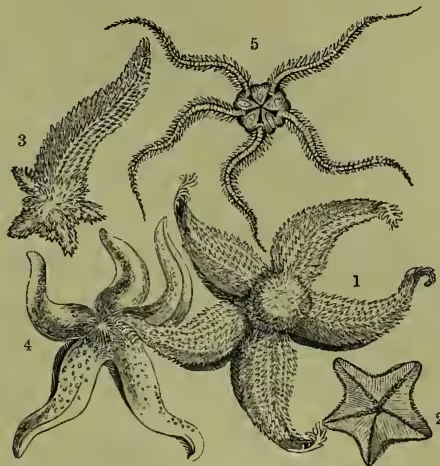
1, Common Starfish (Asterias rubens); 2, Gibbous Starlet (Asterina gibbosa); 3, Common Starfish, reproducing rays; 4, Eyed Cribella (Cribella oculata); 5, Lesser Sand-star (Ophiura albida). (From Forbes's British Starfishes.) not justified by the embryological facts. The interpretation which regards a five-armed starfish as a decentralisation of a flattened pentagonal sea-urchin, is more plausible than that which regards the Echinoid as a concentration of a bloated Asteroid.
Like most Echinoderms, the starfish is very calcareous. Forming the ventral groove of each arm there are important rafter-like plates called ambulacral ossicles; from the more external mesoderm are
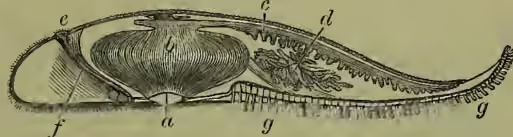
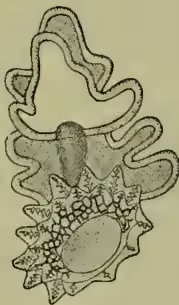
Section through arm and disc of Solaster, showing (a) mouth, (b) stomach, (c) digestive cæca, (d) reproductive organs, (e) madrepore plate, (f) stone-canal, and (g) tube-feet. developed smaller ossicles, superficial spines, and snapping scissor-like pedicellaræ. The starfish is not very muscular, but the arms can be bent in various ways, part of the stomach can be protruded, and there are contractile elements in connection with the water-vascular system. Besides the five radial nerves and the circum-oral pentagon, there is a diffuse nervous network beneath the ciliated ectoderm covering the body. Thus the skin is diffusely sensitive, and the little red 'eye' at the tip of each arm is certainly sensitive to light. The mouth is in the centre of the ventral surface; from the median stomach a pair of digestive cæca grow out into each arm; from the short tubular intestine between the stomach and the central dorsal anus, two little outgrowths arise, comparable, it is said, to the respiratory trees of Holothurians. There is a distinct, though not spacious, body-cavity, lined by ciliated epithelium, and containing a fluid with some amoeboid cells, the brownish pigment of which perhaps aids in respiration.
When we watch a starfish crawling up the side of a rock we see that scores of soft tube-feet are protruded from the ventral groove of each arm, that these become long and tense, and that their sucker-like terminal discs are pressed against the hard surface. There they are fixed, and towards the attachment the starfish gently lifts itself. The protrusion is effected by the internal injection of fluid into the tube-feet; the fixing is due to the fact that the contained fluid, flowing back again from the tube-feet to the internal reservoirs, produces a vacuum between the ends of the tube-feet and the surface of the rock.
On the dorsal surface, between the bases of two of the arms, there is a complex calcareous sieve, somewhat suggestive of the rose of a watering-pan. Its pores converge into a 'stone-canal,' which, like a complex calcareous filter, extends vertically through the body, and leads into a ring around the mouth. This circum-oral ring gives off nine transparent vesicles and five radial tubes, one for each arm. Each radial vessel lies in the ventral groove of an arm, roofed by the rafter-like ossicles, and gives off internally reservoir-like bladders or ampullæ, and externally the tube-feet. The fluid in the system seems to pass from the radial vessels into the tube-feet, and from the tube-feet back into the ampullæ. It is evident that the water-vascular system is modified for locomotion, but it is likely that it also helps in respiration and perhaps also in excretion. At the end of each arm there is a long unpaired tube-foot which acts like a tactile tentacle. The blood-vascular system is well developed, and in its general course corresponds to the water-vascular system. Respiration is in great part discharged by numerous 'skin-gills,' contractile hollow outgrowths from the skin of the dorsal and lateral surfaces. Of excretion in the starfish we know almost nothing. The sexes are separate but quite like one another; the reproductive organs—branched like elongated bunches of grapes—lie in pairs in each arm; the genital ducts open dorsally between the bases of the arms.
The ova are fertilised in the water. It is said that they occasionally begin to develop without fertilisation. The segmentation is complete, a blastosphere is formed and a typical gastrula. The free-swimming larva, as in other Echinoderms, is remarkably specialised, with two ciliated bands and peculiar arm-like outgrowths. It is known as a Bipinnaria or as a Brachiolaria. The adult is a new formation within the larva, retaining the water-vascular system and mid-gut, but absorbing or rejecting the provisional larval structures. There is also in this indirect development a remarkable change from bilateral to radial symmetry. Parental care occasionally occurs among Asteroids; thus a large Asterias has been seen sheltering its young within its arms, while in Pteraster and some others there is a dorsal brood-pouch. Many Asteroids break very readily, throwing off their arms when seized. The lost parts are slowly regenerated, and strange shapes, especially the 'comet-form,' often result in the course of regrowth. It is even possible that this 'autotomy' of members may sometimes be a means of multiplication.
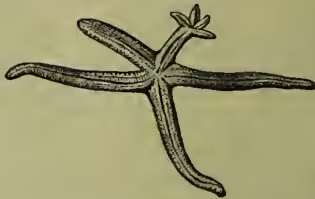
The commonest European starfishes are species of Asterias or Asteracanthion, Astropecten, Cribella, Solaster, Goniaster. In Astropecten and several related forms the food-canal ends blindly; in Brisinga the arms are very long and arise abruptly from a small central disc, as in Ophiuroids; in Luidia the pedicellariæ are three-bladed instead of two-bladed; and there are many minor differences like the above. There are also considerable differences in external form, wit- ness the many-rayed Solaster, the pincushion-like Goniaster, the flat pentagonal Palpites. The largest forms are such as Asterias gigantea, from the Pacific coast of North America, which measures two feet in diameter, and
Fig. 4.—Process of budding from one of the arms of Linckia multifora. (After P. and F. Sarasin.)
Pycnopodia helianthoides, which measures about a yard in diameter, and has over twenty arms. The majority live in comparatively shallow water, but the Ophiuroid-like Brisinga, the widely distributed Hymenaster, the blue Porcellenaster cœruleus, and many others are deep-sea forms. The earliest occurrence of Asteriods is in Silurian strata.
The Brittle-stars (Ophiuroidea) differ from Asteroids in the more centralised body, more sharply defined arms, and more active habit. Compared more fully with starfishes, the brittle-stars are more muscular and less limy; the arms do not contain digestive cæca from the gut nor reproductive organs, and are supported by an axis of limy 'vertebral ossicles;' the tube-feet are smaller, apparently tactile and respiratory, and locomotion is effected by the muscular wriggling of the arms; the groove so well seen on the ventral surface of the starfish arm is here closed in by limy plates; the alimentary canal ends blindly; the entrance to the water-vascular system (madreporic plate) is ventral; the larval form is known as a Pluteus. The popular name 'brittle-star' refers to the extreme ease with which the arms break; another common name, 'sand-stars,' refers less happily to their occasional occurrence on the shore; the technical title Ophiuroid describes the snake-like coils of their arms.
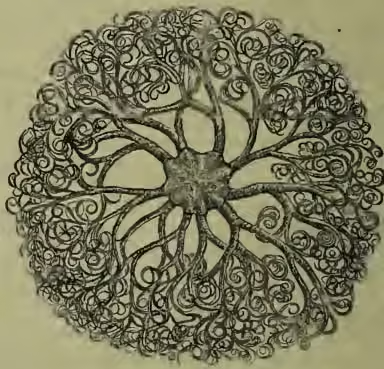
The brittle-stars creep about by wriggling their muscular arms. Some are found creeping on the shores at low-tide, but the majority keep to the floor of more or less deep water. On blocks of coral and the like they swarm in enormous numbers, twisting themselves most fantastically about the crevices. They are carnivorous animals, feeding on small molluscs, crustaceans, worms, and much simpler organisms like Foraminifera.
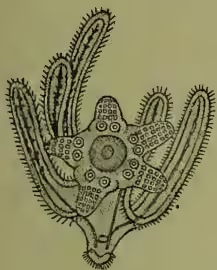
With few exceptions (e.g. Amphiwura squamata), the brittle-stars are unisexual. In most the eggs are liberated as such, are fertilised externally, and develop in the water; but some species—e.g. Ophiopholis bellis, Ophiocoma vivipara—produce their young alive (viviparously), and in these cases the genital clefts are enlarged to form distinct brood-chambers. The openings of the clefts admit water, and thus aid in respiration. When the young are born viviparously they are more or less like the parent Ophiuroid, and have no free-swimming larval stage, but where the eggs develop freely in the water, the result is a strange swimming larval form utterly unlike a brittle-star. This so-called 'Pluteus' is fancifully compared to a many-legged painter's easel, the legs being rods of lime which project from the body of the larva. Similar forms are characteristic of sea-urchins (Echinoids). As in other Echinoderms, the development is indirect. It is well known that in the panic of capture the brittle-stars justify their name by giving off their arms with singular facility. This pathological process is doubtless advantageous, for, like other Echinoderms, the brittle-stars have great powers of regeneration. They can grow new arms or new points, and thus recuperate their injuries; and in some species of Linckia and Ophidiaster an isolated arm may produce other arms.
The brittle-stars are world-wide in their distribution, or occur at least in all seas yet dredged. The depth of their habitat varies greatly. 'More than two hundred species are restricted in their range to a zone of thirty fathoms,' but 'sixty-nine species descend below one thousand fathoms, and about eighteen below two thousand.' About fifty fossil species are known. Some are said to appear in the Silurian and Devonian, but about these very ancient forms not much is certainly known. In the higher Mesozoic strata, however, they become frequent, and are especially numerous in Jurassic beds.
The Ophiuroids form the most numerous class of Echinodermata, and may be divided into two distinct orders—(a) the Ophiurida, with unforked arms, which cannot be rolled up towards the mouth, and usually have distinct limy shields; (b) Euryalida, often with forked arms, which can be rolled up towards the mouth, and have not distinct limy shields.
Important Forms.—(1) Ophiurida.—Among the commonest British species are the Common Sand-star (Ophiura texturata), the Lesser Sand-star (O. albida), and the Common Brittle-star (Ophiocoma rosula). In North-European seas Ophioglypha lacertosa is very common. Ophiopholis bellis is viviparous. Ophiactis virens divides spontaneously. The very widely distributed Amphiwura squamata is hermaphrodite, viviparous, and phosphorescent. Ophiopsis aranea is another luminous form. Ophiothrix fragilis is one of the most abundant species, and Ophiothrix echinata is common on Mediterranean shores. Ophionymxa leads on to the Euryalida, which in its soft skin and general appearance it markedly resembles. (2) Euryalida.—The very curious Gorgonocephalus or medusa-headed brittle-star is one of the best-known genera in this division. The arms are repeatedly forked, and as they curl in towards the mouth become intertwined in a living knot of the most fantastic appearance.
Euryale is another important genus. One form has been occasionally caught on herring nets off British coasts. They are sometimes called Basketfish, Medusa-headed Starfish, or Argus Starfish.
See Forbes, British Starfishes (Lond. 1841); Hamann, Beiträge zur Histologie der Echinodermen (Jena, 1885); Ludwig, 'Echinodermata' in Bronn's Thierreich (in progress), and Morphologische Studien an Echinodermen (Leip. 1877-82); Lyman, Challenger Report on Ophiuroidea (Lond. 1882); Romanes, Jelly-fish, Starfish, and Sea-urchins (Inter. Sc. Series, Lond. 1885).