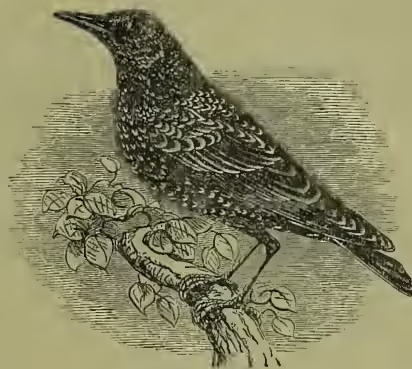
Starling, a genus Sturnus, and family Sturnidae of Passerine birds. The family is a highly characteristic Old-World one, extending to every part of the Eastern continent and its islands, and even to Samoa and New Zealand, but wholly absent from the Australian mainland. The Common Starling (S. vulgaris) is a beautiful bird, rather smaller than the song-thrush or mavis, brown, finely glossed with black, with rich metallic purple and green reflections, with a buff-coloured tip to each feather, giving the bird a fine speckled appearance, particularly on the breast and shoulders; in advanced age it is more uniform in colour. The female is less brilliant than the male, and has the terminal spots larger. Both sexes are more speckled in winter than in summer. The starling is abundant in most parts of Britain, and nowhere more so than in the Hebrides and Orkneys. It is very abundant in nearly every district of England, but is less common in Cornwall and in Wales. It is found in all parts of Europe, extending even to Iceland and Greenland. To the Mediterranean basin it is a cold weather visitor in enormous numbers; and it is also common in the north of Asia. Starlings make artless nests of slender twigs, roots, and dry grass (often in company with other birds), in hollow trees, in holes of cliffs, under eaves of houses, or, readily enough, in boxes, which are often placed for them in trees or elsewhere near houses. Year after year they return and build in the same spot if the nest has been removed. They lay from four to seven pale-blue eggs, and breed twice, sometimes thrice, in a season. In autumn the young birds join to form flocks, which become augmented by the older birds, until there is a whole cloud of starlings executing aerial evolutions night after night before roosting time. In winter they disperse in search of food. Their food consists of worms, slugs, beetles, fruit, especially elderberries, and in severe weather they eat lips and haws and sandworms and small molluscs. They are often found following cattle for the insects attending them. The starling becomes very pert and familiar in confinement, displays great imitative powers, and learns to whistle tunes, and even to articulate words with great distinctness. Its natural song is soft and sweet. In Spain, Southern Italy, and Sicily the unspotted starling (S. unicolor) is found, and from Asia Minor to North-western India S. purpurascens and several other allied species are found. The Rose-coloured Starling (Pastor roseus), a crested bird with rose-pink back, shoulders, breast, and under parts, is an annual visitor to nearly every part of the British Islands, and an irregular migrant over the greater part of Europe. In 1875 many thousands visited Italy, following large flights of locusts, and bred in the province of Verona; and similar incursions have often been made into other places. To North Africa it is an occasional migrant. Eastward it extends through Turkestan to India. Its favourite food is locusts, and on this account it is protected in many districts; but in India, in the cold season, it destroys much grain.