Steam. Steam is the vapour of water. When dry it is invisible and transparent like air, and not to be confused with the semi-liquid cloud which comes from the chimney of a locomotive. When superheated (see below) it changes the characteristics of a vapour for those belonging to what is known as a 'perfect gas' (see GAS). The development of steam is naturally enough connected popularly with a high temperature, but the two things do not necessarily go together. Water (or snow, or ice) gives off vapour or steam at every temperature—a low temperature not preventing the formation of steam, but only decreasing its density. The only limit to this evaporation is when the air surrounding the water (or snow, &c.) is already saturated with vapour of the maximum density which the water can give off at the existing temperature. Thus, water at 32° F. will give off vapour of a pressure equal to 0.085 lb. per square inch; but if the air above it is already saturated with vapour of that density the tendency of the particles of water to fly apart is exactly balanced by the pressure of the vapour on its surface, and no more evaporation takes place. While no atmospheric pressure can prevent the water or ice passing into vapour, the previous presence in the air of vapour of the required density (even when so small as in the instance just given) entirely stops it.
Suppose to be a cylinder, and a piston moving steam-tight within it; and suppose also that the end of the cylinder above is open to the atmosphere, and that below there is in the cylinder a perfect vacuum. There is then a downward pressure upon the piston equal to the whole force of the atmosphere, or about 14.7 lb. per square inch. If now a little water could be introduced into the bottom of the cylinder without admitting any air, a quantity of vapour would rise from it, and press with more or less force on the lower side of the piston so as to sustain a portion of the weight of the atmosphere. How much vapour would rise, and how much elastic force or pressure it would exert, would depend upon the temperature of the water and cylinder.
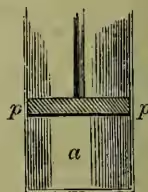
At 32° F., as we have already said, the vapour in the space would exert a pressure equal only to 0.085 lb. per square inch. If the temperature were raised to 80° more vapour would rise until its pressure became about 0.5 lb. per square inch; at 102° the pressure would be 1 lb.; at 162°, 5 lb.; at 193°, 10 lb.; and so on, until at 212° F. the pressure would be 14.7 lb., or exactly equal to that of the atmosphere. When this point has been reached it is evident that the piston will be in equilibrio, the pressure beneath it being exactly equal to that above. At each intermediate point the downward pressure on is equal to the pressure of the atmosphere minus the pressure of the steam below the piston. So far as the piston is concerned the conditions are therefore the same as if the vacuum had been impaired by the introduction of a certain quantity of air below ; but there is this difference between the two cases—if the space had been occupied by rarefied air, then, by forcing the piston down and compressing it into less space, its density would increase until its pressure became equal to or greater than that of the external air. With steam, however, if the piston were depressed, and if the temperature of the steam were preserved the same, instead of its pressure being increased, a portion of it would be liquefied, and the remainder would have the same pressure as before.
It is at 212° F. that water in an open vessel begins to boil—i.e. the vapour rises rapidly and in volumes, being able to displace the atmosphere (see BOILING). In this state it is usually called steam; but there is no essential difference between steam at 212° and steam at 60°. The steam rising from boiling water in an open vessel is of the same temperature as the water—viz. 212°; but, notwithstanding this, it contains a great deal more heat. This heat is employed in (to use popular language) forcing asunder the molecules of the steam, and thus causing it to occupy so much greater a bulk as steam than as water. It does not make itself known by the thermometer (for which reason it is called latent heat), but its existence and amount are known by other means (see HEAT). In speaking of the pressure of steam we have given it in pounds per square inch above a perfect vacuum, or as what is called an absolute pressure. This must be carefully distinguished from pressures (as often given) in pounds above atmospheric pressure. According to the method we adopt, which is the more scientific one, steam of 14.7 lb., or one atmosphere, exactly balances the pressure of the air, and can therefore do no work against it; while, if the other nomenclature had been adopted, steam of 14.7 lb. above atmospheric pressure would have been really steam of two atmospheres pressure.
When a cubic inch of water is converted into steam at the ordinary pressure of the atmosphere its volume is increased to 1645 cubic inches—i.e. a cubic inch of water becomes nearly a cubic foot of steam of one atmosphere. If the steam is produced at any greater pressure, its volume will be very nearly inversely as that pressure; at two atmospheres it would occupy about 855 cubic inches; at four atmospheres, about 457 cubic inches.
When water is boiled in an open vessel neither the temperature of the water nor that of the steam rising from it ever rises higher than 212°, however hot the fire; the heat as it enters is carried off in a latent state in the steam. But under pressure the temperature of both can be raised to any degree. If, when the water and steam in a (above) came to 212°, the application of heat were still continued, more steam would continue to rise, and, the pressure on the under side of the piston being now greater than that of the air above it, the piston would begin to ascend; but suppose it held in the same position by force, the upward pressure of the steam would be found rapidly to increase until it would soon require a weight of 14.7 lb. per square inch to keep it down, showing that the pressure of the steam was now equal to twice that of the atmosphere, or to 29.4 lb. per square inch. If at this point the temperature of the water and steam were examined, it would be found to be very nearly 250° F. When the absolute pressure of the steam reached 50 lb. its temperature would be 281°; at 100 lb., 328°; at 150 lb., 360°, and so on.
From the numerous experiments made on this subject some very important general conclusions may be drawn. Of these one—which will be evident from the figures just given—is that the pressure of steam increases at a far higher rate than the temperature (doubling the temperature increases the pressure nearly 23 times), which shows the extreme danger of continuing to apply heat to a vessel from which the steam is not allowed to escape. The bursting force would soon become such as no vessel could resist. Another important conclusion is that for every temperature there is a corresponding density of steam produced. This steam contains a definite amount of latent heat, and exerts a certain uniform pressure on every side of any vessel in which it may be contained. The following table shows the relation between these values for steam of several different temperatures:
| T. | p. | H. | V. | v. |
|---|---|---|---|---|
| 32° | 0.085 | 1091.8 | 3390.0 | 211.536 |
| 104° | 1.06 | 1113.7 | 312.8 | 19.519 |
| 158° | 4.51 | 1130.1 | 80.02 | 4.993 |
| 212° | 14.7 | 1146.6 | 26.36 | 1.645 |
| 248° | 28.83 | 1157.5 | 14.0 | .874 |
| 293° | 60.4 | 1171.2 | 6.992 | .436 |
| 356° | 145.8 | 1190.4 | 3.067 | .191 |
| 401° | 250.3 | 1204.1 | 1.838 | .115 |
T, Temperature in degrees Fahrenheit; p, absolute pressure in pounds per square inch of the steam at that temperature. H, Total heat of the vapour above 32° F. at that temperature (according to Regnault's experiments) in thermal units. A thermal unit (772 foot-pounds) is the quantity of heat which will raise 1 lb. of water 1° F. at or near its temperature of greatest density, 39.1° F. The specific heat of water increases slowly as the temperature rises, so that 1 thermal unit will not raise 1 lb. of water quite so much as 1° at high temperatures. V, Volume in cubic feet occupied by 1 lb. of steam; v, number of times which volume of steam exceeds that of same weight of water.
The relations between temperature and pressure in the foregoing table apply only so long as the steam is in contact with the water from which it is generated. Once away from the water its temperature may be raised without altering its pressure. Steam which has received additional heat in this way is called superheated steam. It approximates to the condition of a perfect gas, and therefore follows nearly what is known as Boyle's or Mariotte's Law, its volume varying always inversely as its pressure. By this law steam which occupied 1 cubic foot at 20 lb. absolute pressure would occupy 4 cubic feet at 5 lb., and half a cubic foot at 40 lb. absolute pressure. But steam, as commonly used in the steam-engine, is not superheated, but used under the conditions given in the table. It is then called saturated steam, and differs sensibly from the condition of a perfect gas. If the pressure (p) be given in pounds per square inch, and the pro- duct (pv) of pressure and volume in foot-pounds, then the formula, , gives results accurate enough at all ordinary pressures, and can be very easily applied. The volume, instead of increasing inversely as the pressure, increases less rapidly; the difference, though not very great, is so large that it has to be taken into account in all calculations as to the efficiency and behaviour of steam in a steam-engine.
It might naturally be expected that it would take much more heat or fuel to convert a pound of water into steam at a higher than at a lower temperature and pressure. In reality, however, the difference is very slight. Referring back to the table it will be seen that it requires 1146.6 units of heat to raise a pound of water from 32° to 212°, and evaporate it at that temperature; of these 180 are expended in raising the temperature, while 1146.6 – 180, or 966.6 units, become latent in the steam. It only requires 1171.2 units, however (261 sensible and 910.2 latent), to raise the water to 293°, and evaporate it at that temperature; for the latent heat falls nearly as fast as the sensible heat rises. The additional heat required is thus only a little over 2 per cent., while the pressure—which is, ceteris paribus, a measure of the work the steam will do—is more than quadrupled. In this way a large increase of power in any engine may be obtained by a small additional expenditure of fuel, and consequently steam of a high pressure is now being used for all purposes, its economy and advantages being fully recognised by engineers. It was thought for a long time that the total heat of steam—i.e. the sum of the sensible and latent heats—was constant at all temperatures; but this is not strictly the case, although the table shows that the difference for ordinary ranges of pressure is but trifling. See HEAT, and GAS.