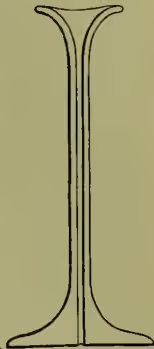
Stethoscope (Gr. stethos, 'the chest,' and skopeō, 'I look into'), an instrument invented by Laennec (q.v.) for examining the sounds of the chest. Its simplest form will be best understood by the figure, which represents the section reduced to half the natural diameter, or one-eighth of the actual size. The upper part is the chest end, the lower the ear-piece. The latter is often made in a separate piece, for the sake of greater portability. The main object of the stethoscope being to circumscribe and localise the sounds which it transmits, the chest end should be small, in order to determine the exact seat of the greatest intensity of sound. To ascertain this, the instrument should be moved right and left, up and down, till its end is on the exact spot from which the abnormal sound for which we are searching—or, it may be, the absence of sound—proceeds. It may be made of wood, metal, or celluloid; it is usually made hollow as represented in the figure, but this is not necessary, as the sound is well conducted by the stem itself. But besides these rigid instruments flexible ones are largely used, particularly the binaural stethoscopes, which have an ear-piece for each of the examiner's ears. In these the ear-pieces and chest-piece are united by hollow tubes of india-rubber, felt, &c., whose mobility permits of much more ready adaptation to different parts and different positions of the patient's chest. The various sounds heard through the stethoscope are very important in the recognition of many diseases of the heart and lungs.