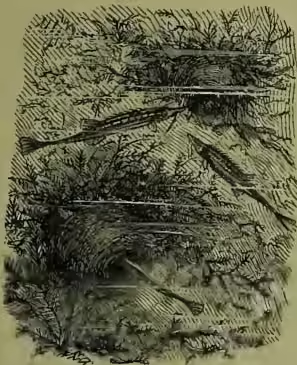
Stickleback (Gasterosteus), a genus of Acanthopterous fishes having the dorsal fin replaced by strong spines which vary in number in the different species. The sticklebacks are small, and the male is brightly coloured, the brightness increasing at sexual maturity. They are widely distributed throughout northern and temperate regions. One of the European species, the Fifteen-spined Stickleback (G. spinachia), is marine; the other two—the Tenspined Stickleback (G. pungitius) and the Three-spined Stickleback (G. aculeatus)—occur in fresh or brackish water, the latter being so abund- ant in some parts of England that it is used for manure.
Much interest attaches to the sticklebacks on account of the high degree of parental care exhibited by the male. At the spawning season he constructs a nest of grass and stems of plants firmly cemented together by mucous threads secreted from the kidneys. The nest is barrel-shaped, and has two apertures, thus admitting not only of easy ingress and egress, but also of the constant current of water necessary to the development of the ova. The work of building ended, the eager male, now resplendent in his wedding-robe, sets forth in search of a mate, whom he coaxes to his nest. After she has quitted it, he enters, fertilises the eggs, and immediately resumes his quest, bringing home another and another mate until the nest is filled with eggs. These eggs he guards with jealous vigilance, freeing them from parasites, and attacking every enemy that comes within reach, even though it be a fish many times larger than himself. With the hatching of the ova his labours become for a time more arduous than ever, for the tiny, active sticklebacks must all be kept safe within the shelter of the nest until they are big enough and strong enough to fend for themselves.