Stones, PRECIOUS. In this category are included numerous mineral substances, and one or two products of organic origin, used in jewellery and for other ornamental purposes on account of their rarity and beauty. The list of stones which may be regarded as precious cannot be definitely limited, as certain substances appear and disappear with the fluctuations of fashion. Some confusion also arises from the commercial application of the same name to several substances which may have a superficial similarity, although they really belong to distinct mineral species. Further, in point of beauty and rarity, the mineral substances used for ornament so merge into the common and abundant that there is no possible dividing line between precious and common stones. Among the substances used ornamentally, however, there are a few which from all times have occupied a foremost place and have been universally prized as precious stones. In such a rank and position may be placed the diamond, the ruby, the sapphire, the oriental amethyst, and the emerald. These, on account of their rare properties—their lustre, their play of light, their brilliance of colour, their great hardness and consequent durability, and especially because of their extreme rarity, have always been the most esteemed of jewel stones. In the second rank, as well-established precious stones of minor value, may be included the spinel or balas ruby, the Brazilian topaz (the oriental topaz is a yellow sapphire), the varieties of garnet, the turquoise, the tourmaline, the aquamarine or pale emerald, the chrysoberyl or cat's eye, the zircon or jargon, the opal, and the varieties of quartz, such as rock-crystal, agate, amethyst, carngorm or Scotch topaz, chalcedony, jasper, onyx, sardonyx, &c. Among other beautiful and valuable stones much appreciated for ornamental purposes, but scarcely to be classed as precious stones, there may be included lapis lazuli, crocidolite, labradorite, moonstone, aventurine, and malachite. To the list of precious stones there should be added two substances of animal origin—pearls and red coral—and perhaps also amber, a comparatively rare and valuable fossil resin. The various substances here enumerated are dealt with, for the most part, under their own proper names.
For the development of the sparkle, lustre, and glow of colour of most precious stones it is essential that they should undergo the process of cutting and polishing. When lustre and sparkle are the principal qualities to be revealed, as in the case of the diamond, the surface is most favourably cut into numerous plane facets as either brilliant or rose cut stones (see DIAMOND, figs. 1 and 3). When colour is the more important quality of the stone it may, if plane surfaces are wanted, be step or table cut (a in fig.). Such stones also, and translucent and opaque stones, may be cut en cabochon—i.e. with curved or rounded surfaces.
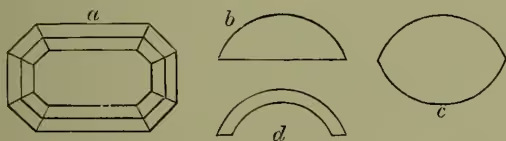
The varieties of cabochon cutting are single cabochon (b), or high plano-convex double cabochon (e), and double convex and hollow cabochon (d), the latter being much used for large garnets, which so cut are called caruncles.
One of the most important qualities of a precious stone is its hardness, as upon that property depends its power of resisting wear and of keeping the brilliance of its polished surface. It is a property of great constancy, moreover, and in many cases affords a ready means of determining the nature of a stone under examination. Of all known substances diamond is the hardest, and representing it, according to Mohs's scale, by 10, the following is the relative hardness of several of the more important of the precious stones: Diamond, 10.0; sapphire, 9.0; ruby, 8.8; chrysoberyl, 8.5; spinel, 8.0; topaz, 8.0; aquamarine, 8.0; emerald, 7.8; zircon, 7.8; tourmaline, 7.5; amethyst, 7.0; moonstone, 6.3; turquoise, 6.0; opal, 6.0.
Artificial Precious Stones.—Numerous attempts have been made by eminent investigators to produce artificial precious stones by means of intense heat and pressure and by electrical action; but hitherto these efforts have failed of practical success. In an important memoir published by Sainte Claire Deville and Caron in 1858 (Comptes Rendus, vol. xvi.) they describe various processes by which they obtained small crystals of corundum, ruby, sapphire, &c. By the action of the vapours of fluoride of aluminium and boracic acid on one another, they obtained crystals which, in hardness and in optical properties, resembled natural corundum. When a little fluoride of chromium was added a similar process yielded violet-red rubies; with rather more fluoride of chromium blue sapphires were yielded; and with still more green corundum was obtained. A mixture of equal equivalents of the fluorides of aluminium and glucinum, when similarly acted on by boracic acid, yielded minute crystals of chrysoberyl. The action of fluoride of silicon on zirconia yields small crystals of zircon, and by the action of silica on a mixture of the fluorides of aluminium and glucinum hexagonal plates of extreme hardness were obtained, which in some respects resembled emerald.
In subsequent researches Becquerel (Comptes Rendus, vol. lviii.), by the use of electric currents of high tension, succeeded in obtaining opals, &c. from solutions of silicates. Among the most successful of experimenters in this direction was the late Ch. Feil of Paris, who successfully crystallised alumina, and by the introduction of colouring matter produced sapphires and rubies identical in hardness and composition, but not in brilliance, with the natural stones. M. Feil also succeeded in preparing true crystals of spinel, and a blue lime spinel of great hardness, but which were glassy rather than crystalline in structure.
Imitations of precious stones consist of a soft, heavy flint-glass called Strass (q.v.) or paste, appropriately coloured, and they may readily be distinguished, among other peculiarities, by their great softness. Fraudulent combinations are made by cementing thin plates of precious materials over, and sometimes also under, a body of valueless glass, and thus the exposed surface or surfaces when tested are real stones, and the veneered mass passes as a genuine large and consequently valuable possession.
See works by H. Emanuel (1865), W. Jones (1879), A. Delmar (1880), Professor A. H. Church (1883), E. W. Streeter (5th ed. 1892), M. D. Rothschild (New York, 1889), and G. F. Kunz (New York, 1890).