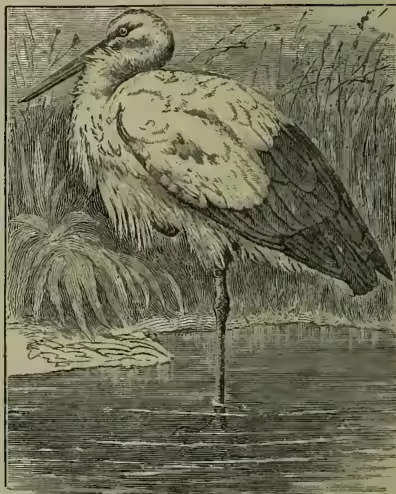
Stork, a group of birds characterised by having the bill larger than the head, very stout at base, not grooved, tapering to the straight recurved or decurved tip; nostrils pierced directly in the horny substance, without nasal scale or membrane, high up in the bill, close to its base; legs long, and with reticulate scaling; three toes, with sometimes a rudimentary fourth, the claws not acute. The storks are usually divided into the True Storks and the American 'Wood Ibises' (Tantalus). There are several genera of storks, including about a dozen species. They belong chiefly to the Old World. The most familiar representative of the family is the Common Stork or White Stork (Ciconia alba), a native of the greater part of the Old World, a migratory bird, its range extending even to the northern parts of Scandinavia. It is common in many parts of continental Europe (though not in France, Italy, or Russia), but is especially familiar in Holland and North Germany, the storks arriving annually in February and March, and in autumn returning to Africa in large flocks, flying mostly by night. It is about three feet and a half in length. The head, neck, and whole body are pure white; the wings partly black; the bill and legs red. The neck is long, and generally carried in an arched form; the feathers of the breast are long and pendulous, and the bird often has its bill half hidden among them. The flight is very powerful and high in the air; the gait slow and measured. In flight the head is thrown back and the legs extended. The stork sleeps standing on one leg, with the neck folded, and the head turned backward on the shoulder. It frequents marshy places, feeding on eels and other fishes, frogs, lizards, snakes, slugs, young birds, small mammals, and insects. It makes a rude nest of sticks, reeds, &c. on the tops of tall trees, or of ruins, spires, or houses. There are four or five eggs, white tinged with buff; and the old nest is re-occupied next year. In many parts of Europe, especially in Holland, it is a very common practice to place boxes for storks, and it is considered a fortunate thing for a household that the box on the roof is occupied: children are told it is the storks that bring the babies out of the well. Storks are protected by law in some countries, on account of their good services not only in destroying reptiles and other troublesome animals, but in the removal of offal from the streets of towns, in which they stalk about with perfect confidence, even in the midst of throngs of people. They have been celebrated from ancient times for the affection which they display towards their young, and have also had the reputation—not so well founded—of showing great regard to their aged parents. Before they take their departure from their summer haunts they congregate in large flocks, which make a great noise by the clattering of their mandibles, and are popularly regarded as holding consultation. The stork has no voice. It is a very rare bird in Britain, and was so even when the fens of England were undrained. Bower says that in 1416 storks came and built their nests on the roof of St Giles' Church in Edinburgh; there they remained a year and departed to return no more; 'and whither they flew,' adds the chronicler, 'no man knoweth.' The flesh of the stork is rank and not fit for food. The Umbrette (Seopus umbretta), an African and Madagascan bird, remarkable for the enormous domed nest which it builds, is nearly allied to the storks and seems to be a link connecting them with the herons. The Balæniceps (q.v.) or Shoe-bill is also a stork.