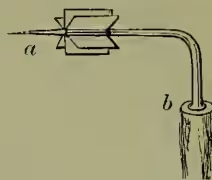
Straw, MANUFACTURES OF. Apart from the importance of the straw of various cereal plants as a feeding and bedding material in agriculture, such substances also possess no inconsiderable value for packing merchandise, for thatching, for making mattresses, and for door-mats. Straw is also a paper-making material of some importance, and split, flattened, and coloured it is employed for making a mosaic-like veneer on fancy boxes. But it is in the form of plaits that straw finds its most outstanding industrial application, these being used to an enormous extent for making hats and bonnets and for small baskets, &c. Wheat straw is the principal material used in the plait trade, the present great centres of which are Bedfordshire in England, Tuscany in Italy, and Canton in China. At first the plait was what is called whole straw; that is, the straw was cut into suitable lengths without knots, and merely pressed flat during the operation of plaiting; and so it continued until the reign of George I., when it was in great demand for ladies' hats, and some plait was made of split straw. Since that time split straw has been chiefly used. The instrument employed for splitting (fig. 1) consists of a number of little square steel blades radiating from a stem which terminates in the point a, and at the other end is bent and fixed into the handle b. The point a, being inserted into the hollow of the straw, is pressed forward, and cuts it into as many strips as there are blades in the cutting-tool. The English straw used in plaiting is obtained principally from the varieties of wheat known as the White Chittim and the Red Lammas, which succeed best on the light rich soils of Bedfordshire and the neighbouring counties. Only bright, clear, and perfect pipes can be employed, and to obtain the straw in good condition great care has to be exercised. The crop is not mowed, but pulled up, and the ears are cut off by the hand for thrashing. The straws are then cut into lengths, cleared of their outer sheath, and assorted into sizes in a kind of sieve apparatus like fig. 2. The apertures
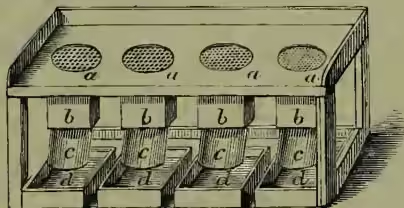
in each successive perforated top are increasingly wider, so that fine straws only pass through a by the shoot b, c, into the box d at the one end, and thicker pipes in each succeeding box. The plaits, made principally by women and children, vary greatly in pattern, quality, and cost. They are sold by the score of 20 yards, chiefly in Luton, where spacious plait halls have been provided for the accommodation of buyers and sellers. The finest and most costly plaits anywhere made—the Tuscan or Leghorn plaits—are made in Tuscan villages around Florence, and are not split. The straw there used—very fine in the pipe and bright in colour—is produced from a variety of wheat thickly sown and grown in a light thin soil. The crop is pulled and prepared as in the English trade, and the plaits are worked by all classes and ages of the rural populace. The finer qualities of
Tuscan plaits are worked with exceeding delicacy and elaboration, the task so straining the eyesight of the plaiters that they can give not more than two hours daily to the work.
Within recent years an enormous amount of straw-plait, of a common but useful quality, has been sent into the European market from China, the port of shipment being Canton. It can be sold in British markets at a price which excludes the possibility of competition by English plaiters, and the consequence is that the Bedfordshire trade in lower-class plaits is practically extinct. At the same time the supply of cheap Canton plaits has greatly benefited the hat and bonnet sewing industry of Luton and other Bedfordshire towns. In the year 1890 there were imported into the United Kingdom 8,558,542 lb. of straw-plaits, valued at £659,892, of which 7,306,100 lb., of a value of £476,210, came from Canton. Of this amount there was re-exported, principally to France, Germany, and the United States, 4,900,924 lb., valued at £328,177. Of hats and bonnets made from straw-plaits there were exported in the same year 653,104 dozen, valued at £371,262, the principal buyers being the Australian colonies.