Sturgeon (Acipenser), a genus of Ganoid fishes of the family Acipenseridae, order Chondrostei. The Chondrostei are Ganoids without ganoid scales, the skin being either naked or with bony plates, as in the sturgeon. The skull is cartilaginous, but covered externally with bony plates belonging to the skin. The tail is asymmetrical or heterocercal, and the gelatinous notochord persists in the centre of the vertebral column throughout life. Spiracles like those of sharks and skates are present in some genera. The distinguishing features of Acipenser are these: the body is long and narrow, and the skin is provided with five longitudinal rows of bony shields, each bearing a projecting keel. One row of these bony plates is along each side of the body, one along the back, and one on each side of the ventral surface. The skin between these rows of plates is naked, but contains minute scales which give it a rough surface. The head projects into a flat, pointed snout, provided with fleshy tentacles or barbels; and on the under surface of this snout, some distance behind its extremity, is the mouth, which is without teeth, and capable of protrusion. The gill-opening is wide. There are two pairs of fins, the pelvic being situated a long way back, close to the anus. There are two median fins, one dorsal and one ventral, both near the tail. The fin-rays are jointed and flexible. Spiracles are present behind the eyes. The air-bladder communicates with the gullet. There are many species of sturgeon, all confined to the northern hemisphere. They live in the sea and great lakes, and ascend the great rivers. All are of considerable size, and supply valuable commodities, for which they are regularly captured on a large scale. These commodities are their flesh, which is palatable and wholesome, their roe (Caviare, q.v.), and their air-bladders, from which isinglass is made. The eggs are small and numerous, like those of bony fishes; there is no copulation, the ova being laid and fertilised on the bottom of the upper parts of rivers, like those of the salmon. The food of sturgeons consists of worms, crustacea, and molluscs, which they seek by routing in the sea-bottom with their snouts.
The Common Sturgeon (A. sturio) is the only species which occurs in British seas and rivers.
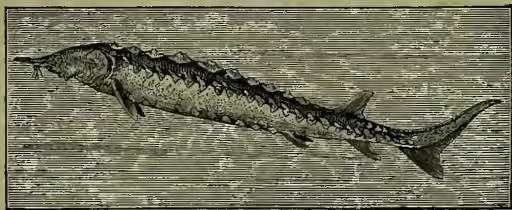
The specific characters distinguishing the species are minute, consisting in the number of the bony scales, position of the fins, length of the snout, &c. A. sturio is sometimes taken by trawlers at sea, more often in salmon stake-nets, and in estuaries, especially in the Severn. It enters the rivers in the early part of the year for the purpose of breeding. When adult it is from 6 to 10 feet long. It occurs in the Mediterranean, western and northern Europe, and on the Atlantic coast of America, but is absent from the Black Sea and Danube, and from the Caspian Sea. In England, as early as Edward II.'s reign, the sturgeon was a royal fish, belonging to the king when captured. The Sterlet (A. ruthenus) is a much smaller species, which is common in the Black and Caspian Seas, and ascends the Danube as far as Vienna. It is one of the principal objects of the sturgeon-fishery on the Volga. A. huso is the largest species, reaching 25 feet in length, and also belongs to the Black and Caspian Seas. A. stellatus is another species of these seas; it reaches 5 feet in length. Other species occur on the Atlantic and Arctic coasts of North America, in the great lakes of the St Lawrence system, in California, and on the west coasts of the North Pacific, in China, and eastern Siberia. A. brevirostris belongs to the southern Atlantic coasts of the United States. The species of the great lakes of the St Lawrence is A. rubicundus. The species of California and the Pacific coast is A. transmontanus.
The most important sturgeon-fishery in Europe is that of the Volga and the Caspian Sea. The flesh of the fish is salted, and caviare and isinglass made on a large scale from the roes and air-bladder. In America sturgeon flesh is eaten fresh, and caviare is made both in Georgia and in San Francisco; but there is no great fishery in any particular district, and the manufacture of Isinglass (q.v.) does not receive much attention.