Submarine Navigation. When the Diving-bell (q.v.) had shown that air for respiration can be supplied to persons in adequately arranged vessels under water, ingenious men began to speculate on the possibility of navigating closed ships or boats in similarly exceptional circumstances. The first submarine boat on record was constructed in the beginning of the 17th century by a Dutchman named Cornelius Drebell, or Drebelle. She was propelled by oars, and was tried in the Thames by order of James I. She carried twelve rowers, besides passengers. This vessel is alluded to in Robert Boyle's New Experiments, Physico-Mechanical, touching the Spring of the Air, &c. (Oxford, 1660). Pages 363–365 of this curious work contain an account of Drebell's experiment, and state that he accounted his chief secret to be 'the composition of a liquid that would speedily restore to the troubled air such a proportion of vital parts as would make it again for a good while fit for respiration.' The composition of this liquid for enabling the same air to be used again and again was never made public. Bishop Wilkins, who also favoured some other whimsical projects, devoted a whole chapter of his Mathematical Magick (1648) to a dissertation 'Concerning the possibility of framing an Ark for Submarine Navigation.' He here recites the difficulties of the scheme, but evidently considers them not insurmountable; and afterwards he enlarges upon its advantages, in privacy, security from pirates, storms, ice, &c., in naval warfare, philosophical experiments, discoveries, &c. In 1774 an inventor named Day lost his life in an experimental descent in Plymouth Sound in a vessel of about 50 tons burden. One of the most successful machines contrived for submarine navigation was that of Bushnell of Connecticut, which was projected in 1771, and completed in 1775. Bushnell's chief object appears to have been the introduction of submarine warfare. His vessel was propelled by screws, somewhat resembling those now in use for steam-vessels, and there was sufficient air to last for half an hour. In 1800 Robert Fulton, also an American, while residing in France constructed a submarine boat, of which he made many trials, some of them at the expense of the French government, on the Seine, at Brest, and at Rouen. Compressed air was used for respiration, and he remained at a depth of 25 feet for four hours, propelling the boat in any direction; he also successfully attached a torpedo containing gunpowder to the bottom of an old vessel lying in Brest harbour, and blew her up. The vessel patented in 1859 by Mr Delaney of Chicago was egg-shaped in transverse section, and diminished nearly to a point at each end. It had two iron tanks in the interior; one had air pressed into it by an air-pump; the second contained water. The engineer of the boat, by pumping water into or out of the second tank through the action of the air in the first, could raise or lower the boat to different depths in the water. In 1863 the Confederates in Charleston made use of a submarine boat against the blockading Federal squadron. This boat, called a 'David' after her inventor, was built of boiler-plates and propelled by hand by eight men at a maximum speed of four knots; two side-rudders were used for sinking and raising the boat when in motion; she was cigar-shaped, and when advancing to attack her top was just on a level with the surface of the water; three trial trips were made, and each time she sank and failed to rise, the crews perishing before they could be rescued; the fourth trial, however, was successful, and passing out of the harbour she succeeded in blowing up the Housatonic, but could not get clear, and was carried down by the Housatonic. Several of these 'Davids' were afterwards constructed by the Confederates, but none of them again succeeded in inflicting any serious damage upon the Federal ships.
For some years afterwards, although several experiments were carried out in France and
America, no successful results were arrived at, but in 1886 a submarine boat was built at Stockholm by Nordenfelt. She was driven by steam, and ran 16 miles at a speed of 5 knots, but was only immersed for five minutes at a time; she descended, however, some 30 feet, and this was repeated several times. A similar boat was constructed for and bought by the Greek government. Two others somewhat larger were built by Nordenfelt for the Turkish government, and were tried at Constantinople in 1887; they were 100 feet long, 12 feet in diameter, with a displacement of 160 tons, and when not immersed had a speed of 12 knots, travelling a distance of 100 miles without recoaling; they had a crew of six men, and descended successfully to a depth of about 50 feet. A still later Nordenfelt boat was tried at Southampton, also in 1887; she was 125 feet long, with a diameter of 12 feet, a displacement of 230 tons, and indicated 1000 horse-power with a speed of 15 knots when not immersed; with her cupola awash, however, this speed was reduced to 5 knots. Although these boats at the time seemed to answer all expectations, further experiments would seem to have shown that they could not be depended upon for real practical work, and the original boat, after lying some time at Copenhagen without finding a purchaser, was finally bought and broken up as old iron in 1891.
By the choice of steam as his motive power the inventor created difficulties not easily to be overcome, and prevented the satisfactory development of that type of boat. One result of this choice was that the boat, when proceeding without communication with the atmosphere, was entirely dependent upon the energy developed by the boiler. That this method of accumulation is disadvantageous is clear from thermo-dynamic principles, which show that from a kilogram of water of 200° centigrade, when it is cooled to 121° C. by the withdrawal of steam, only 2000 m.kg. of work can be obtained. Then not only is the great weight of the engines and boiler a disadvantage, but the continual radiating heat from the boiler renders a prolonged stay in one of these boats impossible when under the surface. An attempt has since been made in England with the Honigman natron-boiler, but with no better results; and later inventors have adopted electric accumulators with electric motor and engines as the motive power. Experiment shows that as much as 8000 m.kg. of work can be developed per kilogram of accumulator weight. In 1888 a boat called the Nautilus, designed by a Mr Campbell, was tried in the West India Docks. She was 60 feet long, with a beam of 8 feet, was driven by electricity, and fitted with two impulse tubes for Whitehead torpedoes. The trial was fairly successful.
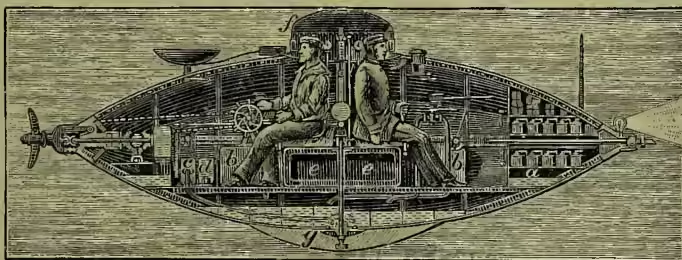
The nearest approach to a workable submarine boat was made in two boats built in France, named the Goubet and Gymnote, and in one, the Peral, built at Cadiz. After exhaustive trials, a fair measure of success was obtained; and in 1897 the French navy had four such boats. The Peral, so called after her designer, a lieutenant in the Spanish navy, was first tried at Cadiz in May 1889. According to the official reports, with 250 accumulators on board she attained a speed of 7 knots, and it is believed that with 616 accumulators a speed of 11 knots would be reached. She covered during two trials some 120 miles without exhausting all the electricity in the accumulators, answered her helm well, and no difficulty appears to have been experienced in sinking or again rising to the surface, although it appears to have been found necessary to rise to the surface before venturing to alter course. A torpedo, of which she is fitted to carry three, was also successfully discharged at a target 400 metres off, while during the six hours she remained closed up, the air on board remained perfectly sweet. In the case of the Gymnote and the Goubet, with which since 1889 a series of trials have been carried out at Toulon and Cherbourg, the results have been much the same. No difficulty was experienced in sinking and rising to the surface, yet they ran on a perfectly straight course; and when it was wished to turn, the boats were brought to the surface, and placed on their new course before again sinking. When they were moving at a depth of some 15 feet below the surface no trace of their course could be perceived on the top of the water, although in the case of the Gymnote at Toulon she was clearly visible and all her movements followed from a captive balloon some 150 feet in the air. The Goubet has a displacement of about 2 tons, is 16 feet 5 inches long, 5 feet 10 inches deep, and with a beam of 3.5 feet; outside the boat at the stem she carries a torpedo charged with 110 lb. of dynamite; she carries a detachable keel weighing 900 kilograms, the dropping of which, in the event of the pumping-out arrangements at any time breaking down, would enable the vessel to immediately rise. Her crew consists of only two men. She is fitted with reservoirs for compressed air, electric accumulators, and motor. The Gymnote is a boat about as large again. In spite of the relative success which has attended the trials of these three boats, the experiments seem to have revealed certain practical difficulties which render it problematical if submarine navigation can ever be carried on with any degree of safety or certainty. It has been shown that at a depth of only some 50 feet it is impossible to distinguish objects more than 25 feet off, and that even the electric light fails to illuminate objects at a greater distance in the gloom which obtains at this depth; the colour of the water at this depth is a deep green, and red objects are completely invisible. Navigation under these circumstances must always be dangerous. The difficulty of changing their course without coming to the surface to reconnoitre, and the slow speed at present attainable, not exceeding 7 to 8 knots, also militates against the possible usefulness of these boats. In 1898-99 very successful experiments were made with the Gustave Zédé, named after the maker. She sailed, partly above and partly below the surface, from Toulon to Hyères and Marseilles, and discharged her torpedoes successfully, making no noise to betray her position. In 1900-01 experiments were made with a new French boat, the Morse, at Cherbourg. She was able to sink in seventy seconds, and was steered by the assistance of a 'periscope' which, floating on the surface of the water, showed the steersman all that was going on. It was also stated that her crew could remain under water for sixteen hours without strain. The British authorities had not recently made experiments; but in the United States Mr Holland was in 1901 experimenting with a boat in which he expected to be able to cross the Atlantic beneath its waves. On the whole the future of these boats is problematical, and cannot as yet be said to be beyond the experimental stage. See also TORPEDOES, and for submarine air supply, DIVING.