Sugar. The sugars form a natural group of substances, for the most part of vegetable origin, connected with glycerol and the glycols on the one side and with the dextrins and with bodies of the starchy class on the other. They are, as a rule, crystallisable, soluble in water, less soluble or insoluble in alcohol, and insoluble in ether and in other solvents which are immiscible with water; they have a sweet taste, a physical characteristic varying in the several members of the group from the luscious sweetness of cane-sugar to the feeble sweetness of some of the saccharoids. This quality, however, is not confined to the sugars, being also possessed by the glycols, by glycerol, by glycine, by certain compounds of the aromatic group, and even by some inorganic salts, such as those of lead and yttrium. Most sugars possess the property of causing rota-
Copyright 1892 in U.S.
by J. B. Lippincott
Company. tion of a ray of polarised light, and this optical activity serves as a means of estimation of very great value to the analyst. The sugars are divided according to the views entertained as to their constitution into three classes: the saccharoids, the glucoses, and the saccharoses. The saccharoids are regarded as saturated hexatomic alcohols, and have the general formula , or differ from this in having in certain instances the elements of water superadded. Mannite, dulcite, isodulcite, hesperidin sugar, persite, sorbite are the chief saccharoids, but quercite, pinite, raffinose, and erythro-mannite, which possess formulae departing from the type , are usually included under the same heading. The saccharoids are all crystalline, and not capable of being fermented either with yeast or with the lactic and butyric bacteria, or in one or two instances undergo a very feeble action of this kind. The glucoses are more important; they are the aldehydes of hexatomic alcohols, and have the general formula . Dextrose, lœvulose, and mannitose closely resemble one another, reduce Fehling's solution, readily ferment (except the last) with yeast, rotate the plane of polarisation, and when oxidised yield saccharic acid. Galactose, which is probably a mixture of two dextro-rotatory sugars, closely resembles lœvulose, but has a feeble action on Fehling's solution, and yields mucic acid under the influence of oxidants. Inosite, sorbinose, and enalcyptose do not ferment with yeast, but are acted upon by the lactic and butyric bacteria (milk and cheese).
Dextrose (synonyms glucose, grape-sugar, starch-sugar) is the most important sugar of the glucose class. It occurs in the anhydrous condition as transparent prismatic crystals, and in warty masses having the composition , which lose all their water below 100° C. It melts at 146° C., is less soluble in water and in alcohol than sucrose, and dissolves in boiling water in all proportions. Dextrose has a dextro-rotatory action upon polarised light, and reduces Fehling's solution. It is not affected by moderate boiling with dilute acids, nor does it readily char under the influence of strong sulphuric acid, but forms with this body an acid ethereal salt decomposed by water. It also forms analogous compounds with many other acids. It is rapidly decomposed on boiling with caustic alkalis or caustic lime. Dextrose is found ready formed in the grape to the extent of 15 per cent., and in many other fruits. It may be prepared by decomposing the glucosides and by the hydrolysis of starch, dextrin, cane-sugar, &c., by means of dilute acids, diastase, or invertase, also by the action of sulphuric acid upon cellulose. In honey and in many fruits it occurs in association with lœvulose, a glucose which bears a great resemblance to it, but is distinguished by having a greater sweetness and a lœvo-rotatory power. Lœvulose is said to be even sweeter than cane-sugar.
The saccharoses, with the general formula , are the most important sugars, inasmuch as ordinary sugar, malt-sugar, and sugar of milk are members of this class. They may be regarded as condensation products of the glucoses, and derived from two molecules by elimination of the elements of water, thus: . The saccharoses are, with the exceptions of malt-sugar (maltose) and milk-sugar (lactose), incapable of reducing Fehling's solution. They are fermented by yeast, but only after previous conversion into glucoses by the agency of an enzyme (or enzymes), invertase, secreted by that organism. The saccharoses are charred by strong sulphuric acid. Besides the three already mentioned, this group contains melitose, melezitose, mycose, and synanthrose.
Sucrose (syn. cane-sugar, saccharose, saccharon, cannose, &c.) is a solid crystallising in the form of monoclinic prisms—generally with hemihedral faces—which are transparent, colourless, and have a sweet taste, a specific gravity of about 1.6, a melting-point of about , and strongly rotate the plane of polarisation to the right (see below). Sucrose is soluble in about half its weight of cold water and in boiling water in all proportions; it is nearly insoluble in absolute alcohol and soluble in dilute alcohol, the solubility increasing with the dilution in an ascending ratio. Ether, chloroform, carbon disulphide, oil of turpentine, petroleum spirit, and liquids immiscible with water generally, have no solvent action upon this sugar. Sucrose melts at about (), and assumes on cooling the condition known as 'barley-sugar,' which is probably an allotropic form; at a little above the fusing-point it passes into a mixture of dextrose and levulosan without loss of water. When still further heated water is given off, and the mass begins to blacken with evolution of fumes having a characteristic odour; and at about caramel, a mixture of caramelan, , caramelen, , and caramelin, , is obtained. Caramel is largely used for the colouring of wines, beer, vinegar, &c. Alkaline hydroxides in the cold have little or no action on sucrose, but when fused with caustic potash this sugar yields oxalate and acetate of potassium.
Solutions of sucrose possess the property of dissolving the oxides of the alkaline earths, with which the sugar forms compounds of definite composition. The Liquor Caleis Saccharatus of pharmacy is a solution of lime in syrup, and with baryta sucrose forms the compound , which falls as a precipitate when syrup is mixed with a concentrated solution of barium hydroxide. With strontia sucrose forms the compound as a precipitate, and this reaction is employed commercially for the separation of crystallisable sugar from molasses. The precipitate is granular, easily separates, and after being washed with hot water is decomposed with carbonic acid.
Sucrose in the solid condition, or in the form of a strong syrup, is decomposed in the cold by concentrated sulphuric acid, with formation of a spongy carbonaceous mass, and evolution of sulphur dioxide and other volatile products. Nitric acid acts upon sucrose, forming nitro-sucrose, saccharic acid, oxalic acid, or carbonic acid, according to the concentration of the nitric acid; the fuming acid in the cold produces nitro-sucrose. Sucrose, like all the members of the saccharose group, is hydrolysed when heated in solution with dilute acids; in the case of sucrose a mixture of dextrose and levulose results, the change consisting in the assimilation of the elements of water and bisection of the sucrose molecule. This action is termed 'inversion,' because the solution after the action of the acid rotates the plane of polarisation to the left, but the term is now applied generally to the hydrolysis of saccharoses by acid. Inversion takes place slowly even in the cold with hydrochloric or sulphuric acid, and with dilute solutions of sucrose, but at the change is very rapid; acetic, tartaric, citric, and the other weak acids have much less power in this respect. The process of inversion is of value in analysis of mixtures of various sugars.
Sucrose is a strong reducing agent, which is another way of saying that it is readily oxidised. It quickly decolorises solutions of potassium permanganate even in the cold, and on boiling with this reagent yields oxalic and carbonic acids. When heated with solutions of silver or mercury it causes separation of the metals, and it precipitates gold from the chloride. When boiled with cupric salts in presence of alkaline hydroxides there is no separation of cuprous oxide, but after continued ebullition a partial reaction occurs. After undergoing inversion by dilute acids or invertase it quickly and completely reduces alkaline solutions of copper (see below).
The behaviour of sugar under the influence of living ferments is of great interest theoretically, and of importance from a practical point of view. Some of the mould fungi (Hyphomyces), nearly all the yeasts (Saccharomyces), and many torula forms ferment solutions of sugar with formation of alcohol and carbonic acid in presence of some forms of albumenoid matter, and of certain inorganic substances. The mould fungi, particularly those of the genus Mucor, function as alcoholic ferments, that property being especially but not exclusively possessed by the budding spores of these organisms, which in many instances closely resemble the yeasts in appearance. The commonly occurring mould Penicillium glaucum possesses the power of secreting an invertive ferment which is able to convert sucrose into other sugars. Monilia candida directly ferments solutions of this sugar without previous inversion, a property not possessed by the strong yeasts; Mucor racemosus secretes invertase and ferments sucrose after inversion; several other Mucors, as M. erectus, M. spinosus, M. mucedo, M. circinelloides, &c., have no inverting action, but can produce fermentation after the sugar has been inverted by extraneous means. But the chief interest attaches to the action of yeasts, which are par excellence the true alcoholic ferments. The strong yeasts, Saccharomyces cerevisiae (both top and bottom forms), the two forms of S. ellipsoideus (bottom forms), and the three forms of S. pastorianus, all secrete invertase and vigorously ferment sucrose. Of the feeble yeasts S. marxiatus and S. exiguus (Hansen), which have little action on maltose, invert sucrose and ferment it with energy. Of the other species of Saccharomyces in some instances little is known regarding their fermentative action; but S. membranefaciens is believed to be the only Saccharomyces which neither inverts nor incites fermentation of one kind or another. S. apiculatus (so called, although not a true Saccharomyces because it forms no gonidia) secretes no invertase, and therefore cannot act upon sucrose. The action even of the stronger yeasts upon this saccharose is very feeble in the absence of albumenoids of the peptone class and of the necessary salts, but in the presence of these latter ammonium compounds, asparagin, and some other nitrogenous bodies can to a great extent supply the place of the albumenoids. Under favourable conditions—viz. the presence of these necessary yeast foods and of sucrose to an extent not too great—the introduction of a small quantity of healthy yeast is quickly followed by the multiplication of the organism, accompanied by inversion of the sugar and the production of alcohol and carbonic acid. The process of inversion takes place at an early stage of the fermentation, and is a chemical reaction capable of being effected by the enzyme (invertase), separately presented in the absence of the organism; the production of alcohol is a function of the living cell, and becomes slower and more difficult as the percentage of spirit increases, the alcohol constantly tending to inhibit the fermentative act, until at length, when about 14 per cent. of alcohol has been produced, it ceases altogether. Pasteur, who was the first to show the true character of yeast, formerly considered the fermentation of sugar to be an anaërobic phenomenon, taking place only in the absence of oxygen, in order to obtain which the yeast tears up the sugar molecule; this view, however, is not now held, it being believed that the Saccharomyces are to a great extent indifferent in this respect, playing their part equally well in presence of much oxygen or of a minute (necessary) quantity. Besides alcohol and carbonic acid other substances are produced from sucrose by yeast, notably glycerol and lactic acid, and certain odorons principles to a small extent. Pure cultures of yeast are said not to elaborate the higher alcohols (fusel-oil), but this view requires to be supported by further investigation.
Sucrose occurs very widely in the vegetable kingdom. It is found in the sugar-cane (Saccharum officinarum), of which a number of varieties are known and cultivated; in many other grasses (Graminæ); in the sap of many forest trees; in the roots of certain plants; in numerous seeds; in most sweet fruits, usually in association with invert sugar; and in the nectar of flowers. The sugar-cane was the source from which sugar was originally prepared, and the East first learned the use of this article of diet. The cane has doubtless been known in India from time immemorial, and century of our era, sugar was grown in Persia, and the Persian physicians of the 10th and 11th centuries first introduced it into medicine. The Arabs cultivated the cane in many of their Mediterranean settlements, and as early as 961 A.D. the plant flourished in the Iberian peninsula. Soon afterwards sugar of Egyptian origin formed a staple of trade between the merchants of Venice and of London, wool, which then constituted the great wealth of England, being largely exported in exchange for it. The manufacture of sugar from the cane, thus interesting historically, still furnishes a considerable part of the entire supply; and the best sugar is derived from this source, although the beet-root now actually yields a greater quantity.
The sugar-cane has been introduced into almost all tropical and subtropical countries; the East and West Indies, the southern United States, Central America, Brazil, Peru, Chili, Mauritius, the Malayan Archipelago, Egypt, northern Australia, South Africa, and many islands of the Pacific may be mentioned as illustrating the wideness of its range, although the list is by no means exhaustive. The cane seems to have been introduced by Jesuits into the southern United States from the West Indies about 1750; but sugar culture was neither an important nor prosperous industry when Louisiana was ceded to the United States in 1803. This state soon became and still is a great sugar-producing state; the cane is grown in all the Gulf states on both sides of the Mississippi (though in all these states it sometimes suffers from frost). In Europe it is or has been grown a little in Sicily and in Andalusia.
The cane, which may be described as a gigantic grass, thrives best in a warm, moist climate, with prevalent sea-breezes and moderate intervals of hot, dry weather. Many descriptions of cane exist, and these are regarded as varieties of one species, although some botanists have raised a few to the rank of distinct species. The common sugar-cane of the United States is the Creole or Madeira; others cultivated being the Otaheite, Batavian, Chinese, and Salangore. The stem, which varies from 6 to 14 feet in height, is from 1 to 1½ inch thick, and jointed at intervals of from 3 to 6 inches; its pith, of open cellular structure, contains the sugary juice. The tops and lower joints are not crushed; the outer skin contains much silica. The 'arrow' or flowering stem is without joints, and bears a panicle of soft, silky flowers. The cane suffers much from the ravages of rats (to check whose ravages the mongoose or ichneumon has in some places been successfully used), from white ants, and several boring insects. The plant is propagated from the eyes or buds which grow on the stems, as no cultivated cane seems to ripen its seed; and the 'stoles,' or portions remaining in the ground, throw up fresh canes, called ratoons, for several seasons—sometimes twenty years—after which replanting is necessary. The young cuttings are planted in rows 3 feet apart, and at intervals of 2 feet from plant to plant. The cane requires a fertile, marly soil, not too heavily charged with common salt or other saline ingredients. The most suitable manure is farm-yard dung or night-soil; superphosphates and the various artificial fertilisers are considered to be less advantageous, but the presence of lime is of primary importance.
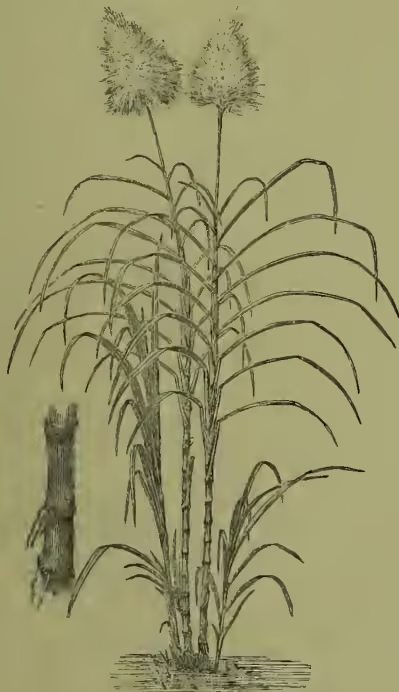
The sugar exists in a state of solution in certain cells in the stem of the plant, and in order to obtain it several methods are adopted. The juice is sometimes expressed by means of powerful roller-mills which rupture the cells, or the crushing is preceded by maceration in water. Sometimes the diffusion method is adopted, which consists in sugar is still produced from this source in that country, but the quality of that now exported does not bear comparison with the product of other lands. The early classical writers, especially Herodotus, Theophrastus, Seneca, and Strabo, make undoubted references to sugar, which they speak of as 'honey of canes,' or 'honey made by human hands;' and at about the date of the Christian era this substance had become pretty generally known under the name of saccharon or saccharum. Our word sugar is derived, through Fr. sucre, Span. azucar, Arabic sakkar, Persian shakar, from the Sanskrit sharkara, which signifies a substance consisting of small grains. The term candy, applied to sugar in large crystals, took its origin from the Arabic and Persian kand or kandat. It is believed that Bengal was the locality in which cane-sugar in a dry granular state was first prepared. The Chinese admit that they first gained their knowledge of the art of making sugar from India, somewhere about 766 to 780 B.C. We have evidence that at a later period, the 9th cutting the canes into short pieces and soaking these in an equal weight of water; several vessels are employed, the liquor from the first being passed into the second, where it becomes more concentrated, and so on throughout the series. Cane-juice, pure and simple, of course contains the highest percentage of sugar, its average composition being as follows: water, 81; sugar, 18; uncrystallisable sugar, 0.4; other organic matter, 0.6; mineral matter, 0.4. To obtain such juice the canes are passed lengthwise through the rollers, usually three in number, which have a combined slow rolling and sliding motion, and great care is taken to prevent doubling up of the canes and consequent stoppage of the mill. So long as the juice is enclosed within the cells of the plant it never enters into fermentation, but when liberated it rapidly undergoes such change, and it is therefore necessary for it to be submitted to the processes of clarification and evaporation without loss of time. Clarification, or defecation, is carried out with lime and chemicals, and may be described in general terms as follows. The juice is raised to a temperature of 80° C. (176° F.), and milk of lime is added in quantity sufficient to neutralise the acid, the liquor then being allowed to stand for the separation of the coagulated impurities, some of which subside while others rise to the surface. Sulphurous acid or its salts are also sometimes used, as well as finings, such as clay, which help to carry down the suspended matter. The clarified juice is next run through bag, charcoal, or capillary filters, and then concentrated. This is effected either in open coppers, by means of film evaporators, or in vacuum-pans. The first method leads to loss of sugar and discoloration of the product, and is becoming obsolete. The second operation may be briefly described as passing the juice in a thin layer over the surface of a cylinder (or 'wetzel') heated internally by steam. The vacuum-pan, for a fuller description of which the student must consult larger works (e.g. Spon's Encyclopædia of Industrial Arts), is essentially a spherical copper vessel heated at the bottom by steam-coils, and communicating at the upper extremity by means of a still-head with a powerful air-pump which draws off the vapour as fast as it forms, and thereby maintains the boiling-point of the syrup at about 66° C. (150° F.).
The art of pan-boiling consists in concentrating the syrup until minute grains are formed, and then 'feeding' these by repeated admissions of fresh liquor. The masse-cuite, as the thick mass of crystals is termed, is usually submitted to the action of centrifugal machines which separate it into two portions, dry crystals and syrup or molasses.
Sucrose is at the present time prepared more extensively from the beet-root than from the cane, and the article so produced is commonly, but erroneously, called cane-sugar. The beet-sugar industry was first stimulated by Napoleon I., especially during the period when France was deprived of sugar by the English blockade, and has assumed immense proportions owing in great measure to the scientific skill that has been expended upon it. The Beet (q.v., Beta vulgaris) is indigenous to Europe, and many varieties of this plant, as of the sugar-cane, are known. The juice of the root contains from 12 to 18 per cent. of crystallisable sugar associated with various salts, such as the phosphates, oxalates, malates, and chlorides of potassium, sodium, and calcium, besides albuminous, pectinous, and other substances. The plant thrives best in a deep, friable 'turnip loam,' neither too stiff nor too light, and manuring with phosphatic manures gives the best results; peaty and moorland soils and farmyard manure are less suitable. The seed is usually sown in April, and the crop gathered in autumn before the incidence of early frosts.
The methods for the extraction of the sugar are in the main analogous with those appertaining to the manufacture of sugar from cane-juice. The roots having been harvested are stored until required for use in pits dug in the ground, and covered with straw and earth for protection from frost. They are afterwards taken out and introduced into vessels called 'washers,' where they are separated from stones and adhering dirt by a rapid current of water. The roots thus cleansed are then treated for the extraction of the sugar either by (1) rasping and pressing, (2) maceration, or (3) diffusion. The first of these methods consists in reducing the roots to a fine pulp by machinery, and subsequently squeezing out the juice by powerful presses, the combination representing the cane-mill of tropical regions. The maceration process is applied to the pulp, which is subjected to the action of water in suitable vessels, the exhausted pulp being afterwards strained from the liquid which now contains the sugar in solution. The diffusion method does not require the rupture of the cells, but utilises the power which sugar and the saline matters, as crystalloids, possess of passing through the unbroken cell-membrane, leaving behind the colloid, albuminous, and pectinous substances. The juice or solution obtained in one or other of these ways is defecated by 'double carbonation,' according to which lime is first introduced in the cold, and afterwards removed by the action of carbonic acid, followed by heating to 90° C. (194° F.), the treatment being subsequently repeated upon the decanted juice this time at a boiling temperature throughout. The liquor is next filtered through animal charcoal for the removal of colouring matter, and of the slight excess of lime still remaining, boiled down to a density of 25° B., again passed over charcoal, and then evaporated to a mass of crystals in a vacuum-pan as in the case of cane-juice.
Sucrose is also made in America from the sugar-mapple (Acer saccharinum) and the melon (Cucumis melo); in America and elsewhere from different varieties of sorghum (see DURRA) and from maize (Zea mays); and in various tropical countries from the date-palm and other species of Palmyra. Palm-sugar is derived from the juice which flows from incisions made in the trunk of the tree. This is very pure, containing less non-saccharine matter than cane-juice, and far less than beet-juice, and the sugar is obtained by simple evaporation in open pans. Sorghum-sugar is extracted and fabricated by processes that are almost identical with those employed in making sugar from the cane, but the machinery is usually constructed on a much smaller scale. Maple-sugar is manufactured by simple evaporation in iron or copper pans of the sweet sap draining from auger holes made in the trunk during the months of spring. In 1891 the total production of sugar of all kinds in the United States was estimated at 539,710,000 lb.—500,000,000 lb. from cane, 29,210,000 from beet, 2,500,000 from sorghum, and 8,000,000 from maple sap. The cultivation of sugar beet is making progress under the auspices of the Department of Agriculture.
In former years, before the beet industry assumed its present enormous proportions, and when the cane was the chief source of supply, sugar was to a great extent consumed in the condition in which it arrived from the producing country. This, which was possible and even pleasant with the sweet and fragrant cane muscavadoes, became impossible when raw beet-sugar with its unpleasant vegetable flavours was introduced, and the practice of refining all sugars became established. Sugar-refining is carried out in high buildings, so that the materials may gravitate from higher to lower levels in order to avoid the cost of pumping. The first operation, that of discharging the hogsheads of muscovado, bags of beet, mats of jaggery (as most of the sugar from the East is called), or other packages, takes place on the highest floor of the refinery. Here the sugars are mixed, and thence delivered on to the next lower or 'blow-up' floor by means of shoots. The 'blow-ups' are large vessels in which the sugar is dissolved in hot water to a syrup of — B. when hot, equal to — B. when cold. The syrup next flows through filter-bags, of which a large number are required, owing to the slimy nature of the suspended matter, and is then caused to gravitate down large iron cylinders packed with granulated animal charcoal. This is produced by heating bones to redness in closed vessels without access of air, and possesses the power of removing colouring (and other) matters not only from sugar solutions, but from most organic liquids. After a time the charcoal becomes spent and ceases to act, but regains its properties upon reburning, an operation which is carried out in a refinery as many as a hundred times. The first syrup running from the char-cisterns is quite colourless, and this portion is collected apart and boiled for the production of loaves or crystals. The last portions of syrup yield the 'pieces' or yellow moist sugar. The boiling is effected in vacuum-pans, and a small quantity of sulphurous acid is added to the pan and greatly improves the colour of the 'pieces.' In boiling this class of goods the object is to form a 'false grain'—i.e. an aggregation of small grains having the appearance of larger particles; in this way a soft-looking sugar of primrose complexion and carrying a large quantity of syrup, which pleases the eye much more than a gray-looking 'piece' sugar of bolder grain, is obtained. The thick mass from the pan is discharged through an opening in the bottom into centrifugal machines, which, with the aid of a little wash water, separate the crystals from the syrup. This operation of 'machining,' it should be mentioned, is frequently applied to hard grainy beet-sugars in the initial stage of refining, and the resulting ill-smelling impure syrup treated apart from the grayish white and comparatively pure crystals left upon the machine.
Lump sugar is made by draining a very stiff masse-cuite of small grain in moulds, and afterwards drying the concreted loaves; for the production of cube sugar moulds of peculiar shape are used, which when filled are placed in centrifugal machines to facilitate the removal of the syrup.
Analysis.—Three estimations are chiefly necessary for the analysis of raw sugar, the determination of polarising value, of glucose, and of ash or mineral matter. The polarimeter is an instrument by which the rotatory power of sucrose (or other sugars) upon a ray of polarised light is made available for purposes of quantitative measurement. Those instruments are the best that require the use of the yellow light of the sodium ray. The two Nichol prisms of the polarimeter being crossed and the vernier at zero, a filtered solution of sugar containing a known weight of the sample in unit volume is introduced into a tube 20 centimetres long and placed between the prisms. The result is a transmission of light requiring for its suppression the rotation of the analysing prism, the one nearest to the eye. From the angular degrees of this rotation the polarising value of the sample is deduced.
In actual instruments an ingenious device is made use of for the sake of gaining delicacy. This consists in covering one-half of the optical field with a half-wave plate of quartz, or, in the modern instrument made by Field & Co. of Birmingham, by a less expensive but equally efficacious half-wave plate of mica; the field in these instruments is always more or less bright, but the slightest movement of the prism in either direction from the neutral point causes an unequal shadowing of the two semi-discs, and very sharp observations can be made. The presence of glucose in sugar, and the amount, are ascertained by titration with standard Fehling's solution made by dissolving in every litre 34.64 grams of crys. sulphate of copper, 70 grams of caustic soda, and 180 grams of Rochelle salt. This liquid is not affected by sucrose, but when a solution of a sample containing glucose (also maltose, lactose, &c.) is delivered into a known volume of the copper solution diluted with water, and kept at the temperature of boiling, the copper is precipitated as red suboxide, and the supernatant liquid becomes colourless. The volume of the solution of sugar required to effect this result is a measure of the glucose present. The ash of sugar is ascertained by burning 1 gram of the sample in a platinum capsule at a red heat; but, owing to the difficulty of obtaining a white ash from the fusible salts, it is usual in technical practice to add two or three drops of strong sulphuric acid before ignition, and to deduct one-tenth for the extra weight thus introduced. From the various determinations made as described the rendement or refining value of the sample is deduced by subtracting five times the percentage of ash plus the percentage of glucose from the percentage of sucrose indicated by the polarimeter; in the case of sugar from the cane only three times the ash is deducted by some analysts.
Besides sucrose the only saccharoses of practical importance are lactose and maltose. Lactose is the natural sugar of milk. It is a solid substance of sweetness inferior to sucrose, crystallising in hard, white, semi-transparent masses, having the composition , and soluble in water, but insoluble in alcohol or ether. When boiled with dilute sulphuric or hydrochloric acid it is converted into the two glucoses dextrose and galactose. It is not fermented by yeast alone, but in contact with yeast and putrefying casein it ferments, yielding alcohol and lactic acid. Koumiss is a product of such fermentation acting upon the milk of mares. Lactose reduces Fehling's solution and rotates the plane of polarisation to the right.
Maltose, , occurs in fine crystalline needles, soluble in water and in alcohol, but to a less extent than sucrose. This sugar reduces Fehling's solution, and has a dextro-rotatory polarisation. It derives its chief interest and importance from the fact that it is the principal ingredient in beer worts, in which it owes its presence to the action of an enzyme, diastase, possessing the power of hydrolysing starch, and forming from it maltose and dextrin, but not glucose, as was formerly supposed. It is probably not directly fermentable by yeast, but is rapidly inverted by that organism and converted into alcohol and carbonic acid.
The world's production and consumpt of sugar—especially beet-sugar—has increased largely within recent years. In an average year of the period 1853–55 the total was estimated, in papers published by the British Board of Trade in 1889, at 1,423,000 tons; in 1871–73, at 2,786,000; in 1886–87, at 5,187,000. In the same years beet-sugar production was respectively 190,000 tons, 1,042,000 tons, and 2,433,000 tons; cane-sugar from British colonies, 261,000 tons, 336,000 tons, 580,000 tons. For 1898 the total crop of beet-sugar was estimated at 4,500,000 tons. Of the total supply the United States is believed to consume 29 per cent., and the United Kingdom 21 per cent. The sugar-refining industry of Britain (as in Greenock, q.v.) has suffered much from the Bounties (q.v.) given by sugar-producing countries and foreign tariff legislation. In 1872 Great Britain imported 1,729,302 cwt. of refined sugar, and of unrefined 13,776,696 cwt. (of which 5,139,499 cwt. were from British possessions). In 1888 the imports of refined sugar were 6,871,681 cwt., and of unrefined 17,857,469 cwt. (of which 6,282,088 cwt. were beet-sugar, and 3,446,949 from British possessions). In 1897 the imports of refined sugar were 15,830,759 cwt., and of unrefined 13,553,527 cwt. (8,694,590 cwt. beet-sugar, and 1,679,113 cwt. from British possessions). In 1872 the United States raised 146,906,125 lb. of sugar at home, imported 1,509,185,674 lb., and exported 16,958,822 lb. In 1889 it raised 337,933,124 lb., imported 2,762,202,967 lb., and exported 19,751,597 lb. Much sugar is used by brewers. The cost of sugar has sunk since about 1850 from 7d. or 8d. per lb. to 2d. In 1892 the sugar-refining industry of the United States passed almost wholly into the hands of one syndicate with a capital of $85,000,000.
See P. Soames, Manufacture of Sugar (1872); Lock, Wigner, and Harland, Sugar Growing (2d ed. 1885); Ware, Sugar Beet (1880); M'Murtrie, Report on the Culture of Sugar Beet (1881); Lock and Newlands, Sugar: Handbook for Planters and Refiners (1889); F. G. Wiechmann, Sugar Analysis for Refineries (1891); H. L. Roth, Guide to the Literature of Sugar (1890); also the exhaustive article in Spon's Encyclopædia of the Industrial Arts, with full bibliography. For the chemistry and analysis of sugar, see Allen's Commercial Organic Analysis (1879; new ed. 1889), or Prescott's Organic Analysis (New York, 1888). For legislation, see Boizard and Tardieu, Histoire de la Législation des Sucres, 1664-1891. See also the article SACCHARIN.