Sumach, Sumac, or SHUMACK (Rhus), a genus of small trees and shrubs of the natural order Anacardiaceæ; having small inconspicuous flowers in panicles or in corymbs, and the fruit a small, nearly dry drupe. The species are numerous, diffused over almost all parts of the world, except its coldest regions and Australia; some of them are useful in the arts and in medicine, and some are remarkable for their poisonous properties. Venetian Sumach (R. cotinus), known also as Wig
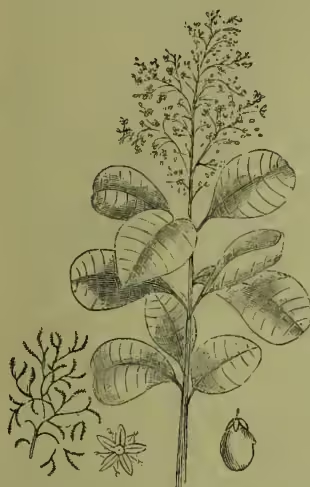
Sumach, or Wig Tree, is a native of the south of Europe and west of Asia, and is often planted in Britain as an ornamental shrub. It has simple leaves, and hairy corymbs of fruit, which have a sort of resemblance to periwigs. The twigs and leaves dye yellow (see FUSTIC), and are used in tanning. The bark has been used as a substitute for Peruvian Bark. The seed resembles the almond in flavour. The very acid fruit of the Sicilian or Elm-leaved Sumach (R. coriaria)—a native of the countries around the Mediterranean, with pinnate leaves, not unfrequent in British shrubberies—has been used as a condiment, and the seeds and the leaves medicinally as tonic and cooling. This species is also used for tanning and dyeing. Similar to this in its properties is the Virginian Sumach, or Stag's-horn Sumach (R. typhina), a native of eastern North America, and common in British shrubberies, which has the branches curiously crooked, and covered when young with a soft velvety down. It has pinnate leaves, with numerous leaflets, and is valuable as an astringent and refrigerant. The milky juice which exudes from incisions made in the bark affords a varnish. The flowers supply abundance of honey. The Smooth-leaved Sumach (R. glabra), a very similar species, also North American, has very acid leaves, and this species is sometimes troublesome as a weed. Of the acrid and poisonous species the most important is the Poison Ivy (R. toxicodendron) of North America, a shrub from 1 to 3 feet high (when it is also called Poison Oak), or an climber, with leaves of three leaflets, and a milky juice, which becomes black on exposure to air. The leaves have been used in medicine as a stimulant of the nervous system. Similar to this in properties is the Poison Sumach (R. venenata), with from 7 to 13 leaflets, also known as Poison Elder and Swamp Dogwood, and other North American species, the juice of which is very acrid; even the emanations are injurious to some persons, who, from standing close to these plants, or from handling them, experience a cutaneous eruption with violent itching. The Varnish Sumach (R. vernicifera), a native of Japan and Nepal, yields a varnish much used in Japan for lacquer-work. R. metopium yields in great abundance a gummy resin, which in a pure state is yellow in colour, and of a hard brittle consistence. R. pumila is regarded as one of the most poisonous of the genus. R. succedanea, a native of Japan, yields a fleshy fruit containing a nut, which yields an oil that is made into candles.—The name Tanners' Sumach is given to Coriaria myrtifolia, a shrub of the south of Europe.