Suture (Lat. sutura, 'a seam') is a term employed both in Anatomy and Surgery. In anatomy it is used to designate the modes of connection between the various bones of the cranium and face. A suture is said to be serrated when it is formed by the union of two edges of bone with projections and indentations (like the edge of a saw) fitting into one another. The coronal, sagittal, and lambdoidal sutures (see SKULL) are of this kind. A suture is termed squamous when it is formed by the overlapping of the bevelled (or scale-like) edges of two contiguous bones.
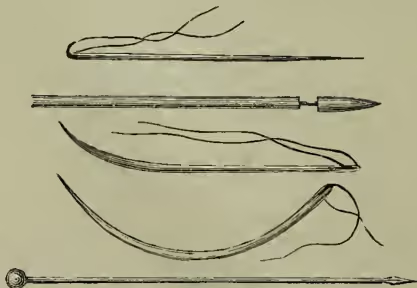
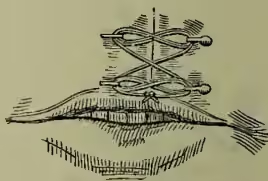
In surgery the word suture is employed to designate various modes of sewing up wounds, so as to maintain the opposed surfaces in contact. The materials most commonly used are silk, silver wire, horsehair, and specially prepared catgut. As it may fall to the lot of any person, on an emergency, to have to sew up a wound, the following general rules, applicable to all forms of suture, should be attended to. In passing the needle, the edges of the wound should be held in contact with the forefinger and thumb of the left hand; and the needle should penetrate the surface at about an angle of 50° (rather more than half a right angle), and should, at least, pass through the whole thickness of the skin at each stitch. The distance from the edge of the wound at which each stitch should enter and leave the skin must vary with the depth of the wound; but there should never be less than the eighth of an inch between the margin of the wound and the entrance or exit of the needle. Sutures should not include vessels, nerves, muscles, or tendons. The line of the thread should cross that of the wound at right angles. For incised wounds on the surface of the body, when the edges can only be transfixed from the cutaneous surface, or when the opposite margins can both be traversed by one plunge, a curved needle (such as a common packing-needle) is most convenient, whereas a strong straight needle is more convenient for the completely free margins of extensive wounds, such as are left after amputation. Fig. 1 represents various forms of needles used by surgeons; fig. 2 shows the twisted suture, as used in the operation for hare-lip, in which the wound is transfixed by pins, around which, beginning with the uppermost, a thread is twisted, in the form of the figure 8.