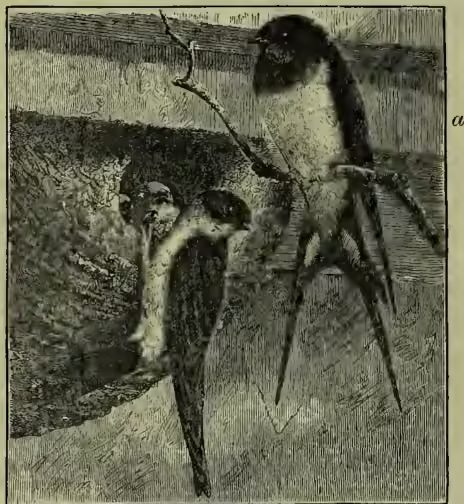
b, House-martin (H. urbica).
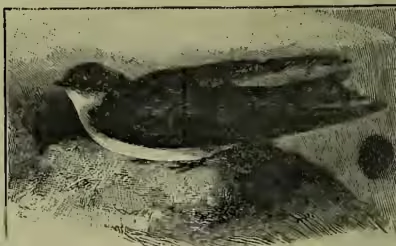
Swallow, a genus (Hirundo) and family (Hirundinidae) of Passerine birds. The members of this family are distinguished by their long and pointed wings, long head, slender wide bill, small legs and feet, tarsus scutellated in front, and tail generally forked. They have no autumn moult, but acquire their new dress in February; hence Seebohm thinks they are a recent import from the south which, like some shrikes, have changed their breeding time, but have not yet altered their moulting time. The genus Hirundo is cosmopolitan in distribution, and contains about sixty species. The members are gregarious, and prefer well-cultivated districts and the proximity of water. They have great powers of flight and perch but little, catching their prey, which consists chiefly of insects, on the wing. Their usual note is a twitter, but some species sing sweetly. Their nests are built of mud, straw, and feathers, on ledges under eaves, on rocks, in caves, and in holes in earthy cliffs. Five species are found in Europe, and three are migrants to the British Isles. The Common Swallow, or Chimney-swallow (Hirundo rustica), is distributed in Europe, Asia, and Africa, from Lapland to the Cape of Good Hope and to the Moluccas. It breeds in the Orkney and Shetland Islands, and straggles to Iceland, Spitzbergen, and Nova Zembla, but does not reach America. It exhibits a character common to many other species, in the very long and deeply-forked tail, the two lateral feathers of which far exceed the others in length. The plumage is very beautiful, the upper parts and a band across the breast glossy bluish black, the forehead and throat chestnut, the lower parts white, and a patch of white on the inner web of each of the tail-feathers except the two middle ones. The whole length of the bird is about 8 inches, of which the outer tail-feathers make 5 inches. The female has a shorter tail, less chestnut on the forehead, and whiter under parts. The nest, probably originally built in caves, is made of mud or clay, formed into little pellets and stuck together, along with straw and bents, and lined with feathers. It is open and cup-shaped, and is generally placed in a situation where it is sheltered from wind and rain, as a few feet down an unused chimney, under the roof of an open shed, or in any unoccupied building to which access can be obtained. From four to six eggs are laid, blotched and speckled with shades of gray and brown. Two broods are produced in a year. Large flocks collect together in autumn before they depart for the south. Some birds, probably belated individuals, have been found in a torpid state in winter. A popular delusion, shared in by Johnson, credited swallows with hibernating regularly under water. The Window-swallow, or House-martin (H. urbica, or Chelidon urbica), is another very common British species, glossy bluish black above, white below and on the rump; the feet covered with short, downy white feathers. Its length is a little over 5 inches; the sexes are alike in plumage. The nest is built of mud or clay, like that of the chimney-swallow, but is hemispherical, with the entrance on the side, and is attached to a rock, or, very frequently, to the wall of a house, under the eaves or in the upper angle of a window. Two or even three broods are produced in a season, and the old birds return year after year to nest in the same spot. House-martins congregate in great numbers, as the chimney-swallows do, before their autumn migration, and disappear all at once. The only other common British species of swallow is the Sand-martin (H. riparia), smaller than the two preceding and arriving before them. It has the toes naked, the tail moderately forked, the plumage brown on the upper parts and across the breast, the under parts white. It makes its nest in sandy river-banks, the sides of sand-pits, and other such situations (even the turf-covered roofs of peasants' houses in Norway), excavating a gallery of 18 inches or 2 feet, sometimes 3 or even 5 feet in length, and more or less tortuous, in the slightly dilated extremity of which some soft material is placed for the reception of the eggs. This wonderful excavation is accomplished entirely by the bill of the bird. The floor slopes a little upwards from the entrance, so that the lodgment of rain is prevented. The sand-martin, on account of the nature of its haunts, is somewhat more local than the other British swallows; but it is distributed over most parts of Europe, Asia, Africa, North America, and South America to the Amazon valley. The Purple Swallow, or Purple Martin (H. or Progne purpurea), is a North American species, which is said to have visited the British islands. The general colour, both of the upper and under parts, is shining purplish blue; the wings and tail black. It abounds in North America, and is a universal favourite in the northern parts, being hailed as the harbinger of spring, and frequenting even the streets of towns. It is a very general practice to place boxes near houses for the martins to make their nests in, which are very inartificial, consisting merely of dried grass, leaves, moss, feathers, and the like. Boxes nailed to trees are also readily occupied by the Rufous-bellied Swallow (H. erythrogaster), another North American species. But this species, which very nearly resembles the chimney-swallow of Britain, makes a nest of mud and fine hay, in the form of the half of an inverted cone, with an extension at the top, for one of the parent birds to sit in occasionally. The Republican
Swallow, or Cliff-swallow (Petrochelidon lunifrons), of North America, makes a nest of mud, in form somewhat like a Florence flask, which it attaches to a rock or to the wall of a house. Hundreds sometimes build their nests in close proximity. The Fairy-martin (H. ariel), a small Australian species, also builds a flask-shaped nest with the mouth below, attaching it to a rock, or to the wall of a house; and numerous nests are often built close together. Another Australian species (Pterochelidon nigricans) lays its eggs in a hollow tree or rock without any nesting material. Some of the swallows of tropical countries are much smaller than any of the European species. See SWIFT.