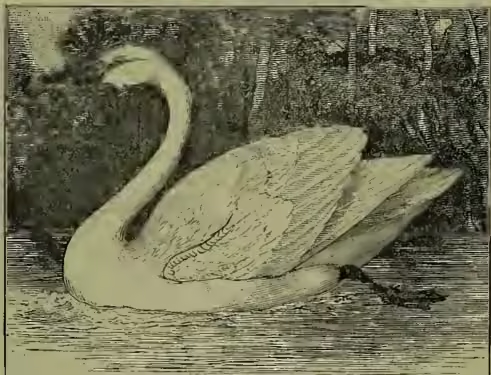
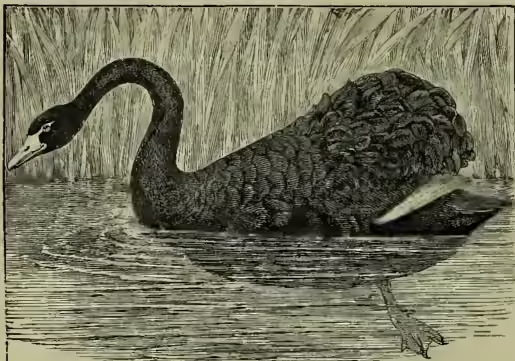
Swan (Cygnus), a genus of birds constituting a very distinct section of the Duck (q.v.) family Anatidæ. They have a bill about as long as the head, of equal breadth throughout, higher than wide at the base, with a soft cere, the nostrils placed about the middle; the neck longer than the body, arched, and with twenty-three vertæbræ; the legs short and placed far back; the front toes fully webbed, the hind toe without membrane; the keel of the breast-bone very large; the intestines very long, and with very long cæca. They feed chiefly on vegetable substances, as the seeds and roots of aquatic plants, but also on fish spawn, of which they are great destroyers. They are the largest of the Anatidæ. They have a hissing note like geese, which they emit when offended, and they deal tremendous blows with their wings in attack or defence. The Common Swan, Mute Swan, or Tame Swan (C. olor) is about 5 feet in entire length, and weighs about 30 lb. It is known to live for at least fifty years. The male is larger than the female. The adults of both sexes are pure white, with a reddish bill; the young (cygnets) have a dark bluish-gray plumage and lead-coloured bill. The bill is surmounted by a black knob at the base of the upper mandible, and has a black nail at its tip. In its wild state this species is found in the eastern parts of Europe and in Asia as far as Mongolia and the north-west of India, breeding in Denmark, the south of Sweden, in central and southern Russia, and in Turkestan; in a half-domesticated state it has long been a common ornament of ponds, lakes, and rivers in all parts of Europe. It is said to have been brought to England from Cyprus by Richard I. It is perhaps the most beautiful of water-birds, when seen swimming, with wings partially elevated, as if to catch the wind, and finely-curving neck. The ancients called the swan the Bird of Apollo or of Orpheus, and ascribed to it remarkable musical powers, which it was supposed to exercise particularly when its death approached. The note of the male bird at breeding time is loud and trumpet-like; the tame bird's note is little more than a hiss. The nest of the swan is a large mass of reeds and rushes, near the edge of the water, an islet being generally preferred. The female begins as a rule to lay in her second year from three to five eggs; when older she lays ten to twelve eggs, of a dull greenish-white colour. These birds are said to pair for life. The female swan sometimes swims about with the unfledged young on her back; and the young continue with their parents till the next spring. The swan is now seldom used in Britain as an article of food, but in former times it was served up at every great feast, and old books are very particular in directions how to roast it and to prepare proper gravy. The Polish Swan (C. immutabilis of Yarell) is generally believed now to be a mere variety of the common swan. The Whistling Swan, Elk Swan, or Whooper (C. ferus or musicus) abounds in the northern parts of Europe and Asia, but to Britain it is now merely a cold-season migrant from more northern regions, although about a century ago it used to breed in the Orkneys. The size is about equal to that of the common swan, and the colour is similar, but the bill is more slender, is destitute of a knob, and is depressed and black at the tip and yellow at the base. This bird is frequently brought to the London market. The names whooper and whistling swan are derived from the voice. Like all swans of the northern hemisphere, except the common swan, this one has a large cavity in the interior of the breast-bone in which the windpipe coils before passing to the lungs. Bewick's Swan (C. bewicki), another native of northern Europe, is more rare in Britain, but large flocks are sometimes seen. It is about one-third smaller than the whistling swan. The American Swan (C. americanus), closely resembling Bewick's swan but larger, is sometimes found in Britain. It breeds in the northern parts of North America, but its winter migrations extend only to North Carolina. The Trumpeter Swan (C. buccinator) is another American species, breeding chiefly within the Arctic Circle, but of which large flocks may be seen in winter as far south as Texas. It is rather smaller than the common swan. The ancients spoke of a black swan proverbially as a thing of which the existence was not to be supposed, but Australia produces a Black Swan (C. atratus), discovered towards the end of the 18th century, rather smaller than the common swan, the plumage deep black, except the primaries of the wings, which are white. The neck is long, thin, and gracefully curved. The eye is red. The bill is vivid carmine, with a white, cross band. It has been entirely acclimatised in the northern hemisphere. The black-necked Swan (C. nigricollis), perhaps the handsomest bird of the genus, is a
South American species, ranging from Chili to the Falkland Islands. The Duck-billed Swan (C. anatooides), the smallest of all the species, common about the Strait of Magellan, has the head and neck dark brown, and the rest of the plumage of the purest white. It is curious that the black colour appears in all the species of the southern hemisphere, and in them alone, except in the approach to it made in the cygnets of the north.
Swans, according to the law of England, are birds-royal. When they are found in a partially wild state, on the sea and navigable rivers, they are presumed to belong to the crown. The royal birds generally have a 'nick' or mark on them, and the king's swanherd once was an important person. But any person may have tame swans in his grounds, and then he has a property in them. Whoever steals or destroys swans' eggs forfeits 5s. for every egg, and whoever steals a marked swan of the crown, or a tame swan, commits felony. The most famous swannery is that of Abbotbury in Dorsetshire, 8 miles NW. of Weymouth, though the number of its swans has diminished from 7000 to 1000.