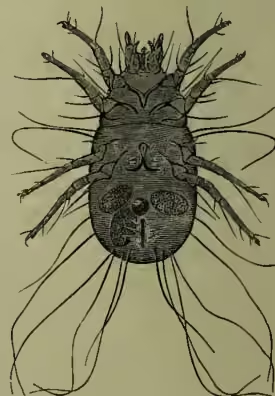
Acari'na, or mites, in the wide sense, form a low order of Arachnida (q.v.). Most of them are extremely small, the body is all one piece, the mouth parts are modified for sucking or biting, and the organs are generally simple and often degenerate. While their simplicity is partly associated with their frequently parasitic life, some of them appear to be connecting links between worms and arthropodous animals. They are very prolific, some of them by way of parthenogenesis. Of universal distribution, they occur especially where food is abundant—e.g. in decaying animal and vegetable matter, or within and upon other organisms. Many of them form galls on plants. The
Cheese-mite (q.v.), the Sugar-mite, the Itch-mite (q.v.), the common Harvest-bug (q.v.), the frequent parasite on the human nose (Acarus folliculorum, q.v.), the abundant ticks, the water-mites or water-beetles, &c.; the familiar 'red spider' of hot-houses, are exceedingly frequent forms of acarina. An East-Indian species of harvest-mite (Trombidium tinctorum) yields a dye. In their destruction of decaying organic matter, mites doubtless act as beneficial scavengers. As abundant and troublesome parasites they are of some importance, while their very diverse modes of life bring about curious instances of structural adaptation and degeneration.