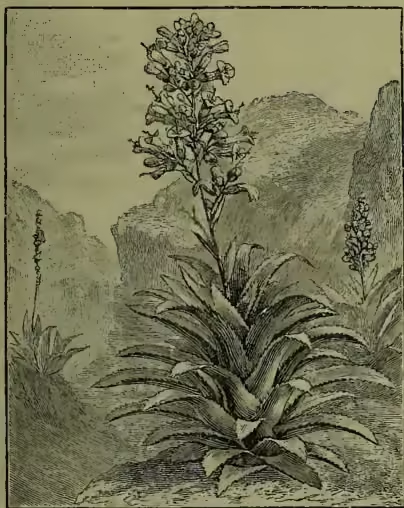
Agavé, a genus of plants of remarkable and beautiful appearance, belonging to the natural order Amaryllideæ (q.v.). There are a number of species, all natives of Mexico and Central America. They are often popularly confounded with Aloes (q.v.); and Agave americana is generally known by the name of American Aloe. The agaves have either no proper stem, or a very short one bearing at its summit a crowded head of large, fleshy leaves, which are spiny at the margin. From the midst of these shoots up the straight, upright scape, 24 to 36 feet high, and at the base often 1 foot in diameter, along which are small, appressed, lanceolate bractæ, with a terminal panicle, often bearing as many as 4000 flowers. In Mexico, these plants usually flower in the seventh and eighth, sometimes even fifth or sixth year, and even in poor soils or exposed situations seldom later than the twelfth year, but in our hothouses not until they have reached a very advanced age (80-100 years); whence arises the gardeners' fable of their flowering only once in one hundred years. After flowering, the plant always dies down to the ground, but new plants arise from lateral buds. The best known species is Agave americana, which was first brought to Spain in 1561, and being easily propagated by cuttings, is employed for fences in Italian Switzerland, and has become naturalised in Naples, Sicily, Greece, and the north of Africa. By maceration of the leaves, which are 5 to 7 feet long, are obtained coarse fibres, which are used under the name of maguey, for the manufacture of thread, twine, ropes, hammocks, &c. This fibre is also known as Pita Flax. It is now produced to some extent in the south of Europe. It is not very strong nor durable, and if exposed to moisture it soon decays. The ancient Mexicans employed it for the preparation of a coarse kind of paper, and the Indians use it for oakum. The leaves, cut into slices, are used for feeding cattle. When the young flower-bud has been cut out, the sap continues to flow into the cavity for a considerable time. This is termed aguamiel, and contains a considerable amount of sugar. It is collected daily, and after rapid fermentation furnishes the national beverage called pulque. This is milky, sour, and ill-smelling, resembling thin buttermilk, and strongly recalling the flavour of rotten eggs; yet even Europeans soon find it agreeable and refreshing. In large quantities it produces a dull intoxication followed by heavy sleep. The strong spirit of the country (aguardiente) is also distilled from it. Agave americana, Agave mexicana, and other species are extensively cultivated for these purposes. The roots of Agave saponaria are used in Mexico for washing, being a powerful detergent.