Algæ. While the sea-weeds furnish the most familiar representatives of this great series of lower plants, many forms are abundant in fresh water, and even occur on terra firma. So great is the diversity of form which they present, that they must by no means be regarded (as was too long the case) as a 'mere natural order,' corresponding to those of higher plants, but rather as a vast and vague alliance comprehending many orders, and presenting all degrees of organisation, from the simple and almost undifferentiated cell, onwards through linear and plane cell-aggregates, to forms of almost arborescent complexity and often gigantic size. It is impossible, therefore, to indicate any set of common characters corresponding to those presented by higher groups: the real diagnosis must be rather a negative one. Dividing the vegetable kingdom into (a) Cormophytes, characterised by the possession of an ascending and descending axis, with appendages, and comprehending the higher cryptogams as well as the phanerogams; and (b) Thallophytes, destitute of stem and leaf—the latter are broadly distinguishable as Algæ, Fungi, and Lichens. The Lichens (q.v.) being analysed into a curiously interwoven web of mixed algal and fungal nature, the problem of discriminating algæ from fungi remains, and this has been the subject of no little research and controversy (see FUNGI). The essential fact, however, is, that in both groups there is exhibited a broadly parallel advance in morphological complexity, from unicellular and filamentous to higher forms, and similarly as respects the reproductive system. These correspondences are, moreover, sometimes so close as to leave little doubt of the origin of the fungal form from the corresponding algal one, by the simple disappearance of its chlorophyll, consequent on the assumption of parasitic or saprophytic life, just as is observed among phanerogams, such as dodder or toothwort. The presence or absence of chlorophyll becomes thus the only absolutely constant distinction between fungi and algæ, and this break-down of the morphological barrier led Cohn, and subsequently Sachs and other botanists, to frame classifications in which the fungi and algæ were arranged together in a single ascending series, characterised by the degree of differentiation of the reproductive system. A summary of this mode of classification is thus worth noting, not only because it has been extensively employed in botanical manuals, &c., but because emphasising the importance of the degree of development of the reproductive system. (1) Reproduction asexual—PROTOPHYTA. (2) Reproduction by conjugation of similar cells to form a resting 'zygospore'—ZYGOSPOREÆ. (3) Reproductive cells distinctly differentiated as male and female; the fertilised female cell (ovum) giving rise to swarmspores or a new plant—OOSPOREÆ. (4) After fertilisation, a peculiar vegetative growth arises, within which the fertilised ovum may variously develop—CARPOSPOREÆ. The defects of such a classification, both in grouping quite unrelated forms and separating obviously kindred ones, have been now, however, fully pointed out, especially by De Bary; and for the present purpose it will be convenient to waive as far as possible the dogmatic treatment of the problem of classification, and above all things clearly to point out the general lines upon which all classifications are based, and the essential facts which these differ merely in variously accenting. A series of the most important and accessible of the simpler types of algæ must, in the first place, be briefly described.
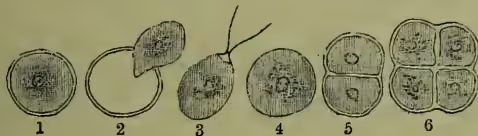
Our concrete studies may therefore conveniently commence with such a simple and common form as the Pleurococcus vulgaris, to which the green covering of tree trunks, &c. is largely due. Here the organism is a simple Cell (q.v.), or nucleated mass of protoplasm, tinged green by chlorophyll, and covered by a cellulose wall. Multiplication by transverse division is, however, in active progress; twos and fours are thus formed, but soon separate as independent cells. Closely allied forms occur in water, and may be followed through a more complex life-history. Especially after a period of cold or drought, the remarkable process of 'rejuvenescence' may be observed: the protoplasm escapes through a rupture in the cell-wall, develops a couple of delicate contractile filaments or cilia, and thus enters an actively 'motile stage' of existence. After a time the resting phase is resumed, the cilia being withdrawn, and a cell-wall redeveloped.
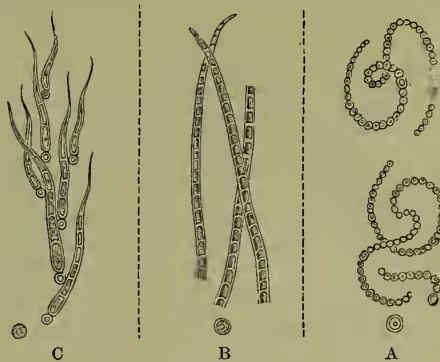
A, Nostoc; B, Oscillatoria; C, Rivularia.
Some such forms are known in the vegetative state alone, and where simply green, are termed Palmellaceæ; they frequently have gelatinous cell-walls. Many closely allied types develop bluish or yellowish chlorophyll (phycocyan and phycocanthin of spectroscopists; and are hence united under the common title of Cyanophyceæ). Some of these form jelly-like masses (Glæoëpsa, Nostoc), others become filamentous; the constituent cells of the filament remaining similar to each other (Oscillatoria), or differentiating a larger cell, or 'heterocyst' of dubious function, generally at one end (Rivularia). The chlorophyll, too, may disappear altogether, and then we pass almost insensibly among the Bacteria or Schizomycetes. These lowest algæ, in which multiplication is by transverse division only, may therefore more con- veniently be discussed along with their more important congeners, the Bacteria (q.v.).
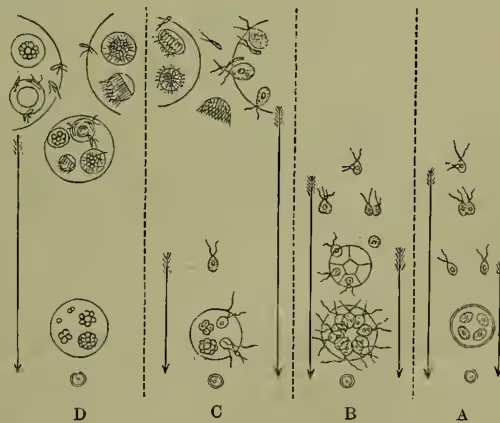
Returning to our primitive Protococcus-like form, we may readily imagine its multiplication by division to continue until not only four, but eight, sixteen, or more segments are formed. Let these segments, held together by a slightly more gelatinous cellulose envelope, pass into the motile phase, the result will be a ciliated sphere, of which the constituent cells may sometimes themselves re-segment before breaking up; more frequently, however, they separate, and may often be observed uniting or 'conjugating' in pairs to form a single cell, which, after a period of rest, divides and repeats the cycle anew. Such a form with eight segments is Chlamydomonas; with sixteen segments, Pandorina. Among such forms, a differentiation of the conjugating cells becomes increasingly obvious, until the primitively equal and similar 'zoospores' become distinctly larger and smaller—macro- and microspore respectively; we have, in short, the dawn of sex. Vegetative progress also continues; the segmentation mass may increase to thirty-two or sixty-four, and after a brief period of agitation, may settle into a beautifully stellate figure like Pediastrum, or may even continue dividing till many thousand minute cells are formed, which, on settling, elongate, and apply themselves point to point, so as to form a network of loose meshes (Hydrodictyon). Macrospores and microspores are here well distinguished; we have still, however, to seek for the full differentiation of sex. This occurs in such a form as Volvox, where the segmentation mass forms a beautiful spherical layer of ciliated cells, connected by protoplasmic bridges, and embedded in a gelatinous matrix of undistinguishable cell-wall substance. After the vegetative growth has passed its climax, some cells begin to grow at the expense of others; of these, many become ova, while others, after a time, segment into tiny spermatozoa (for the familiar animal names of the essential sex-cells may be fairly applied). Fertilisation takes place in the usual way, and is followed by the segmentation of each ovum into a new colony.
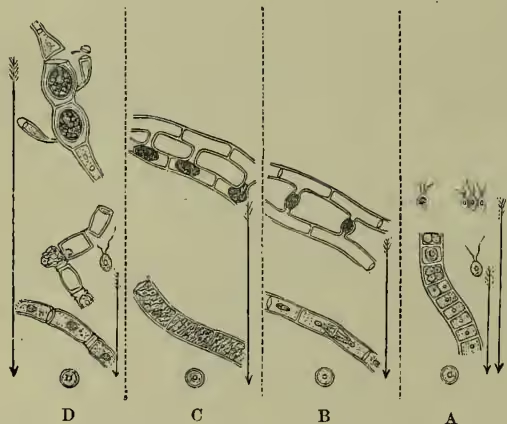
But instead of the simple spherical segmentation of Pandorina or Chlamydococcus, which we may trace to the division in planes at right angles seen in Protococcus (fig. 1), we may have the successive planes of division remaining parallel. Such successive divisions in parallel planes will produce a filament, and, as we have seen above, we thus enter among a vast new series of forms. The simplest of these, as already stated, merely vegetate indefinitely, with periods of repose, without showing any signs of conjugation or the sexual process. In many Conferve, however, the process of rejuvenescence occurs, and the zoospores may conjugate; in the lowest of which conjugating forms the zoospores are equal and similar, but the differentiation of macrospore and microspore soon arises (Ulothrix). Again, the motile phase may entirely disappear, and conjugation without rejuvenescence take place between the cells of parallel filaments: here, as formerly, equality and similarity may be perfect (Mesocarpus); or incipient sex may manifest itself (Spirogyra); finally, sex may become perfected (Sphaeroplea). Yet a further specialisation is possible: the reproductive changes may be restricted to definite cells or portions of the filaments; and such a case is afforded by Edoignonium. This peculiar form is characterised, so far as its vegetative system is concerned, by the peculiar specialisation for the opening and the repair of that (in other forms irregular) rent of the cell-wall which is necessary for rejuvenescence. The repro- ductive system is, however, still more remarkable; many species are constantly dioecious; the dwarfed male filaments grow on the larger female ones; spermatozoid and ovum respectively develop, with separation of portions recalling the sperm-cap and polar vesicle of animals, or the distinction of vegetative and reproductive nucleus demonstrated by Strasburger in the pollen grain (see OVUM).
The remarkable and varied Desmideæ and Diatomaceæ, so familiar to microscopists, though rarely filamentous, are usually regarded, on account of their habit of conjugation, as allied to the Mesocarpeæ; but since they are on many grounds entitled to separate and fuller treatment, their structure and affinities need not here be discussed (see DESMIDS, DIATOMS).
Branching occurs at various points in this filamentous series, and this readily leads us to the formation of bi-dimensional (flat) cell-aggregates, such as the common green Ulva of every sea-shore. Here we start afresh with rejuvenescence by swarm-spores, capable of reproducing the parent plant without conjugation; in higher genera at least (Enteromorpha), conjugation occurs, and macrospore and microspore are distinguishable; while the change from a plane to a tubular arrangement of cells in Enteromorpha leads us to solid or tridimensional forms.
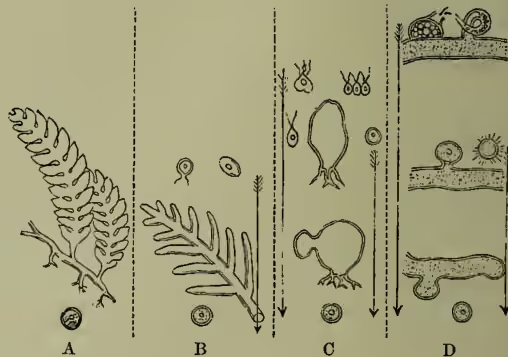
Before entering, however, on the study of these complex multicellular forms, we should return to note the unexhausted possibilities of unicellular differentiation. Hitherto we have examined different modes of cell-division, but we may imagine the necessity of this superseded by the continuous growth and regional differentiation of the primitive cell. Such a form is commonly presented us by the remarkable Botrydium, not uncommon in greenhouses (fig. 5, C). Here the cell elongates vertically, without division, into what is curiously analogous to the ascending and descending axis of a higher plant. The upper portion remains above ground, expands, and vegetates; the lower divides into colourless processes, which perform both the mechanical and absorptive functions of roots. Multiplication may take place by simple lateral gemmation, or by other methods, varying widely with the conditions of the environment. In ordinary circumstances, when moisture is abundant, the protoplasmic contents simply break up into zoospores, which, on settling down with or without conjugation, reproduce the plant. Under the influence of drought and sun, the protoplasm descends into the root filaments, and there encysts itself, rejuvenescence by-and-by taking place as usual; while, on the approach of winter, the encystment takes place with the upper vegetative portion of the cell, which becomes gradually thickened. Another very interesting allied form is Vaucheria (fig. 5, D). Here the cell lengthens into a filament, and distinct male and female organs differentiate from short lateral branches, true sexual fertilisation occurring. In some species, however, all the less differentiated modes of reproduction have been observed; thus in Vaucheria sessilis, a man-ciliated zoospore is formed, which is active for hours; in another (V. sericea), this is only active for a few minutes, and in V. geminata it never issues at all, but simply rejuvenesces without leaving its cell-wall, like a pollen grain; finally, the quiescent bud simply drops off (V. tuberosa), to germinate into a new filament. The marine types start with simple forms—Valonia recalling Botrydium, as Codium does Vaucheria—but assume a high degree of vegetative complexity, e.g. the mushroom-shaped Acetabularia, or the branched Bryopsis. With this increase of vegetative differentiation, the converse reproductive degeneration is beautifully illustrated. Thus the former still multiplies by zoospores which conjugate, but those of the latter simply rejuvenesce, and the plant is more frequently reproduced by vegetative buds; while in the enormously ramified and complex, but still unicellular Caulerpa, the mode of multiplication seems to be reduced to occasional gemmation from the relatively less vegetative root portion alone.
We have now surveyed the families of lower algae, and have seen that the degree of differentiation of the reproductive process in the direction of definite sex runs broadly parallel, while the vegetative structure is much more widely differentiated. It is therefore rather by the latter that we must especially classify, and, without insisting on a too rigorous application of this principle, it is evident (1) that, as has long been increasingly obvious, the Palmellaceæ represent, or, at any rate, include largely the vegetative states of higher forms; (2) that the Protococcaceæ, Pandorineæ, Hydrodictyæ, and Volvocineæ form another natural series, characterised by their mode of cell-division and aggregation; (3) that the Convolvæ lead to Ulvoceæ on one hand, and to Chato-phoraceæ, Ulothrichaceæ, and Sphaeropleaceæ on others, the Conjugatæ being also not very far remote; while (4) the Siphoneæ, despite the necessary parallelism of their reproductive evolution, represent an exceedingly distinct and lower type of structure, which separates them from all the algae proper.
The brown seaweeds (Phæophyceæ, Fucaceæ) and the red seaweeds (Floridicæ) are of much greater complexity, both vegetative and reproductive, than any of the preceding forms, and may conveniently receive separate treatment (see SEA-WEEDS).