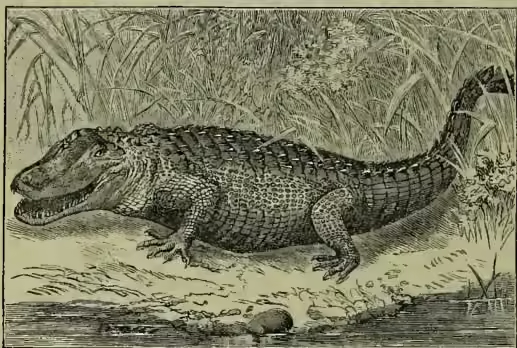
Alligator (Span. Iagarto, 'a lizard'), a genus of Crocodylia, the highest sub-class of reptiles. The alligator family (Alligatoridæ) includes three genera—Alligator, Caiman, and Jacare, which differ from crocodiles in their shorter and broader head; in their more unequal teeth; in the presence of pits on the upper jaw, which receive the first and fourth lower-jaw teeth; in the limited extent of the union between the two lower jaws, which does not extend backwards beyond the fifth tooth; in the separation between the scales of neck and back; and in other less notable characters. Generally, however, they resemble crocodiles both in habit and structure—e.g. in the lizard-like body, with powerful tail and short legs; in the bony armature of the skin; in the abundant teeth fixed in sockets; in the large head, with very solid skull and nostrils at the end of the snout; in the double ventricle of the Heart (q.v.); and so on. The alligators are now exclusively confined to the warmer parts of America, but fossil forms indicate a much wider distribution. They vary in size from 2 to 20 feet. The genus Alligator includes a few species, of which the most familiar is Alligator lucius, the pike-headed alligator of the Mississippi region. The snout is broad, flattened, and rounded; the nostrils are separated by a prolongation of the nasal bone; the feet are webbed to about the middle; the bony plates of the back are not articulated together, and there are none on the ventral surface. There are twenty teeth on each of the upper and lower jaws. The lids of the gleaming eyes are fleshy and smooth. The genus Caiman is at home in tropical South America, but extends northward to Mexico. The nostrils are undivided, the webs of the feet are still more rudimentary, the bony plates of the back are articulated to form a connected armour, and there is also a ventral shield of jointed plates. The eyelids are strengthened by an internal bony plate, and there are twenty teeth on each jaw above, and twenty-two below. The Jacare closely resembles the Caimans, and is also South American. There are fewer teeth, rougher eyelids, and minor differences of little importance. All these forms occur abundantly in the rivers, especially in quiet corners where the current is not too rapid. During the floods of the wet season they frequent adjacent basins, while in other circumstances they avoid the consequences of cold or drought by burying themselves in the mud and remaining torpid till the return of suitable conditions recalls them to active life. They feed for the most part on fishes, which they are said to stun with their tails; but many of them are extremely, and often unadvisedly, omnivorous. After seizing some land animal, such as sheep or pig, they frequently allow it to drown without relaxing their grip, and then return to the shore to eat it at leisure. While most of them seem timid and shy of man, especially when on land, they are sometimes emboldened by hunger to venture an attack. They are to a large extent nocturnal animals, and their loud harsh bellow is a familiar sound in the districts which they frequent. The large eggs are laid on shore in a hollow in the sand, covered over with grass and reeds, and left to themselves and the sun's heat. As many as sixty may be laid in one nest, arranged in separate layers. The young are developed before the period of flooding, and are carefully tended by the mother alligator. In spite of this, the majority probably fall victims to large fishes, birds of prey, and hardened male alligators. The flesh of some forms (Jacare) is eaten by Indians and negroes. It has a musky flavour, and this smell is also very characteristic at pairing time. An alligator oil, said to burn well, is also utilised; and the tough skin forms a strong leather, useful for saddlery and other purposes. Fossil remains prove the ancient standing of the alligator family.