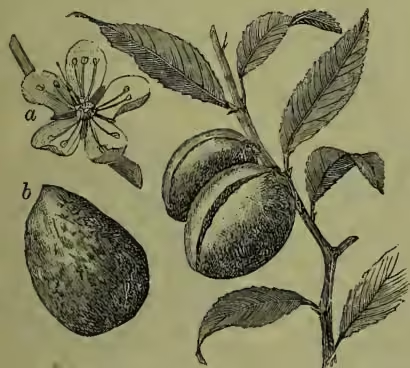
a, flower; b, fruit.
Almond (Amygdalus), a genus of the natural order Rosaceæ (q.v.), sub-order Amygdaleæ or Drupaceæ, consisting of trees or shrubs, distinguished by the coarsely furrowed and wrinkled shell (endocarp or putamen) of the drupe, and by the young leaves being conduplicate, or having their sides folded together. According to the greater number of botanists, it includes the Peach (q.v.), constituted by some into a distinct genus, Persica, in which the drupe has a fleshy covering (sarcocarp), whereas, in the species to which the name almond is commonly given, this part is a dry fibrous husk, which shrivels as the fruit ripens, and finally opens of its own accord. The almond-tree (Amygdalus communis) is very similar to the peach-tree, and is about 20-30 feet high, a native of the East and of Africa, but has now become completely wild in the whole south of Europe. Even in the more northern parts of Germany and of Britain it is planted for the sake of its beautiful flowers, which are produced in great abundance, and resemble those of the peach in form and often in colour, although generally paler and sometimes white. The blossoms appear before the leaves, and are very ornamental in shrubberies in March and April. The wood of the almond-tree is hard, and of a reddish colour, and is used by cabinet-makers. But it is chiefly valued on account of the kernel of its fruit, which forms an important article of commerce. The almond-tree is often referred to in the Old Testament, and the word translated hazel is supposed to be another name for the almond. The tree flowers in Palestine in January. The rod of Aaron, mentioned in Numbers xvii., was taken from an almond-tree, and it is yet customary with the Jews to carry rods of almond-blossom to the synagogue on festival days. It seems to have been very early introduced into England, and is named in the Durham Glossary (11th century) the 'Easterne Nutte-Beam.' Its great beauty has made it a favourite with every one wherever it can be successfully grown. Gerard, in Shakespeare's days, says the trees were 'in our London gardens in great plenty;' but Spenser had sung of its beauty before that time. It is only in the most favoured situations in the south of England that it ever produces good fruit.—Almonds are either sweet or bitter. The bitter appear to be the original kind, and the sweet to be an accidental variety, perpetuated and improved by cultivation. Sweet almonds contain a large quantity of a very bland, fixed oil, emulsin, gum, and mucilage sugar, are of a very agreeable taste, and very nutritious, and are used in the dessert, in confectionery, and medicinally in an emulsion, which forms a pleasant, cooling, diluent drink. Bitter almonds contain the same substances, and, in addition, a substance called Amygdalin (q.v.), from which is obtained a peculiar volatile oil. (For the almond oils, see the following articles.)—The muddy water of the Nile is clarified by rubbing bitter almonds on the sides of the water-vessels, in the same way in which the nuts of the Strychnos potatorum (see CLEARING NUT) are used in India. The principal varieties of almond in cultivation are—the common sweet almond, with thick hard shell; the brittle-shelled, with a very thin, almost leathery brittle shell and sweet kernels; the bitter almond, with thick hard shell (sometimes also with a brittle shell) and bitter kernels; the large-fruited, with large flowers of a whitish rose-colour, and very large, sweet fruit; the small-fruited, with very small sweet fruit; and the peach almond, with a slightly succulent blackish sarcocarp (see above), yellow shell, and sweet kernels. In commerce, the long almonds of Malaga, known as Jordan almonds, and the broad almonds of Valencia, are most valued. Large quantities of almonds are annually imported into Britain and America from France, Spain, Italy, and the Levant; and California produces annually about 2,000,000 lb. Bitter almonds are brought to Britain chiefly from Mogadore.—The DWARF ALMOND (A. nana) is very similar to the common almond, except that it is a low shrub, seldom more than two or three feet in height. Its fruit is also similar, but much smaller. It is common in the plains of the south of Russia, and is frequently planted as an ornamental shrub in Britain, flowering freely in March and April, but not producing fruit.