Alpaca (Auchenia Paco), an animal of the same genus with the Llama (q.v.), and belonging to the Camel family of Ruminants. It is the half-domesticated form of the wild vicuña. It is remarkable for the length and fineness of the wool, which is of a silken texture, and of an uncommonly lustrous, almost metallic appearance. The alpaca is smaller than the llama; the legs and breast are destitute of callosities. In form it somewhat resembles the sheep, but has a longer neck and more elegant head. It carries its long neck erect; its motions are free and active, its ordinary pace a rapid bounding canter. The eyes are very large and beautiful. The wool, if regularly shorn, is supposed to grow about six or eight inches in a year; but if allowed to remain upon the animal for several years, attains a much greater length, sometimes even thirty inches, and not unfrequently twenty. Its colour varies; it is often yellowish brown; sometimes gray, or approaching to white; sometimes almost black.
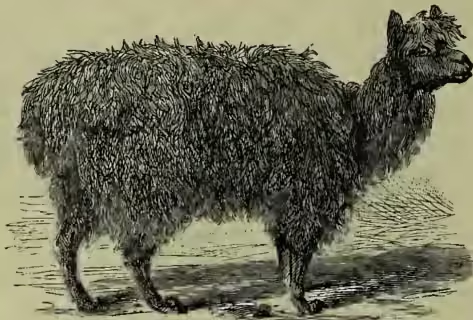
The alpaca is a native of the Andes, from the equator to Tierra del Fuego, but is most frequent on the highest mountains of Peru and Chili, almost on the borders of perpetual snow, congregating in flocks of one or two hundred. In a wild state, it is very shy and vigilant; a sentinel on some elevated station snorts to alarm the flock on the approach of danger. Alpacas seem instinctively to know when a storm is coming on, and seek the most sheltered situation within their reach. Flocks, the property of the Peruvian Indians, are allowed to graze throughout the whole year on the elevated pastures, and are driven to the huts only at shearing-time. When one is separated from the rest, it throws itself on the ground, and neither kindness nor severity will induce it to rise and advance alone. It is only when brought to the Indian huts very young, that they can be domesticated so as to live without the companionship of the flock; but then they become very bold and familiar. Their habits are remarkably cleanly.
The Indians have from time immemorial made blankets and ponchos or cloaks of alpaca wool. It is fifty years since it became an article of commerce, and its use for the manufacture of shawls, coat-linings, cloth for warm climates, umbrellas, &c. has gradually increased, and more than 2,000,000 lb. are now annually imported into Britain. The credit of introducing and raising to its present magnitude the alpaca wool-manufacture in Britain, which has still its chief seat at Saltaire, is due to Sir Titus Salt.
Attempts have been made to introduce the alpaca into Europe; but not yet with very satisfactory results. The only considerable flock known to exist is in the Pyrenees. There seems no reason, however, to doubt that the mountains of Wales and Scotland are suitable for this branch of husbandry; and it is to be hoped that enterprise such as has been directed to the manufacture of alpaca wool in Britain, will soon, and with equal success, be directed to the production of it. There are probably not more than two or three hundred alpacas in Britain, and these mostly in parks connected with the residences of noblemen and gentlemen, not in the situations for which they seem to be peculiarly adapted. An attempt was made in 1821 to introduce the alpaca into the United States; in 1857 a cargo of them was shipped to Baltimore, but the result showed that they could not be acclimatized.
Alpaca wool is straighter than that of the sheep, very strong in proportion to its thickness, and breaks little in combing. The fibre is small, and it is very soft, pliable, and elastic.—The flesh of the animal is said to be very wholesome and pleasant.