Church of the Sacred Heart, Edinburgh.
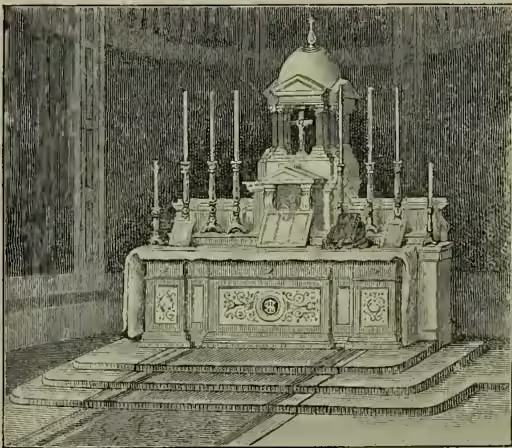
Altazimuth (a contraction for altitude and azimuth instrument), an astronomical instrument for determining the apparent places of the heavenly bodies on the celestial sphere. It consists of a telescope revolving about a horizontal axis, which in turn revolves about another vertical axis, the angle of revolution being measured in each case by a divided circle. These angles give the Altitude (q.v.) and Azimuth (q.v.) of the heavenly body colour according to the feast or season. The essentials of the altar for mass in Roman Catholic churches are the altar itself, the altar cloths, the missal, the three cards (containing portions of the missal), the tabernacle for the reservation of the host, and the crucifix. In the throne above the tabernacle, the host is occasionally exposed in a vessel called the Monstrance (q.v.), as at the service of the 'Benediction'; the crucifix being observed at the instant of observation, and so indicate its place. Small instruments of this kind are used in surveys. The principal one in existence is that at Greenwich, designed by Sir George Airy, the object of which was to supplement the lunar observations taken on the meridian by the Transit Instrument (q.v.) by others taken when the moon was in other parts of the sky. Its two chief principles of structure are, that as many parts as possible are cast in one piece, and that no power of adjustment is provided anywhere; the errors of construction and original adjustment being allowed for in the reduction of the observations. By means of this instrument much has been gained in knowledge of the moon's places, the observations made with it, owing to its freedom of pointing to any part of the heavens, exceeding in number those obtained by the fixed meridional instruments in the proportion of 16 to 9. The altazimuth is not, however, in general use, owing to its liability to many errors, unless, as at Greenwich, most carefully and solidly designed and constructed.