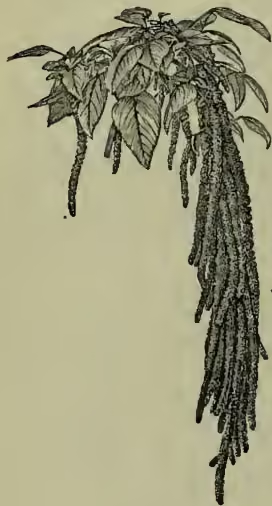
(Amaranthus caudatus).
Amaranth (Amaranthus), the leading genus of Amaranthaceæ, an order differing from Chenopodiaceæ (q.v.), in the possession of a crowded bracteate inflorescence and membranous perianth. A. caudatus (Love-lies-bleeding), A. speciosus, A. hypochondriacus (Prince's Feather), and other species, are common annuals in our flower-gardens. A. tricolor, from China, is cultivated in the Southern United States, and is popularly known as Joseph's Coat. The spikes of A. caudatus are sometimes several feet in length. The dry red bracts which surround the flower retain their freshness for a long time after being gathered; for which reason the plant has been employed from early times as an emblem of immortality.—The Globe Amaranth (Gomphrena globosa) and the Cockscomb (q.v.), well-known tender annuals, belong to the same natural order. The Globe Amaranth is much cultivated in Portugal and other Roman Catholic countries for adorning churches in winter. Its flowers, which are of a shining purple, retain their beauty and freshness for several years. No species of the order can be regarded as a true native of Britain, although A. blitum is now found in waste places near London and elsewhere. A. blitum, A. oleraceus, and other species, are used as pot-herbs, but rarely in Britain. Wholesome mucilaginous qualities are very generally found in the leaves throughout the order. The seeds of A. frumentaceus (called Kiery) and of A. arundinaria are gathered as corn-crops in India.—Medicinal properties are ascribed to some species of the order, particularly to Gomphrena officinalis and macrocephala, which have a high and probably exaggerated reputation in Brazil, as the popular names, 'para todo,' &c., indicate, as cures for many diseases.