Amnion is a foetal membrane which immediately invests the embryo, appearing very early in the development of the latter, and adhering closely to it. Double folds grow round the embryo, arching over it on all sides, and uniting in a central point. The origin of the anterior and posterior folds is indicated in the diagram (A.F.) The inner layer of this double fold becomes separate from the outer and forms the amnion, while the outer portion, the history of which need not here be noticed, is best known by Turner's designation, as the sub-zonal membrane. In fishes and amphibians it does not exist, but is found in reptiles, birds, and mammals. As gestation proceeds, this membrane secretes from its inner surface a fluid which distends the amnion, within which the foetus floats suspended by its umbilical cord. That this fluid, the liquor amnii, is of foetal origin, is shown by its occurrence in
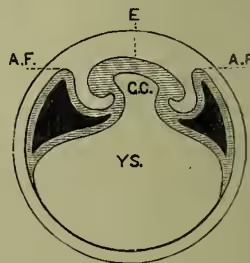
A.F., amnion-fold; E., embryo; G.C., gut-cavity; Y.S., yolk-sac. (After Weidersheim.) birds. It consists of water, containing epithelium, hairs, and to 2 per cent. of fixed solids. In mammals, the foetal urine is added to it during the second half of pregnancy. Its specific gravity varies from 1007 to 1011. The fluid preserves the foetus from injury and pressure, permits of the free movement of its limbs, and prevents them from growing together. When gestation is completed, and labour commences, the amniotic fluid is the chief mechanical agent in dilating the os uteri, and so opening the way for the foetus. For further particulars, see EMBRYO, and for many curious superstitions connected with the subject, see CAUL.