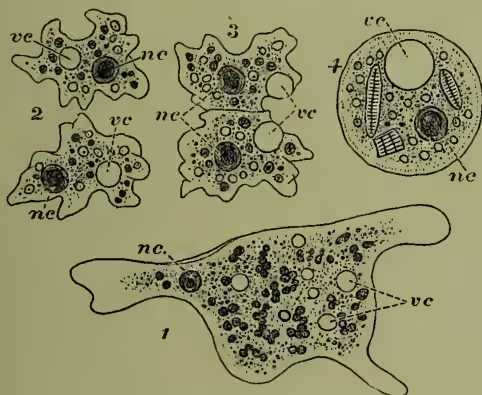
Amœba (Gr., 'change'), a name given to a number of the simplest animals or Protozoa (q.v.), which consist of unit masses of living matter (see CELL, and PROTOPLASM). They are found in fresh water or in mud, and occasionally in damp earth (A. terricola). One of the commonest was first described in 1755 by an early microscopist, Rôsel von Rosenhof, and the name he gave it—Protœus animalcule—still survives in popular language. They are all minute, but some are distinctly visible with the unaided eye. The naked mass of living matter or protoplasm flows out in all directions in blunt processes (pseudopodia = 'false feet'), and the endlessly varying form has earned for these simple animals their technical and popular names of 1, amoeba with blunt processes, nucleus, nc; contractile vacuoles, ve; food vacuoles and granules. 2, two daughter amoebæ. 3, amoeba in process of dividing. 4, encysted phase, with inclosed diatoms, &c. (After Bütschli and G. B. Howes.) amoeba and Protœus animalcule. Many unit masses or cells of higher animals—e.g. the white corpuscles of the blood—exhibit the same ceaseless change of form, which is generally described as amoeboid. The outer layer of the protoplasm is usually firmer than the interior, and in reference to this physical difference the terms ectosarc and endosarc are often used. The central portion contains the more refractive body or nucleus, which is so characteristic of all cells, and which evidently plays an important part in the life of the animal. More than one nucleus is often present. The amoeba flows along the surface of stone or plant by the slow protrusion of the ever-changing processes. In this way, too, it flows over, and gets outside particles of food, such as diatoms, which are engulfed in the protoplasm, and form with the little bubble of water surrounding them what are known as food-vacuoles. The available material, which may be either vegetable or animal, is slowly digested, and the refuse expelled. As the result of internal changes, granules and globules of various kinds appear in the protoplasm. Two pulsating bubbles or contractile vacuoles are usually to be seen, which doubtless secure to some extent the aeration and purification of the protoplasm. In unfavourable circumstances, the amoeba can save its life by sweating off a sheath or cyst, within which it waits passively for better times. This passage from an active to an encysted phase is exceedingly common among the Protozoa. On attaining its maximum size, the amoeba draws itself out, and breaks into two daughter amoebæ, each of which contains half of the mother nucleus. In a closely allied giant amoeba, Pelomyxa, a number of spore-like young are formed within the parent, and in other cases some of the processes are nipped off as buds. Two amoebæ sometimes flow together and fuse in a manner which may be fairly regarded as an incipient form of sexual union (see CONJUGATION, SEX). This simple organism thus exhibits within small compass all the usual animal functions. It is contractile, irritable, and automatic; it feeds, assimilates, secretes, grows, and reproduces; and the intimate changes within the unit mass of protoplasm, in which there is no division of labour, must therefore be exceedingly complex (see PHYSIOLOGY, PROTOPLASM). There are several species of amoeba and numerous related forms, which differ in the formation of an external shell, and in similar unessential characters. All amoeboid forms with blunt processes are ranked together in the sub-class Lobosa, and are often included under the more general title of Rhizopoda, which comprises all the Protozoa that are predominantly amoeboid. A. villosa has a rough tuft at one end; Lithamoeba is large and disk-shaped; Pelomyxa may attain a diameter of one-sixteenth of an inch, and a number may be artificially united into a much larger mass; Arcella has a somewhat horny shell, and the power of floating itself by means of secreted gas bubbles, as has been also observed in an amoeba; Diffugia has a membranous shell stuck over with sand grains and other foreign particles. Amoebæ are to be found by allowing mud and debris from ponds to settle, and then examining patiently under the microscope. See Leidy, Fresh-water Rhizopods of North America (1879), Bronn's Protozoa, and Bütschli's Protozoa in Bronn's Thierreich.