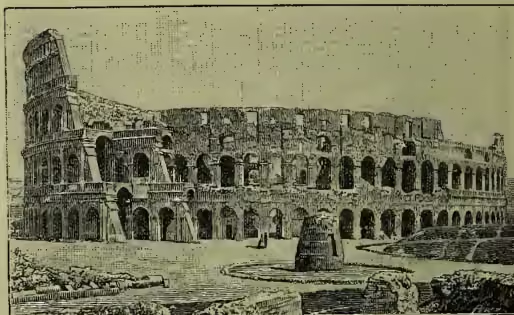
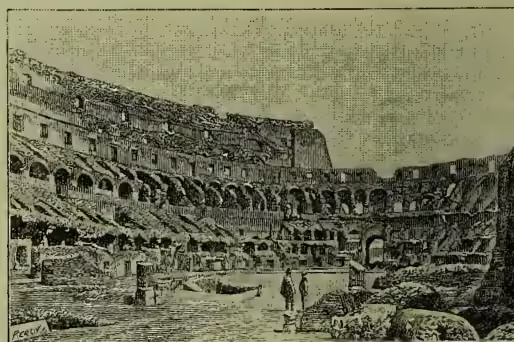
Amphitheatre, a spacious building, generally oval in form, used by the Romans for exhibiting gladiatorial combats, fights of wild beasts, and other spectacles. The amphitheatre differed from a theatre for dramatic performances (theatrum) in this, that whereas the theatre had only a semicircle of seats fronting the stage, the amphitheatre was entirely encircled by them; hence the name of amphitheatre (Gr. amphi, 'all round'). At first these erections were of wood, and merely temporary, like a modern race-stand. They seem, however, to have been of enormous size, as Tacitus mentions one at Fidenæ, during the reign of Tiberius, whose collapse is said to have caused the death or injury of 50,000 spectators. Amphitheatres of stone had begun, however, to be erected at an earlier period than this, the first having been built in 31 B.C. at the desire of Augustus. The Flavian amphitheatre at Rome, known as the Colosseum from its colossal size, was begun by Vespasian, and finished by Titus 80 A.D., ten years after the destruction of Jerusalem. It was the largest structure of the kind, and is fortunately also the best preserved. It covers about five acres of ground, and was capable of seating 87,000 spectators. Its greatest length is 612 feet, and its greatest breadth 515, the corresponding figures for the Albert Hall in London being 270 and 240. On the occasion of its dedication by Titus, 5000 wild beasts were slain in the arena, the games lasting nearly a hundred days. The exterior is about 160 feet in height, and consists of three rows of columns, Doric, Ionic, and Corinthian, and, above all, a row of Corinthian pilasters. Between the columns there are arches, which form open galleries throughout the whole building; and between each alternate pilaster of the upper tier there is a window. Besides the podium, there were three tiers or stories of seats, corresponding to the external stories. The first of these is supposed to have contained twenty-four rows of seats; and the second, sixteen. These were separated by a lofty wall from the third story, which contained the populace. The podium was a gallery surrounding the arena, in which the emperor, the senators, and vestal virgins had their seats. The building was covered by a temporary awning or wooden roof, the velarium. The open space in the centre of the amphitheatre was called arena, the Latin word for sand, because it was covered with sand or sawdust during the performances. The taste for the excitement of the amphitheatre which existed at Rome, naturally spread to the provinces, and large amphitheatres were erected not only in the provincial towns of Italy, as at Capua, Verona, Pompeii, Pozzuoli, &c., but at Arles, Nîmes, and Frejus, in France; at Italica, near Seville, in Spain; and even in this country, at Cirencester, Silchester, and Dorchester.