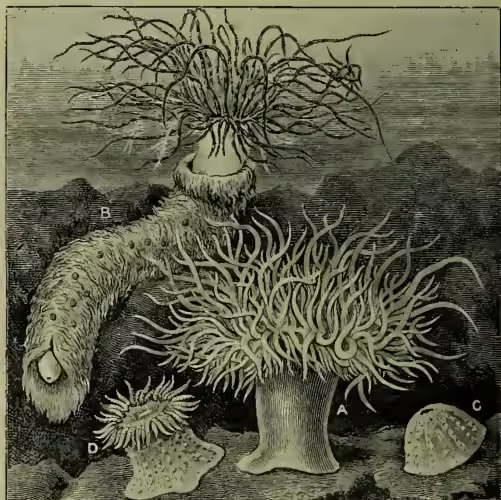
Anemone, SEA, a popular name of Actinia and some allied genera of Actinozoa (q.v.). The term obviously refers to that gay flower-like appearance which has in other countries won for these forms titles such as 'sea-roses' and the like. They occur abundantly along our coasts, attached to rocks or sometimes imbedded in sand, from low-water almost to high-water mark, and are very familiar objects both when expanded with spreading tentacles, and when contracted into a puckered conical knob. They are occasionally borne on floating objects, on the swinging seaweeds, or on other animals. Almost cosmopolitan in their distribution, they attain most magnificent development in the warmer seas, such as the Mediterranean. The sea anemone consists of a muscular tube, fixed by its expanded base, and with a rich crown of tentacles round the mouth. So far it is like a hydroid polyp, but the mouth margin is prolonged inwards to form an open stomach-cavity extending to near the base, and this inner tube is connected with the outer by vertical radiating mesenteries or membranous partitions. Not all of these mesenteries reach right across from outer wall to the stomach-tube, and below the termination of the latter they are all reduced in size so as to leave a wide basal space (see fig. 1). The chambers between the partitions communicate with one another, with the tubular cavities of the very variable tentacles, and with the general body-space. As usual, the body
consists of an outer layer or ectoderm, an inner layer or endoderm, and a slightly developed median layer or mesoderm. None of the Actiniæ (Malaco-dermata) form any skeleton, but the body-wall is very thick and muscular, especially in the basal and oral regions. The outer layer of cells includes a large number of offensive elements—nematocysts or Thread-cells (q.v.), from which fine lassoes bathed in poison are thrown out on the least provocation, and are of great importance in numbing or killing both prey and enemies. The long uncoiled lassoes, usually much longer than the thread-cells which contained them, are too delicate to pierce the skin of the hand, but may be readily felt on cheek or tongue. Besides these, there are abundant sensitive cells scattered up and down in the outer layer, and especially frequent on the tentacles and mouth region. Externally these elements form fine hairs, which catch stimuli from the outside world, while internally they are in connection with a network of nerve fibres and cells lying beneath the skin. The nervous system is thus very diffuse. Developed sense organs are often present—e.g. round the margin of the mouth, in the form of azure spots like turquoise beads. These are apparently rudimentary eyes. Both outer and inner layers form muscle fibres which lie apposed to the median sheath or mesoderm. The mouth is somewhat sunk below the level of the surrounding disc, and forms an elongated slit, which is occasionally constricted in the middle, so that one end serves for food coming in and the other for waste matter passing out. The mesenteries or partitions are fringed by special coiled filaments, which have been shown to digest food by taking the particles holus-bolus into their cells. The generative organs are also borne on the sides of the mesenteries, and lastly, in some genera there are long, richly ciliated, thread-like weapons, which are beset with stinging-cells, and can be protruded through special apertures in the body-wall.
Sea anemones are very voracious, and feed on numerous forms of invertebrates. Johnston relates an interesting case of a sea anemone which had contrived to swallow a valve of Pecten maximus of the size of an ordinary saucer, and, having become divided into two compartments by the abnormal extension, had formed a second mouth and tentacle-wreath for the lower story. 'The individual became indeed a sort of Siamese twin, but with greater intimacy and extent in its union' (British Zoophytes, i. 235). With the exception of a few genera, the Actinæ never form colonies, but remain as isolated individuals. They may attain very considerable size, and though that is usually covered by a few inches, they have been found in the Chinese Sea up to three feet in diameter. The sexes are separate or united. The eggs are fertilised in the body-cavity, and the Planula-like larvæ issue by the mouth. Division may also occur in varied fashion, and buds may also be formed externally or internally. Artificial division has also been frequently performed with success. Some forms attain considerable age, as in the classic instance of 'Grannie'—a common sea anemone (Actinia mesembryanthemum), which was taken from the Firth of Forth by Sir John Dalyell in 1828, and which died 4th August 1887. In six years this specimen produced 276 young. Sea anemones afford beautiful illustration of the association of different organisms. Some occur constantly on certain sponges in a more or less passive partnership, while others become associated with hermit for their bearer, and are also useful in numbing, killing, or paralysing the desired prey. Such a mutual association is termed Commensalism (q.v.). Again, certain small fishes are found as commensals sheltered within the cavity of various sea anemones. But an even more intimate association is exhibited in those sea anemones which contain 'yellow cells.' These elements are minute single-celled plants which thrive in mutual partnership with the animal cells of the sea anemone. The carbonic acid given off by the animal cells is as useful to the minute plants as the oxygen and starch formed by the latter doubtless are to the sea anemone. Such an association is termed Symbiosis (q.v.). Sea anemones in many cases readily accommodate themselves to confinement in an aquarium, within which, however, they usually try to exterminate their fellow-prisoners.
It remains to notice some representative forms. The commonest British species is Actinia mesembryanthemum. It is hardy and readily kept in confinement, though accustomed to move about not a little by means of its muscular basal disc. The mouth margin bears a beautiful circle of rudimentary eyes. Anthea or Anemonia cerereus is also common in the south. It bears towards two hundred long, many-coloured, very mobile tentacles. Actinia dianthus, a large and extremely beautiful form, inhabits deep water; and the Challenger expedition brought up some species from very considerable depths (see Challenger Report on Sea Anemones). A large genus (Discosoma), measuring two feet across, is said to spread like a carpet over the Red Sea bottom, and even larger forms are known to occur. Some form for themselves a tubular sheath or other external protection. Cereus crassicornis, found abundantly on the south coasts of England, is one of the largest and most beautiful British forms, measuring about four inches in height, and fully more from tip to tip of expanded tentacles. The colour varies very greatly. A large number of forms (Ilyanthus, Edwardsia, Peachia, &c.) live in the sand, and have narrowed bases and elongated bodies. The best impression of the sea anemone group—apart from seeing the actual forms—is to be got by consulting the wonderfully magnificent monograph by Dr Angelo Andres, included in the series of reports on the fauna and flora of the Gulf of Naples. The Challenger report on the group ought also to be consulted. Abundant references will be found in these works.