
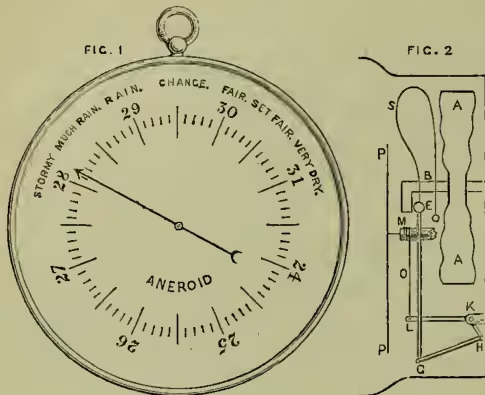
An'eroid (formed from Gr. a, 'not,' and nēros, 'wet'), the name given to a barometer invented in 1844 by M. Vidi of Paris, in which the pressure of the air is measured without the use of liquid, as in ordinary instruments. The face of the aneroid barometer, represented in fig. 1, has usually a diameter of about 5 inches, and the case behind, which contains the mechanism, a general idea of which is given in fig. 2, is about 2 inches deep. The pressure of the atmosphere acts upon a circular metal box, AA, about 3 inches in diameter, and of an inch deep, which has been nearly exhausted of air, and then soldered air-tight. The sides are corrugated in concentric rings, so as to increase their elasticity and strength, and one of them is fixed to the back of the brass case which contains the whole. The amount of exhaustion is such that if the sides of the box were allowed to take their natural position, they would be pressed in upon each other, and to prevent this they are kept distended, to a certain extent, by a strong spring, S, fixed to the case, which acts upon the head of the stalk, B, attached to the side next the face. When the pressure of the air increases, there being little or no air inside the box to resist it, the corrugated sides are forced inwards, and when it diminishes again, their elasticity restores them to crabs in a close mutual union. On the one hand they are borne on the mollusc shell, or even on the claws of the hermit crab, and thus secure the advantages of locomotion, of a certain amount of protection, and of a share of the booty; while on the other hand they serve as protective organs their former place; and thus the little box becomes a spring extremely sensitive to the varying pressure of the external atmosphere. Supposing the two sides pressed inwards, the end of the spring, E, will be drawn towards the back of the case, and carry with it the rod, EG, which is firmly fixed into it. EG, by the link GH, acts on the bent lever, HKL, which has its axis at K, so that, while the arm, KH, is pushed to the right, LK is moved downwards. By this motion, a watch-chain, O, attached at L, is drawn off the little drum, M, and the index-hand, PP, which is fixed to it, would move from the position represented in fig. 1 to one towards the right. When the contrary motion takes place, a hair-spring moves the drum and the hand in the opposite way. By this mechanism, a very small motion of the corrugated sides produces a large deviation of the index-hand, of an inch causing it to turn through 3 inches. The aneroid barometer is graduated to represent the inches of the mercurial barometer. Both from its small size and construction, it is extremely portable, and consequently a very useful instrument; but from its liability to change from time to time, it must be frequently compared with a good mercurial barometer. The 'Metallic Barometer' of M. Bourdon is a modification of the aneroid principle. See BAROMETER.