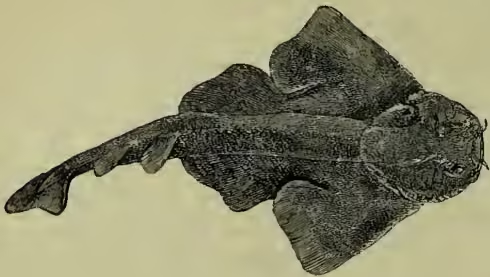
Angel-fish, a quaint and ugly fish belonging to the shark sub-order of Elasmobranchs (q.v.). It is often called the monk-fish, and is technically known as Rhina Squatina or Squatina angelus. The body usually measures about 4 feet in length, and is of a sandy gray colour above, and a dirty white beneath. The fish is in structure nearly allied to the sharks, but resembles the skate type, not only in its general habit, but also in its somewhat flattened body, and in its large pectoral fins, which, in their wing-like expansion, have won for this form its undeserved title of angel-fish. The gill-slits open laterally, however, and are only slightly covered by the bases of the fore-fins. The rounded head with terminal mouth, and wide spiracles behind the eyes, is wider than the body proper, and is separated from the pectoral fins by a short neck. The pelvic fins are situated just behind the pectorals, and there are two unpaired dorsals towards the tail. The rough skin is richly beset with Placid Scales (q.v.), and exhibits speci- ally large spines down the back and round the eyes. The teeth are conical. The fish has an exceedingly strong and peculiar ammonia-like smell. It occurs abundantly in European seas, hiding in the sandy bottom, and working havoc among the flat-fish. It is pretty common and specifically identical on the Atlantic coasts of North America. The young are born alive about midsummer. The coarse flesh is said to be nourishing. The rough skin has been long used for polishing purposes, for making instrument-cases and the like, and formerly had some repute as a powder for skin-diseases.