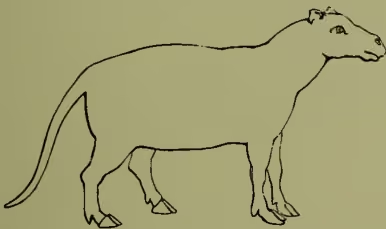
Anoplothe'rium (from the Greek an, 'not'; hoplon, ' armour; ' and thērion, 'a beast'), a genus of extinct even-toed hoofed animals, Artiodactyla (q.v.), established by Cuvier from bones occurring in great abundance in the gypseous strata of the Oligocene formation near Paris. They are found also in the same formation in the Isle of Wight and elsewhere. The teeth differ from those of all other Ungulates, extinct or recent. There are six incisors, two canines, eight præmolars, and six molars in each jaw—the dental formula thus agreeing with that of the fossil genus Palæotherium (q.v.); but the teeth are arranged in a continuous series without intervening vacancies—a circumstance very remarkable, as it does not occur in any existing quadruped, but now appears in man alone. The molars of the upper jaw have quadrate crowns; those of the lower are marked with a double or triple crescent of enamel, which forms prominent ridges. In some respects, the teeth resemble those of the rhinoceros, and exhibit generalised selenodont characters—that is to say, the teeth are crescentic, like those of the Ruminantia (q.v.), or ruminating quadrupeds, between which and the non-ruminant Artiodactyla the Anoplotherium has been thought to form a connecting link; but in some of the species originally included in this genus, and which are now sometimes ranked along with it under the name Anoplotheroids, the teeth exhibit peculiarities which have led to the supposition that their food may not have been exclusively vegetable. The snout is not much elongated, and it is evident that there was no proboscis. The feet are terminated by two toes, as in the Ruminantia; but they have always separate metacarpal and metatarsal bones, not a single canon bone. Several species of Anoplotherium have been determined—the size of the animal being about that of the ass. Closely allied to Anoplotherium are certain other genera, of which Dichodon and Dichobune are the most important. These, with Anoplotherium, form the family of the Anoplotheriæ.