Ant-eaters (Myrmecophagidae), a family of South American mammals belonging to the insect-eating division of the order Edentata. The absence of teeth, the long head, tubular mouth, worm-like tongue, the marked development of the third digit of the fore-foot, and the insect diet, are prominent characteristics of this small family. (1) The largest form is the Great Ant-eater (Myrmecophaga jubata), or Ant-bear, as it is called in Demerara, which inhabits swampy regions in South and Central America. It measures 4 feet in length, not including the bushy tail, which is sometimes as long as the body. The long coarse hair is of a dark-gray colour, and a black band extends from the chest across the shoulder backwards. The skull is prolonged into a narrow snout. The ears and eyes are very small. The long worm-like tongue may be protruded to a length of 18 inches from the tubular mouth at the end of the muzzle, and is covered with a viscid secretion from large glands which extend back over the chest. By this means, the very abundant termites or white ants are caught in great numbers as they issue from the invaded nest, and whipped with extraordinary rapidity into the mouth.
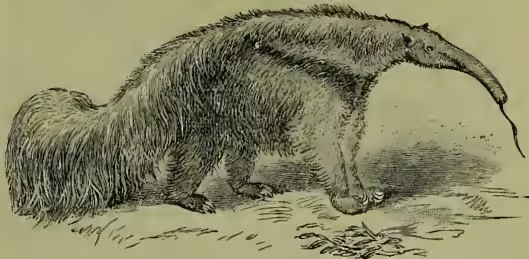
The internal opening of the nose is unusually far back in the mouth, as in crocodiles and whales. The posterior portion of the stomach forms a muscular gizzard in adaptation to the nature of the food. The third digit of the fore-foot is much larger than the three others, and bears a very powerful claw, which is used in breaking into the termite nests. In walking, the fore-toes are much bent, the pointed tips are protected by being turned inwards and upwards, and the animals thus rest their weight in a sort of club-footed fashion on the outer portions of the outer toes. The five toes of the hind-foot are almost equal, and bear strong claws; the broad sole rests on the ground. This form is wholly terrestrial, and has the reputation of being slothful, unsocial, and stupid. Like other insectivorous animals, it can live for prolonged periods without food. It spends much of its time in sleep, the long snout concealed in the fur of the breast, the hind and fore claws locked together, and the bushy tail thrown over all, as if for a shade from the sun. Though the collar-bones are rudimentary, the Great Ant-eater has great strength in its fore-legs, and is said to hug like the bear, so as to crush its enemy to death. The female bears but one at a birth, and carries it about on her back during its slow growth. The flesh is eaten by the Indians and negroes. Another much smaller form, the Tamandua (T. tetradactyla), is arboreal. The head is shorter, and the somewhat prehensile tail is scaly below and at the end. The Little Two-toed Ant-eater (Cyclosurus didactyla) is also arboreal. The skull is still shorter, the fur is softer, the feet adapted for climbing, the collar-bones well developed, and the tapering tail thoroughly prehensile.—(2) The Pangolins (q.v.), or Scaly Ant-eaters of the Old World, though closely related, belong to a different family, and are discussed elsewhere.—The name Ant-eater is given at the Cape of Good Hope to the Orycteropus capensis, the Aard-vark (q.v.) or Earth-hog of the Dutch colonists, a quadruped of about the same size as the great ant-eater of America, and belonging to the same natural order.—(3) The Echidna of Australia are sometimes called Porcupine Ant-eaters; but though they agree with the above in the nature of their food, and in the sharp snout and protrusible tongue, their general structure is quite different. See ECHIDNA. (4) The Myrmecobius fasciatus, a small marsupial of Australia, is also called ant-eater.