Aphides (Gr.), a family of small 'plant-lice' belonging to the order of hemipterous insects. They occur very abundantly in temperate regions as parasites on the roots, leaves, stems, &c. of plants, to which they frequently do great damage. Towards the tropics they seem to be replaced by the families to which the cochineal insects and Cicadas belong. The Rose Aphid, the 'colliers' of the bean-plant, the cottony 'American blight' of apple-trees, and the Phylloxera (q.v.) of vines, are too familiar representatives of the family. The mouth organs are adapted for piercing and sucking plants, and consist of four long sharp stylets within a proboscis or sheath. The posterior end of the body usually bears two projecting honey-tubes, which emit a sweet secretion. Wings may be absent in both males and females, but are usually present in the former, and absent in a section of the latter to be afterwards noted. The legs are long and slender, but not adapted for rapid movement; in fact, the aphides rarely wander far from their birthplace, except during the spring and autumn migratory flights of the females. Many forms migrate at the beginning of summer to another kind of plant, and return in autumn to their original haunt; but others seem to restrict their attentions to one form. The body is often brightly and protectively coloured—very frequently green or brown. They are generally dusted over with a protective mealy substance, and many forms exhibit a silky or cottony coat, secreted from skin glands.
Their presence is readily detected by marks, wrinkles, or abnormalities on the infested plant, and notoriously also by the 'honey-dew' which they secrete. This glutinous sweet substance which covers the leaves of trees, &c., especially during warm weather, is sometimes abundant enough to drop to the ground. It has excited interest from very early times, and has a widespread popular reputation for medicinal virtues. Pliny hesitates whether he ought to regard it as 'the sweat of the heavens, the saliva of the stars, or a liquid produced by the purgation of the air.' It is, however, a by-product, perhaps manufactured within the aphid from the juices of the plant on which it preys, or very probably an excretion, if not even a mere overflow, of surplus undigested glucose. The secretion oozes out from the honey-tubes above referred to, but similar products have also been observed to issue from the anus. Ants and other insects greedily hunt for this luxury, and the former have been seen tickling the aphides to induce secretion. They also tend, protect, and imprison these valuable sources of sweetness, which Linnaeus long since expressively called their 'cows' (see ANT). Besides injuring or killing plants by preying upon their juices, the aphides produce abnormal growths and Galls (q.v.). These are often of considerable size, and sometimes exhibit a protective mimicry of fruits. They serve as the homes or cradles of the parasites. The reproductive relations have been for long noted on account of the prevalence of Parthenogenesis (q.v.), or reproduction without fertilisation. At the end of autumn both male and female forms may be observed; and the fertilised eggs deposited in some safe place are hatched in spring, and give rise to female parthenogenetic forms, which are usually winged, and produce their young alive. Throughout summer there is a constant succession of parthenogenetic, viviparous females, and the number of generations appears to be limited only by temperature and food-supply. The return of autumn, however, means of course lowered temperature and scarcity of food, and these conditions are associated with the production of males. These fertilise the females, which are at this stage wingless, and the winter eggs are then laid. It appears that males may sometimes occur along with the viviparous forms, and that the latter may perhaps occasionally hibernate; but it is nevertheless demonstrable that warm weather and abundant food are conditions which result in the production of parthenogenetic females, while scarcity of food and cold weather cause the reappearance of males, and consequent sexual reproduction. Thus Réaumur succeeded in rearing above fifty parthenogenetic generations, all descended from one mother, by keeping up, for three or four years, an artificial summer. The experiment has been often repeated, and the viviparous parthenogenesis retained for even longer periods. The viviparous females are
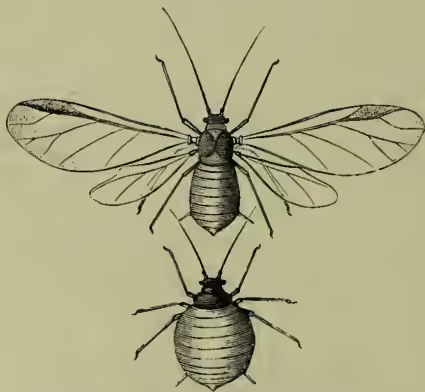
The figure represents equally well, 1, the autumn forms—the sexual male and the wingless female, the parents of the spring brood; 2, winged and wingless viviparous parthenogenetic forms occurring in spring; and 3, an autumn winged female appearing after a succession of wingless forms. frequently equipped with wings, which are generally absent in the egg-laying forms. They differ in other respects, but especially in the simplified structure of the reproductive organs, from which the young are developed by a process comparable to internal budding. So, too, the early spring forms, arising from fertilised eggs, resemble their sexual parents, and differ markedly from their parthenogenetic progeny. The eggs of aphides develop into active six-footed larvæ, which moult several times (see METAMORPHOSIS), and give rise to six-footed pupæ, which finally become imagoes.
It is quite impossible to give in figures any idea of the prolific increase of these luxurious parasites. Even during its short lifetime an aphid may have a progeny computable only in billions. A score may be born in as many hours, and these become in a few days the founders of new families. From a form producing only one per day, a population of not less than the fifteenth power of 210 would be the result at the end of 300 days, while an even more moderate computation given by Huxley shows that the tenth brood alone would weigh more than 500 millions of stout men. The increase is continually checked, however, by storms and sudden changes of weather, and also by the voracity of birds and insects. Some insects regularly feed upon aphides, while others deposit their ova in their living bodies (see ICHNEUMON), and thus utilise them as living cradles for their young, which, in such cases, are literally born out of death. Favouring circumstances sometimes lead to the appearance of extraordinary swarms of aphides, which have been noted in local histories as 'darkening the sun,' and have left a more permanent mark in the destruction of certain crops. In this connection the tiny plant-lice are of some economic importance.
Apart from the vine insect Phylloxera (q.v.), which does so much damage in the vineyards of the Continent and North America, the aphides of turnip, cabbage, potato, bean, apple, pear, larch, &c. have frequently been the cause of widespread loss. The price of hops varies from one year to another very much according to the prevalence of the 'fly.' For the last hundred and fifty years aphides have been unremittingly studied. Their life-history was first precisely investigated by Réaumur and Bonnet, and many of the most noted naturalists have continued their researches. The reader is referred to G. B. Buckton's Ray Society Monograph on British Aphides (4 vols. 1876); and Miss Ormerod's work on Injurious Insects ought to be consulted for practical purposes.