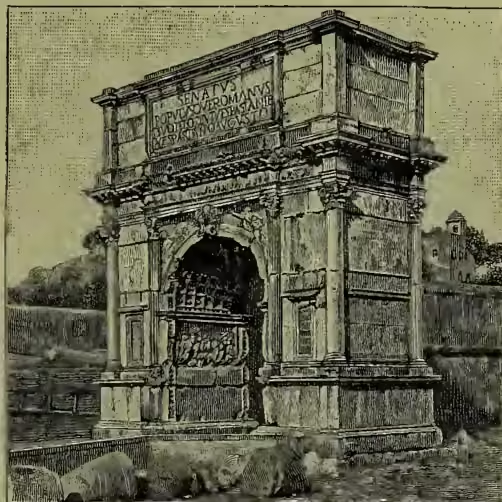
Arch, TRIUMPHAL, a structure erected by the Romans across roads, or at the entrance of cities, in honour of victorious generals. The earliest triumphal arches were two erected by L. Stertinius (196 B.C.) in the Circus Maximus and the Forum Boarium. Under the emperors, these structures became numerous and magnificent, and were decorated with bas-reliefs and inscriptions. Of nearly forty that were built during that period, at least three remain, those of Titus (circa 82 A.D.), Septimius Severus (203 A.D.), and of Constantine (306-337 A.D.). Numerous similar monuments exist also in other parts of the old Roman empire, as at Rimini, Susa, Verona, Ancona, Orange (in France), Capura (in Spain). Napoleon proposed to adorn Paris with four triumphal arches, and erected in 1806 the Arc de Triomphe du Carrousel, between the Louvre and the Tuileries, after the model of the arch of Septimius Severus. The Arc de Triomphe de l'Étoile, beyond the Champs Elysées, was begun at the same time, but not completed till 1836. Through it the Germans marched on their entry into Paris in 1871. In London there is the Marble Arch, transferred to Hyde Park in 1851 from Buckingham Palace, where
George IV. erected it at a cost of £80,000. It resembles the Arch of Constantine.