Arm. The upper extremity of the human body may be divided into three portions—viz. the shoulder, the hand, and the intermediate shaft or arm. The latter consists of an upper arm and a forearm. In the upper arm there is one bone, the humerus, h (fig. 1). This bone presents a globular head, which articulates with and moves freely upon the scapula, s, forming the shoulder-joint. At the junction of the head and shaft of the humerus, there is a constriction termed the anatomical neck.
The shaft is cylindrical in its upper part, but becomes flattened and somewhat three-sided below. A short distance above its lower end, and on the inner side, a hooked process pointing downwards is not unfrequently found. This represents a process of bone forming a complete foramen in carnivorous animals, through which the main artery and nerve of the limb run. At the lower end of the shaft two articular surfaces for the bones of the forearm are found; the outer, rounded for the head of the radius, r; the inner, a pulley or trochlea for
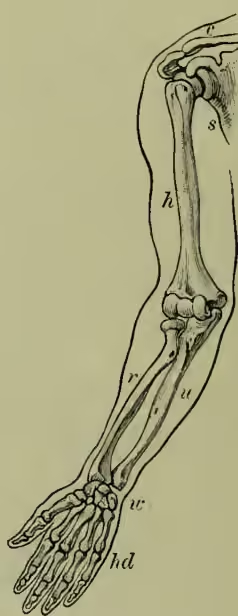
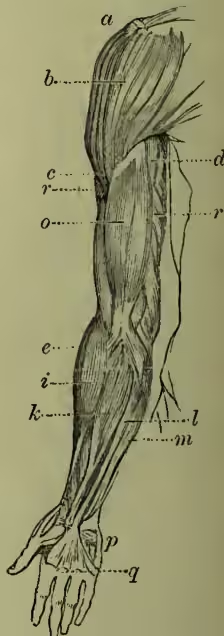
abc, deltoid muscle; d, coracobrachialis muscle; r, r, triceps; e, i, extensors of wrist and long supinator of the hand; km, flexor of fingers and radial and ulnar sides of the wrist, and l, palm of the hand, or palmaris longus; p, palmaris brevis; q, palmar fascia; o, biceps. the movements of the ulna, u. The bones of the forearm are two in number, the radius and ulna; the former being placed upon the outer, the latter upon the inner aspect of the forearm. By their upper ends, these bones articulate with the humerus, to form the elbow-joint; by their lower ends, with the carpus, to form the wrist-joint, w.
The shoulder-joint is constricted upon the plan of a ball and socket, the bones being held in position by a capsular ligament which is very loose, thereby allowing freedom of movement to a greater extent than in any other joint in the body. This gain in movement occasions a loss of stability, hence dislocations are frequent. For the most part, the head of the humerus is driven downwards into the armpit, this being the only side of the joint unsupported by muscles passing to be inserted into the upper end of the shaft. See SHOULDER.
A large triangular muscle, the deltoid, raises the arm from the side—a movement distinctively human; it is depressed by the coraco brachialis, the latissimus dorsi (the great muscle of the back), and the pectoralis major (the great muscle of the chest); in addition, it can be carried forwards and backwards by the action of these muscles.
Circumduction is the result of a combination of these movements.
The elbow-joint is hinge-like or ginglymoid. It is provided with strong lateral ligaments, and its movements are extension or straightening of the forearm produced by the triceps; flexion or bending by the biceps, brachialis anticus, and supinator longus. During the latter movement, the twist upon the trochlear surface at the lower end of the humerus causes the hand to be carried inwards in the direction of the mouth.
Joints called radio-ulnar are found between the bones of the forearm at their upper and lower extremities. The movements at these joints affect the hand, for it articulates with the lower end of the radius to which they are principally due. When the radius rolls forward upon the ulna, the palm of the hand is turned downwards—pronation; when it rolls backwards, the palm is turned upwards—supination. Each movement is produced by two muscles, which take their fixed points from the humerus and ulna.
A variety of the hinge-joint is found between the radius and carpus, for, in addition to flexion and extension, the hand can be drawn to the radial or ulnar borders of the forearm. These movements are effected by the palmaris longus, the flexors and extensors of the radial and ulnar sides of the wrist.
The upper extremity is supplied with blood by the continuation of the axillary trunk, the brachial artery, and its branches. The veins collect into large superficial trunks, which unite at the bend of the elbow, at which situation one is frequently selected for venesection, and then pass on to join the axillary, on the outside by the cephalic vein, on the inner side by the basilic. The axillary vein is formed by the junction of superficial vessels just mentioned with the deeper companion veins which accompany each branch of the brachial artery.
The nerves pass down as large cords by the side of the artery, and diverge from it to their ultimate distributions; the musculo-spiral soon passing round the back of the upper arm to appear on the outside, and become the radial and posterior interosseous nerves; the ulnar running behind the internal condyle, for which it has obtained the term 'funny bone,' from the electric-like thrill which passes along the arm when the nerve is struck or pressed. The median, as its name implies, keeps a middle course with the artery. See NERVOUS SYSTEM.
The arm affords excellent illustrations of some of the principles of mechanics. The insertion of the muscles so near, as will be seen, to the fulcrum or centres of motion, involves a loss of power in the usual sense of the word; there is, however, a corresponding gain in velocity at the end of the lever; and for most of the purposes to which the hand is put, agility is of far greater moment than dead strength. See LEVER.
As far back as 1795, attention was first directed by White to the proportion between arm and forearm. Subsequent measurements have shown that a long humerus, and a still longer radius, are essentially ape-like characters, while the very reverse is typical of man, in whom the radius is shorter than the humerus. In anthropoid apes, the arm, from shoulder to wrist, is therefore longer than in man.
Extending the investigation to the different races of mankind, we find that there is very little divergence, except in the case of the African negro and Australian aboriginal, in whom the forearm is longer than in the white races. Notwithstanding this approximation to the anthropoid type, the arm of the negro, from shoulder to wrist, is a little shorter than that of the European. The explanation of this anomaly is found in the fact that the humerus of the negro is shorter than that of the European, and thus two inferior characters—a short humerus and a long radius—have combined to produce a superior one—a short arm. This affords an illustration of the fact that the proportions between human and anthropoid skeletons may approximate at one point while they diverge at another, even in the same type.