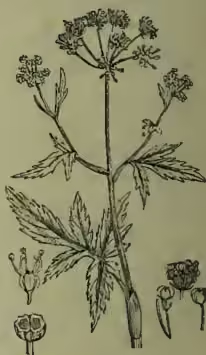
Arraca'cha (Arracacha cesculenta), a plant of the natural order Umbellifere, a native of the elevated tablelands in the northern parts of South America. It is much cultivated in its native country for its roots, which are used as an esculent. When boiled, they are firm and tender, with a flavour not so strong as that of a parsnip. The plant is very like hemlock, to which genus Humboldt indeed referred it, and has a similar heavy smell. The flowers are in compound umbels, and are of a dull purple colour. The arracacha was at one time very strongly recommended as a substitute for potatoes; it was introduced into Britain through the exertions of the Horticultural Society, and its cultivation perseveringly attempted; but it has been found unsuitable to the climate of Britain, and of other parts of Europe where it has been tried, perishing on the approach of the frosts of winter without having perfected its roots. The dry weather of summer is also unfavourable to it. The climate of the south of Ireland resembles that of its native regions more than any other in the British Islands. It seems to require a very regular temperature and constant moisture. There are probably some parts of the British colonies in which the arracacha would be found a very valuable plant. In deep loose soils it yields a great produce. It is generally propagated, like skirret, by offshoots from the crown of the root. By rasping the root and washing, a starch, similar to arrowroot, is obtained.—There is another species of the same genus, A. moschata, the root of which is uneatable.