Ass (Asinus), a genus of Perissodactyla (q.v.), closely related to the Horse (q.v.). It differs from the latter in having short hair at the root of the tail and a long tuft at the end, in the absence of warts on the hind-legs, and in the persistence of stripes, except in albinos. The upright mane, the long ears, the cross stripe on the shoulders, and the dark bands on the back, are also characteristic. The domestication took place at an early date, probably before that of the horse, from a type like the present Abyssinian ass (A. tæniopus), and apparently in Asia; but the donkey has been common in England only since Queen Elizabeth's time. The dwarfing and degeneration so generally exhibited are the results rather of ill-treatment and careless breeding than of uncongenial climate, as the condition of the domesticated forms in some favourable parts of the East plainly indicates. In Arabia, Syria, Egypt, Spain, Kentucky, and elsewhere, the asses are well cared for, and the breed has been considerably varied and improved; a Spanish he-ass of a good breed may be worth £200. In Britain not a little improvement has been due to the kindly interest of the late Lord Shaftesbury. The stupidity for which the animal has for long been proverbially reproached seems largely the result of human influence. The male ass is capable of procreation at two years old; the female carries her foal eleven months. The mule is a hybrid bred between mare and male ass; while the hinny is the rarer result of hybridism between horse and female ass. The mule is much nearer in temper and appearance to the ass than to the horse; the hinny in some points resembles the horse more, as it neighs, while the mule brays like the ass. The ass is admirably adapted for a beast of burden, being remarkable for endurance, hardiness, and docility under kind treatment. The peculiar pace, the quaint intelligence, often superior in spite of ill-usage to that of the horse, curious traits of character such as the aversion to cross water, which is probably an unconscious recollection of ancestral nomadic life, the longevity and general hardiness, are facts as familiar as the names donkey, dicky, neddy, cuddie, &c. of these useful animals.
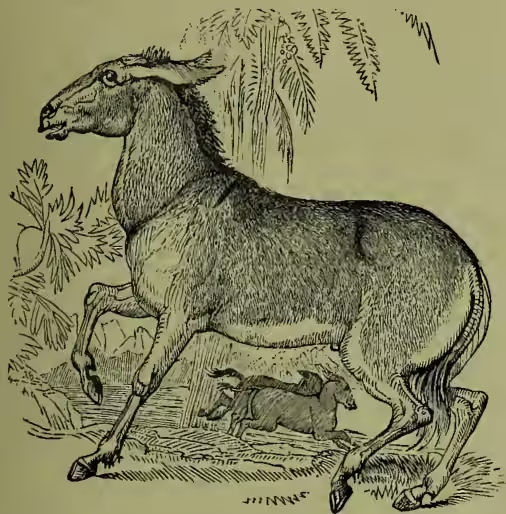
The various species of wild asses are handsomer in form than the familiar degenerate donkey. They have shorter ears, and longer, finer limbs. The shy, swift A. onager occurs in herds in the Asiatic deserts, migrating southwards in winter. The large, handsome A. hemionus, with dark stripes on its back, inhabits high plateaus from Tibet to Mongolia; see DZIGGETAL. The Abyssinian form has been already noted as the probable ancestor of the donkey. The even wilder Zebras and Quaggas will be discussed separately.
The wild ass is hunted in the East—e.g. in Persia; and the flesh of the hardly-won booty is much esteemed. The milk of the ass is more sugary and less cheesy than that of the cow, and is on that account recommended to some invalids—
e.g. consumptives. The leather called Shagreen (q.v.) is made by a peculiar process from the skin, which is also utilised for shoes and drums. The ancients are said to have used the bones for making flutes. From early times, white (albino) asses were reserved for the use of the honoured. The reader may be referred to Darwin's Animals and Plants under Domestication, where some other works are noted. See DOMESTICATION, HORSE, ZEBRA, QUAGGA.