Assyria (called Assur in the Assyrian inscriptions, Athura in the Persian, and Assura in the Median) was the northernmost of the three great countries that occupied the Mesopotamian plain. It was bounded on the N. by the Niphates Mountains of Armenia; on the S. by Susiana and Babylonia; on the E. by Media; and on the W., according to some, by the Tigris, but more correctly by the watershed of the Euphrates, for many Assyrian ruins are found to the west of the Tigris. It was thus about 280 miles long from N. to S., and rather more than 150 broad from E. to W. This plain is diversified by mountain-chains on the north and east, and watered by the Tigris and its affluents, between two of which—the Zab rivers—lay the finest part of the country, called Adiabéné. As it was the boundary-land between the Semitic people and Iran, it became the scene of important political events. Its extraordinary fertility enabled it to support a large population. The high degree of prosperity and civilisation reached by its inhabitants in very early times is attested not only by ancient writers, but by the extensive ruins of mighty cities, by the canals and contrivances for irrigation, and by the numerous proofs—furnished by recent excavations—of an acquaintance with the arts and sciences. The ruins of many cities are grouped around Nineveh; while lower down, the Tigris exhibits an almost unbroken line of ruins from Tekrit to Bagdad. Under the Mohammedans this fine country is now almost a desert.
History.—Ancient authorities differ widely from each other respecting the rise and progress, the extent and the duration, of the Assyrian empire. Berosus, a Greco-Chaldean priest at Babylon, who wrote about 268 B.C., and Herodotus, who there is strong reason to suspect did not visit Babylonia, as he claims to have done, differ widely from Ctesias of Cnidus, who was court-physician to the Persian king Artaxerxes Mnemon (405 B.C.); the latter, no doubt, writing from distorted Persian sources, Herodotus from the reports of Greco-Egyptian and Phœnician dragomans. Berosus, who was a member of the caste of Chaldean scribes, and able to read the inscribed records in the Babylonian libraries, has hitherto met with very strong confirmation from the inscriptions.
In the Bible narrative we are told that Nineveh was founded from Babylonia—'Out of that land (Babylonia) he (Nimrod) went forth into Assyria' (Gen. x. 11)—and this statement is fully confirmed by the results of recent explorations. The earliest inscriptions found on the bricks from Assur (Kileh-Shergat), the ancient capital, give to the first rulers of the land the Akkadian title of Patesi or 'high-priest of the city of Assur,' and to the city itself the Akkadian name of Pal-bi-ki. The next notice of Assyria does not occur until the Assyrian king Pul or Tiglath-pileser II. invaded Palestine, and was bought off by Menahem, king of Israel (738 B.C.). In the same reign we find the Jewish king Jehohaz (Ahaz) becoming a vassal of the court of Assyria, and the tribes beyond Jordan carried away captive (734 B.C.). In 722 B.C. Samaria is captured by Sargon 'the Tartan,' who had usurped the throne from his weak master, Shalmaneser IV. The next reference to Assyria is that of the siege and capture of Jerusalem by Sargon (Isaiah, x. xi. xx.), and the siege of Ashdod (712-11 B.C.). This event is now proved to be distinct from the siege by Sennacherib in 701 B.C., which terminated apparently in a disaster for the Assyrian army. The last mention of Assyria is the record of the murder of Sennacherib by his sons in 681 B.C., and the accession of his faithful son Esar-haddon, the most powerful of all the Assyrian monarchs, for he carried his arms as far as the Mediterranean and conquered Egypt. Little credit is to be attached to the expedition of Holofernes recorded in the Book of Judith.
After this the empire appears to have gradually decayed, until at last, in the reign of Assur-bani-pal or Sardanapalus, or that of Esar-haddon II. (Sarakos), a league for its destruction was formed between Nabopolassar, governor of Babylon, and Cyaxares, king of Media, which was strengthened by the marriage of Nebuchadnezzar, son of the former, to Nitocris, daughter of the latter. The war and siege are said to have been interrupted by an invasion of the Scythians, which drew off Cyaxares; but at length Nineveh was taken and destroyed about 605 B.C., or, according to Rawlinson, 625. In the time of Darius Hystaspes, Assyria rebelled without success in conjunction with Media. In the time of Herodotus, the capital had ceased to exist; and when Xenophon passed it, the very name was forgot, though he testifies to the extent of the deserted city, and asserts the height of the ruined walls to be 150 feet. An inconsiderable town seems to have existed on its ruins in the reign of Claudius; and the last notice we have of Nineveh in the classics is in Tacitus.
The fanciful history related by Ctesias is now found to be based on distorted Greco-Persian traditions, and though the writer managed to make the ancient world give credit to him in preference to Herodotus, his work is now proved to be very untrustworthy. According to him, for thirty generations after Ninys, the kings led a life of luxury and indolence in their palace; the last of them, Sardanapalus, made a vigorous defence against Arbaces, the rebel governor of Media, but finding it impossible to defend Nineveh, he set fire to his palace, and burnt himself with all his treasures; this event took place 1306 years after Ninus. Now, the above account represents Nineveh to have perished nearly three centuries before the real date, which was about 606 B.C., and is utterly incompatible with Scripture. Herodotus assigns to the empire a duration of 520 years, and Berosus of 526. In order to reconcile these conflicting accounts, historians have supposed that Nineveh was twice destroyed, but this supposition is now generally rejected. However, that part of Nineveh was actually destroyed by fire, is proved from the condition of the slabs and statues found in its ruins, which show the action of intense heat.
Assyria became a Median province, 606 B.C., and afterwards, in conjunction with Babylonia, formed one of the satrapies of the Persian empire. In 331 B.C., at Gaugamela, near Arbela, in Assyria, Alexander defeated Darius Codomannus. In 312 B.C. Assyria became part of the kingdom of the Seleucidae, whose capital was Seleucia, on the Tigris. It was afterwards subject to the Parthian kings, whose capital was Ctesiphon, and was more than once temporarily in possession of the Romans. When the Persian monarchy of the Sassanides was destroyed by the successors of Mohammed, Assyria was subject to the califs. Their seat was Bagdad from 762 A.D. till 1258. It has been under the Turks from 1638, at which period it was wrested from the Persians.
Monumental History.—The Babylonian monarchy was already growing old before the Assyrian began. The early rulers of Assur were mere governors appointed by the Babylonian kings. They gradually acquired more power until they managed to set up an independent kingdom at Assur (about 60 miles below the later capital, Nineveh), in the 17th or 16th century B.C. A constant border warfare was long kept up, though alliances were made from time to time, and even cemented by marriages, as when Burna-Buryas of Babylon married Muballit-Serua, the daughter of Assur-uballit, about 1400 B.C. The first Assyrian king other than a patesi or viceroy, was Bel-kapkapi. His rule extended along both sides of the Tigris, but, under his successors, the boundaries varied with the valour of each king. The kingdom first began to be powerful under Rimmon-nirari I. about 1320. His son Shalmaneser I. founded Calah, and his grandson Tiglath-Adar I. had become so powerful that he invaded Chaldea and captured Babylon in the year 1280. His descendant in the direct line of kings was Tiglath-pileser I., about 1140, the real founder of the first Assyrian empire. The reign of this prince, Tiglath-pileser I., son of Assur-ris-ilim, forms the zenith of the early empire. He spread the dominion of Assyria over all Western Asia, from the frontiers of Elam to the shores of the Mediterranean, and from the slopes of the mountains of Armenia, the land of Uratu, to the shores of the Persian Gulf. He captured Babylon, Sippara, and Upiya (Opis), and reduced Chaldea to the position of a tributary state. On the west he advanced as far as Khilikhhi (Cilicia), defeating the Hittites and capturing their stronghold Carchemish, and receiving the homage of the people of Arvad and the cities of Northern Phoenicia. He repaired and enlarged the palace at Calah and the temple of Anu and Rimmon at Assur. The prince Assur-belkala, who succeeded his father in 1110, by his weakness as rapidly allowed the empire to fall into decay as his father by his energy had enlarged and consolidated it. For nearly two centuries Assyria sank below the horizon of Western Asiatic history, and became so weakened as to render tribute to the Vannic kings of Armenia. This period of decay is synchronous with the rise and rapid development of the Hebrew kingdom under David and his successors.
In 930 B.C. Assyria once more began to emerge from oblivion, and a new dynasty was founded by Assur-dân II., whose son Rimmon-nirari II. (911-889 B.C.), and great-grandson Assur-natsir-pal (883-858 B.C.), by a long series of cruel wars once more established the power of Assyria. All the old provinces of the former empire were recovered, and extensive annexations made in the regions to the north-east in Armenia and Kurdistan. During the period of the middle empire, the capital was removed from Assur to Calah (Nimroud), at the junction of the Tigris and Upper Zab (Lycus), about 20 miles below Nineveh, where elaborate temples and palaces were erected by the kings. Assur-natsir-pal was succeeded in 858 B.C. by his son Shalmaneser II., whose annals are found inscribed on the famous Black Obelisk in the British Museum, and on the bulls and slabs from his palace at Calah. For more than thirty years he carried out year by year a series of campaigns which established the power of Assyria over all Western Asia.
His reign is, however, most important for the fact that during his rule the Assyrian and Hebrew annals are first brought in contact, and a valuable series of synchronisms established, which is maintained until the fall of both kingdoms. In the year 854 B.C. Shahmaneser defeated in the battle of Karkar, fought in the Orontes Valley, a powerful confederation of allied Syrian tribes, of which the chief leaders were Benhadad, king of Damascus, Irkfuleni, king of Hamath, and Ahab, king of Israel, the latter contributing 2000 chariots and 10,000 foot-soldiers. Again, in the eighteenth year of his reign, the Assyrian king invaded Syria, and defeated Hazael of Damascus in a battle fought on the heights of Hermon or Shenir (Deut. iii. 9), and captured 1121 chariots and 470 carriages. He then besieged and captured Damascus, destroying the beautiful garden which then as now fringed the city, and after marching into the Hauran, where he destroyed many cities, he returned and held a tribute 'durbar' at Beyrout, near to which city his statue is carved on the rocks at the mouth of the Nahr-el-Kelb. Here he received tribute from the Tyrians, Sidonians, and Yahua abil Khumri, 'Jehu, the son of Omri.' To the Assyrians Samaria was known as Bit Khumri, 'the house of Omri;' and so Jehu was regarded as one of the line of Omri. The tribute paid on this occasion indicates the wealthy condition of the Israelite capital; 'silver, gold, a bowl of gold, cups of gold, pitchers of gold, and a sceptre for the king's hand.' The reign of Samas-Rimmon II. (823-810 B.C.), the son of Shalmaneser, who succeeded to the throne after a rebellion and civil war lasting two years, added largely to the eastern provinces, and the Assyrians came for the first time in contact with the Aryan invaders who were advancing from the north-east.
In the year 763 B.C. the Assyrian eponym canon records the observation of a solar eclipse in the month Sivan, which is now identified as that of the 15th of June. This eclipse forms the pivot-point on which Assyrian chronology turns. The empire now began to display signs of weakness, and when Assur-nirari ascended the throne in 753 B.C. there were many indications of a spirit of revolt. This is indicated by the statements in the eponym canon. Arpad in Syria revolted, and for four years the army remained at home, owing no doubt to the disturbed state of the country. An attempt was then made to repress the revolts in Namri or Kurdistan, which apparently failed, for in the year 746 B.C. we have a revolt in Calah, which indicates a rebellion of the army, followed by the usurpation of the throne in 745 by Pulu or Pul, a Babylonian who assumed the Assyrian name of Tiglath-pileser II. Like his early namesake, he proved the saviour of the nation, and at once instituted an entirely new system of government of the provinces of the empire. In former times it was conquest and spoil rather than annexation and annual revenue that formed the policy of the rulers of Assyria. Tiglath-pileser II., however, introduced a new system into the government, that of centralisation. Conquered districts were now annexed and became satrapies ruled by Assyrian officials, and responsible for a fixed yearly revenue to the central government. The leaders of the national party in these regions were removed to Assyria, and their place supplied by bands of colonists from other regions, as in the case of Samaria, Arpad, and Hamath. Another great aim of the new sovereign was the control of the great commercial centres in Western Asia. Thus Carchemish and the cities of Phoenicia were objects of campaigns to secure the trade-route through Syria. In 742 B.C. Arpad revolted and was besieged two years by the Assyrians, and its subsequent fall brought about the conquest of North Syria.
Hamath, then in alliance with Uzziah, king of Judah, and whose king Eniel may have been, as Professor Sayce suggests, a Jewish nominee, was taken by storm, and the kings of Syria hastened then to pay homage to the conqueror. Among the names mentioned in the inscriptions we find Menahem, king of Samaria, Rezin of Syria (Damascus), Hiram of Tyre, Pisiris of Carchemish. This was the campaign referred to in the Scriptures (2 Kings, xv. 19), when Menahem gave a thousand talents of silver to Pul, king of Assyria. The successful war in Syria and Palestine was followed by campaigns in Armenia on the shores of Lake Van. The Assyrians next appear in Syria as the allies of Ahaz, called Yahua-khazi or Jehoahaz by the Assyrian scribes. The result of this campaign was the siege of Damascus, and the ravaging of the kingdoms east of Jordan. The fall of Damascus made Syria a province of the court of Nineveh, and the tribute-lists discovered by Sir Henry Layard at Nineveh show Carchemish, Damascus, Arpad, Arvad, Hamath, Tyre, Sidon, and Samaria as contributing a regular sum to the national revenue. Having reduced the west to submission, the Assyrian king now attacked Chaldea, and after a severe war, commencing in 731 B.C., he defeated and slew Ukin-ziru, the Kinziros of the Canon of Ptolemy, and was proclaimed king of Sumir and Akkad in 729 B.C.
This important reign ended abruptly in 727 B.C., and a weak prince, Shalmaneser IV., of whom no inscriptions are extant, ascended the throne. He made an ineffectual attempt to capture Tyre, which had revolted, and during the siege either died or was murdered at the instigation of Sargon, 'the Tartan' or commander-in-chief of his army. The usurper continued the war in Syria, and in 720 B.C. captured Samaria and carried away 27,280 of the leading inhabitants, and placed them in the province of Gozan, near the Khabour, and in Media. The latter days of the reign of Tiglath-pileser II. evidently had been marked by a general revolt of the provinces, which Sargon had to reconquer; and in the battle of Raphia on the borders of Egypt, which terminated the war, he checked the advance of the Egyptians under Sabako. In 717 B.C. the Hittite capital, Carchemish, fell, and produced the rich spoil of 'eleven talents, thirty maneh of gold, and two thousand one hundred talents of silver.' All this time the intrigues of Merodach-baladan III. in Chaldea were causing trouble, but the disturbed state of the other provinces still kept Sargon from the object he most desired—the conquest of Babylon. In order to delay the attack, Merodach-baladan sent his embassy to Hezekiah, and raised a revolt in Syria, in which Phoenicia, Moab, Edom, and Philistia, supported by the Egyptians, took part. Sargon besieged Jerusalem and burned Ashdod (Isaiah, xx. 1). Having quelled the revolt, Sargon invaded Babylonia, and after a terrible campaign captured the capital, Merodach-baladan taking refuge in flight, and was proclaimed king 710 B.C. Tablets dated in his reign as king of Babylon are preserved in the British Museum. Sargon built for himself a magnificent palace called Dur Sargon, 'Fort Sargon,' marked by the ruins at Khorsabad, about 15 miles from Nineveh. This palace was explored by M. Botta for the French government, and the fine sculptures from this site form one of the treasures of the Louvre. The bas-reliefs, sculptured figures, and architectural decorations of this palace show a new departure in Assyrian art, and indicate foreign influence. Sargon was killed during a revolt of the soldiers in the new palace on the 12th day of the month Ab (July) 705 B.C., when his son Sennacherib succeeded him. The annals of Sennacherib are only known to us for eight years of his reign. The Babylonian revolt on the death of Sargon led to the return of Merodach-baladan, but nine months later he was defeated by the Assyrians in the battle of Kisu. At the same time a revolt broke out in Philistia, and the people of Ekron having deposed the Assyrian nominee Padi, sent him for security in chains to Hezekiah, king of Jerusalem, who placed him in prison. This brought on the Jewish king the vengeance of Sennacherib. Having conquered Phœnicia, he marched against Ekron, where he punished the chief priests and Philistine lords who had broken their oaths to Assyria, defeating the allies on the plain of Eltekeh, where they were aided by a strong contingent of Egyptian troops. He next ravaged Judæa, capturing forty-six cities, chiefly in the hill-country, and then advanced to Jerusalem. Here he states he shut Hezekiah up in the capital 'like a bird in a cage.' There is no indication in the inscriptions how long this siege lasted, and the meagre account of this event in the campaign, and the remarkably abrupt termination of the account, seems to indicate that the siege terminated in a disaster to the Assyrian arms. The tribute paid by the king was sent by an envoy to Nineveh, not paid on the surrender of the city; and this, together with the fact that Sennacherib never again entered Palestine, seems to confirm the statements of the Hebrew writers.
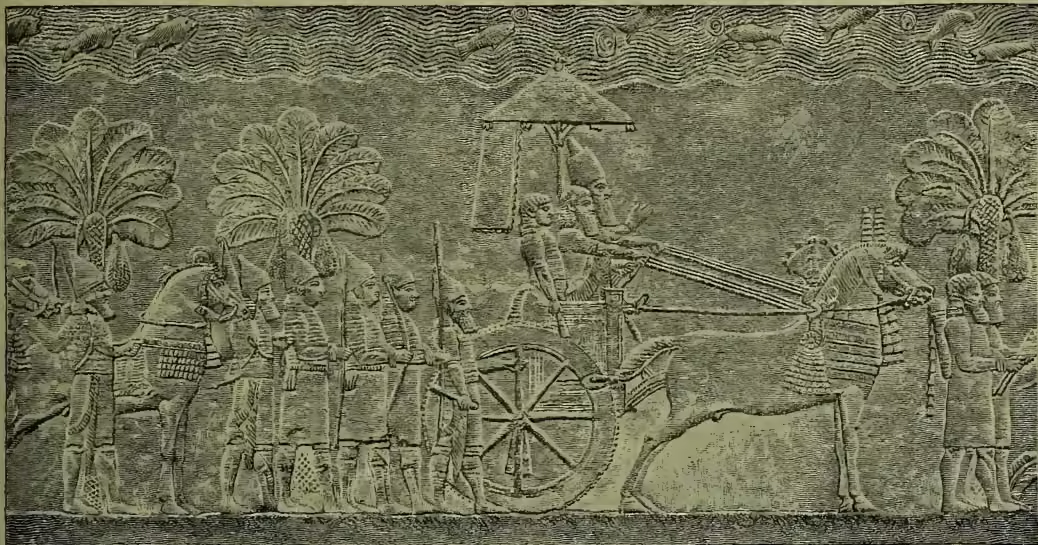
(Height, 38 inches—British Museum.)
The statement as to the murder of Sennacherib by his sons meets with a most accurate confirmation from the inscriptions. In the Babylonian canon we are told that on the 20th of the month Tebet (December) 681 B.C., the king was slain by his two elder sons, who were jealous of the favour shown to their younger brother Esar-haddon, who was at the time serving with the army. Seven weeks later, Esar-haddon overthrew his brothers, together with their ally Erimenas, king of Armenia, at Malatiyeh in Cappadocia, entered Nineveh in triumph, and placed himself upon the throne. Though the most active general of his father, Esar-haddon was far more than a mere warrior. He possessed great political tact, and at once inaugurated a new policy with regard to the troublesome court of Babylon. He divided the court between Babylon and Nineveh, residing at the former place during the winter, the latter in the summer months. It was during one of these periods of the winter court at Babylon that Manasseh was brought prisoner (2 Chron. xxxiii. 11). A son of Merodach-baladan had attempted during the period of anarchy to seize the throne of Babylon, but being defeated, he fled to Elam, where he was put to death by the Elamite king, who wished to preserve the friendship of the king of Assyria. In 675 the Assyrian king commenced one of the most important wars in the whole period of Assyrian history—namely, that which resulted in the subjugation of the powerful kingdom of Egypt to the Assyrians, and left the ancient world under one rule for twenty years, thus first giving to the world the idea of universal empire. After the war had waged with varied success for more than three years, the Assyrian king made one great effort to terminate it. A very powerful army left Nineveh the first day of the year, and took the road to Egypt. The march occupied three months, and on the Assyrians having reached the Egyptian strong-holds, a series of battles was fought, resulting in the retreat of the Egyptians on Memphis, which was captured by the Assyrians on the 22d of Tammuz (June), whereupon King Tirhakah fled up the Nile. Esar-haddon returned by way of the coast of Syria, receiving en route the tributes of the Phœnician and Greek kings of Cyprus, and the Philistine, Moabite, and Israelite rulers. In commemoration of this successful campaign, the king had his statue carved on the rocks at Baal-Rasi (Nar-el-Kelb), and an inscription recording the capture of Memphis engraved upon it. Before leaving Egypt the Assyrian king divided the newly conquered land into twenty satrapies, ruled by prefects subject to the court of Nineveh.
The Egyptians did not long remain quiet after the departure of the main body of the Assyrian army; for Tirhakah returned from the Upper Nile, and the Assyrian king had once more to prepare for a campaign in the Nile Valley. During his absence with the main body of the army in Egypt in the previous year, a revolt had been raised in Nineveh; so the king, to guard against the repetition, crowned Assur-bani-pal, the eldest of his four sons, king, and placed him on the throne to rule in Nineveh, 12th Iyyar (April) 669. Two years later, during the campaign, on 12th
Marchesvan (October), the warlike Esar-haddon died with the army. Assur-bani-pal had all the ambition, but he lacked the genius of his father. He was a generous patron of art and letters, and his reign was the culminating point of Assyrian splendour. He continued the Egyptian war, drove Tirhakah from Memphis to Thebes, which city he captured and stripped of its treasures. Phœnicia was next invaded, and Tyre captured, after a siege lasting some months. Campaigns in Elam and in Northern Arabia next occupied the army. The empire was now shaken by one of the most serious revolts raised against the government. Acting, probably, on the advice of his father, Assur-bani-pal had appointed his brother, Samas-sum-yukin (the Saosduchinos of the Canon of Ptolemy), viceroy of Babylon, who, taking advantage of the absence of the Assyrian armies in various lands, rose in revolt, aided by the Elamites, Arabs, and by the Egyptians under Psammetichos. The revolt lasted more than five years, and at last Babylon, Borsippa, Sippara, and Cuthah were besieged and taken, and fire, sword, and pestilence spread through the land. The rebellious prince burned himself in his palace with many of his followers.
This revolt, however, shook the foundations of the empire, and soon the vast fabric began to totter. Egypt declared her independence, Syria was in revolt, Elam and the north-eastern provinces refused tribute, and Kandalanu, the new viceroy of Babylon, proclaimed himself king, while his successor Nabopolassar, father of Nebuchadnezzar, openly threw off all semblance of his allegiance and declared himself king. Assur-etil-il-yukinni succeeded his father about 640. He rebuilt the palace of Calah, and bricks bearing his inscriptions have been found there. The last Assyrian king was Esar-haddon II. (the Sarakos) of Ctesias. There are some tablets relating to this prince which show that during his rule the north-east provinces were invaded by a powerful confederation of Aryan and Turanian tribes, Medes, Gimmerians, and Armenians, under the command of Kazarit (Cyaxares). The meagre character of the inscriptions about this date, and the apparent number of claimants to the throne, indicate that after the death of Assur-bani-pal a period of disruption and anarchy set in, followed about 606 B.C. by the siege and destruction of Nineveh, after which Assyria became a Median province. The Mespila mentioned by Xenophon in the 'retreat of the Ten Thousand' was probably the Musaphi of the inscriptions, 'the lower town'; the acropolis having been destroyed. The remains of Sassanian art found by explorers on the site indicate that the town was occupied then and in Roman times.
Chronology.—The chronology of the Assyrian empire now rests upon a very firm basis, being founded on several carefully prepared chronological inscriptions. The most important of these is the 'Eponym Canon,' a tablet containing a list of the archons, or eponyms of Nineveh or Calah, giving an exact chronology from 913–659 B.C. As each of these officials ruled in office only one year, the year was named after them; and as the date of the official year of Bursagah is fixed by a solar eclipse, the dates of all the officials can be ascertained. Fragments of seven copies of it were discovered by Sir Henry Rawlinson in 1862. An historical inscription of Rimmon-nirari I., dated on the side by the name of the eponym of the year, enables us to go back as far as 1330 B.C. A recent discovery has brought to light a table of Semitic Babylonian kings, arranged in dynasties, traced back as far as 2330 B.C. The dated contract tablets give us further help for the later dates. The parallel Assyrian inscriptions give much help in settling the chronology of Babylonia.
Government.—The government during the early and middle empires was a pure despotism and rule by force of conquest, held together by the obligations of tribute and homage; but no centralisation existed. In the reign of Tiglath-pileser II., an extensive system of central government with the accompaniment of bureaucracy was introduced. In conquered lands the native rulers were either removed and replaced by nominees from the Assyrian court, or a resident ambassador placed in the court. Tributary cities were ruled by prefects (pikhate) and sub-prefects. Revenue was levied by collectors from all towns and districts, and an annual present from the native princes. In home government the Assyrians modelled their system on that of Babylonia. Taxes were levied on all produce from towns and villages, and tithes for the temple revenues. Special taxes were levied for the army, the river-flotilla, and the maintenance of the royal roadways. Justice was administered by appointed judges, the courts being held in the temples or in the city gate, with the right of direct appeal to the king. The king had absolute power over life and death, and offenders were treated with the greatest cruelty; impalement, decapitation, mutilation, and burning by fire, were the punishments inflicted. The king was feudal lord of all land, and could grant or take away any estates except those of the temples. Public works were carried out by corvée (forced bands of labourers) and captive-labour, provisions for the workmen being provided by the state.
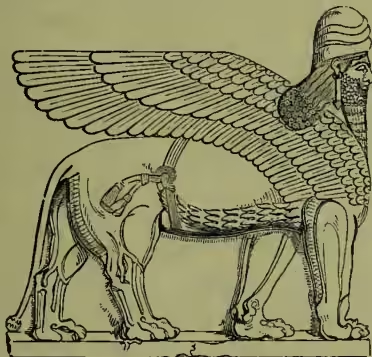
Religion.—The religion of Assyria, though essentially of Babylonian origin, was much simpler, and though polytheistic in character, was free from the multitudinous pantheon of the more ancient empire. At the head of the pantheon was the god Assur, the national deity, always invoked first in the royal inscriptions, and regarded as the divine founder of the nation. He is called 'the holy one,' 'the glorious chief of the gods.' His name does not appear in the 'Chaldean Creation Tablet.' The Assyrian pantheon consisted of two principal triads, with numerous minor deities: (1) The Nature triad, whose birth is described in the Creation Tablet—Anu, 'the father of all the gods,' 'the Progenitor, who changes not the decree coming forth his mouth,' 'the lord of heaven,' 'the heaven.' Bel, the second member of the triad, is called 'lord of the world,' 'lord who protects the land'; he was the ruler of the earth. Hea, the third member, was one of the most important gods in the pantheon. He was 'lord of the sea, of rivers and fountains,' 'lord of wisdom and knowledge. (2) The Celestial triad.—This triad consisted of the moon-god, Sin, called the 'illuminator of earth,' 'the lord of waxing and waning,' 'the lord of laws.' The sun-god, called Shamas, 'the judge of heaven and earth,' 'the lord of light,' 'the driver away of evil.' The sun-god was one of the gods most worshipped in the Assyrian pantheon; and the morning and evening hymns to this deity are among the most beautiful specimens of Assyrian sacred literature. Istar, the third member of this triad, was the goddess of the crescent moon, and the 'queen of the stars.' Strictly speaking, the goddess Istar was the only goddess in the Assyrian pantheon, and she assumes many and varied attributes. She was also 'queen of war and battle,' 'the archeress of the gods.' Among the minor divinities, the most important was the god Marduk or Merodach, the son of Hea. This god occupied a most important position; he was 'the mediator between gods and men,' 'the protector of mankind,' the 'god who raises the dead to life.' The goddess Zirāt-banit, the Suceoth-benoth of the Bible (2 Kings, xvii. 30), appears but little in the Assyrian inscriptions, though most often invoked in those of Babylonia (q.v.). Next in importance was Nebo, the god of learning, and his consort Tasmituv. The libraries in Nineveh and other cities were all dedicated to this god, and the epithets applied to him indicate that he was the Assyrian Hermes. He is called 'the wise god,' 'the lord of illustrious birth,' 'the enlarger of the mind,' 'the writer of inscriptions.' Nergal (2 Kings, xvii. 30) and Nusku were the gods of war and hunting, and the former also the god of death, with the title of 'the great devourer,' to whom the winged lions at the temple or palace gates were dedicated. The two gods of Sepharvaim, Adrammelech and Anammelech, are to be identified with Adar-malik, 'the god of the noonday sun,' and Anu-malik—Anu, the father of the gods. Most of the other minor divinities were those worshipped principally in Babylonia. The religious ceremonies of Assyria bore a close resemblance to those of Babylonia, the temples being orientated to the north-east, and the holy place separated from the nave by a veil. The morning and evening sacrifice, the offering of cakes, wine, milk, and honey, are found in the liturgies of the temples. See BABYLONIA.
Ethnology.—The Assyrians, it is now generally acknowledged, were a branch of the Semitic family of nations, and therefore were members of the same grand division of the human race as the Syrians, the Phoenicians with their colonies, the Jews, and the modern Arabians. Long prior to the 21st century B.C., Semitism, as a distinct ethnic element, appears to have first established itself in Chaldea. The races variously called Scythic, Turanian, or Tartar, appear to have once been spread over the whole space from the Caucasus to the Indian Ocean, and from the Mediterranean to the mouths of the Ganges. Their type of language has continued to our time to exist in the greater part of Asia, and in some of the remotest corners of Europe, as among the Finns, Lapps, Turks, and Hungarians. In Chaldea they were the dominant race until about the 21st century, when the pressure of eastern invaders, Elamites, &c. forced the Semites from Chaldea. Then seems to have commenced a series of migrations. Assur went forth probably at this time from Babylon to Assyria, Abraham and his followers to Palestine. From these seats, Semitism was afterwards carried to Cyprus, to the southern seaboard countries of Asia Minor, to Carthage, Sicily, Spain, and Western Africa.
The traditions of Assyria indicate a very early connection between Ethiopia, Arabia, and the cities on the Euphrates. Mesopotamia undoubtedly contained a large proportion of Arabs, and this accounts for the fact that Herodotus styles Sennacherib king of the Arabians and Assyrians.
The Chaldeans, colonies of whom were planted in Armenia by the Assyrian kings, were probably removed from the south. But the Sumirian-Akkadian races (see BABYLONIA) are now shown to have inhabited Babylonia from the remotest times, and by them the earliest civilisation in Mesopotamia was originated (see CUNEIFORM, INSCRIPTIONS).
In language, Assyrian is clearly allied to the northern branch of the Semitic family. The vocabulary has a close affinity with Hebrew and Phoenician, while in the full development of the verbal conjugation, the use of numeration, and its richness of synonyms, it approaches nearer to the Arabic. The predominant features of the Assyrian ethnic type are Semitic, but modified by intermixture with Akkadian and other elements.
Literature and Civilisation.—One of the most important results of the explorations has been the discovery, in the palace of Assur-bani-pal at Nineveh, of a large library consisting of many thousand tablets, large numbers of which are now stored in the British Museum. This library, in all probability, owes its origin to the keen political insight of Esar-haddon, but was completed by his son Assur-bani-pal, whose name most of the tablets bear. In the colophon or docket attached to each tablet, the king says: 'The wise things of Nebo, all there was on tablets I wrote, I engraved, I explained, and, for the inspection of my people, in my palace I placed.' A careful study has been made of the tablets in this library, and it is evident it was chiefly composed of tablets copied from more ancient originals in the temple libraries of Chaldea, each being stated to be 'like its old copy,' or 'like the ancient tablets of Sumir and Akkad.' That such was the case is now demonstrated by the discovery of duplicate copies in the libraries of Babylonian cities. The library was evidently founded to prevent the youth of Assyria from going to be taught at Babylon or Borsippa, where they would be subjected to dangerous political influences. Its educational character is shown by the discovery of a number of syllabaries, dictionaries, and text-books for instruction in the ancient Akkadian and Sumirian languages. These tablets, called by the Assyrians 'tablets to be with him' (handbooks), were the class-books of the students in Nineveh, and have been the medium by which the decipherers have learned the older languages of Chaldea (Lenormant, Études Accadiennes). In this same section we find works on mathematics, tables of square and cube roots, as well as lists of plants, metals, and precious stones, animals and birds. The geographical works appear to be limited to lists of countries with their products, such as 'Lebanon cedar,' 'Elam horses,' 'Cilicia tin and silver,' and 'Arabia camels.' The section, however, which has been most prolific in discoveries has been that of poetic and mythological literature. In 1872 the late George Smith, of the British Museum, discovered a series of poetic legends relating to the great Chaldean hero Gizdhubar or Izdubar, the eleventh tablet of which contained a legend of the Deluge, very closely resembling the Hebrew account. This series of tablets was found to consist of twelve books of an epic poem, describing the labours of Gizdhubar, the various episodes of whose career are arranged according to the sun's passage through the signs of the zodiac, the Deluge tablet being the eleventh corresponding to the sign Aquarius. From three duplicate copies and numerous fragments, scholars have been able to obtain a nearly complete text of this important tablet, and the resemblances which it presents to the Hebrew narrative are even more striking than was at first recognised. The flood is sent as a punishment for sin; the builder of the ark is called Samas-napisti, 'the living sun;' he gathers into the vessel all his male and female servants, and young men, and all the beasts of the field. The preparation of the ark occupies seven days, the rain lasts seven days, seven days are occupied in reaching the mount Nizir (safety). Here a sacrifice is offered, and the gods smelling the sweet savour, gather about the altar, and by the intercession of Hea the peace is restored, and a covenant made, and sealed by the appearance of the 'great bow, which Anu had created for his glory.' The resemblances are very striking; but there are also differences, especially local features, which show that the traditions are not copied from one another, but probably have a common origin in an older tradition. The discovery of these legends was followed shortly after by the discovery of an important series of cosmogonic legends. The close resemblance which they present to the Hebrew Genesis story is well illustrated by the first legend, which may be thus translated: 'When as yet the heavens were unnamed and below on earth a name was not recorded. The ocean the glorious was the father of them. The chaotic sea was the mother of them all. Their waters were joined in one. The darkness was not withdrawn (and) no flower had opened. When as yet the gods had not come forth any of them. By name they were not called. Order did not exist,' &c. The resemblance to the first chapter of Genesis is most remarkable, as also in the other fragments. The psalms, hymns, and prayers also are most poetic and beautiful in character.
Antiquities, &c.—The excavations carried out by Botta, Layard, Ménant, Oppert, Rawlinson, George Smith, and Rassam near Mosul, Khorsabad, and Koyunjik, have led to many very interesting discoveries. The palaces and buildings that have been laid open are full of sculptures, all covered with inscriptions, in deciphering which considerable progress has been made, and more may be expected. Among the most remarkable monuments now in the British Museum are two winged human-headed lions, 12 feet high, and as many in length; winged human-headed bulls of the same dimensions as the lions; winged sphinxes; and the famous obelisk of black marble, sculptured on the four sides. On this last are represented a victory, a prisoner prostrate at the feet of the king, and foreign people offering tribute, and leading such animals as the Bactrian camel, elephant, lion, and rhinoceros—animals, with the exception of the lion, found in Asia only far east of the Tigris. The bas-reliefs are very numerous, exhibiting especially war and hunting. The march, the onset, the pursuit, the siege, the passage of rivers, the submission and treatment of captives, secretaries noting the number of heads taken in battle, and the amount of spoil; the chase of the lion, of the antelope, of the wild ass, and other animals—such are the favourite subjects of the Assyrian sculptor. Nor are they treated in the conventional style of Egypt, but in a manner which, for grace, spirit, correctness, and delicacy of execution, excels everything else known in Asiatic art. The artists sometimes follow modes of representation different from ours; for instance, a bull has five legs given him, in order that from all points of view he may be seen with four; a ladder stands edgeways against a side wall, to show it is not a pole. But a truthful impression is always aimed at, and it is this that gives these sculptures their value. The labour bestowed on the careful finish of a priest's dress, and on the tasteful decoration of an article of furniture, proves them to be the work of an ingenious and painstaking people. From the bas-reliefs we learn little about the private life of the Assyrians.
There are a few which represent the foddering of cattle, women riding on mules, &c.
It is natural to expect that Nineveh—a wealthy and luxurious city—imported many of the products of other countries, yet the manufactured goods would mainly be of home production. The jars, bronzes, glass bottles, carved ornaments in ivory and mother-of-pearl, engraved gems, bells, earrings, arms, utensils, are of excellent workmanship. The ornaments especially are in good taste, and evince no inconsiderable skill in the working of metals. Transparent glass was not unknown, nor the use of the lens as a magnifying agent. The Assyrians knew the principle of the arch, the use of the lever and roller, and the construction of aqueducts and drains. In the arts of peace they appear to have been not inferior to any ancient nation; while their conquests, and the long duration of their empire, suffice to prove their capacity for war.
For the archaeology, see the books by Botta, Layard, Oppert, George Smith, and Perrot and Chipiez, Chaldée et Assyrie (1884), vol. ii. of their Histoire de l'Art dans l'Antiquité (Eng. trans. 1884). For the history, see Rawlinson, The Five Great Monarchies of the Ancient Eastern World (4 vols. 1862-67); Oppert, Histoire des Empires de Chaldée et d'Assyrie d'après les Monuments (1865); Lenormant, Manuel d'Histoire ancienne de l'Orient (3 vols. 1869); Ménant, Annales des Rois d'Assyrie (1874); Maspero, Histoire ancienne des Peuples de l'Orient (1875, 4th ed. 1883); and Sayce, Ancient Empires of the East (1884). For the language, see the grammars of Sayce (1872 and 1875); his Lectures on the Syllabary and Grammar (1877); and the dictionaries of E. Norris (1868-72) and Delitzsch (1887). For the religion, see the comparative history by Tiele (2d ed. Amsterdam, 1870; French trans. 1882; English trans., vol. i., 1884); and Sayce's Hibbert Lectures (1887). See also the following general books: Sayce's Assyria: its Princes, Priests, and People (1885); and Fresh Light from the Ancient Monuments (3d ed. 1886).